I think the Congressional Super Committee was always intended to fail. The rules that set it up already included massive cuts to social services and defense. The president has already said he will let the Bush tax cuts run out. Together, these cuts and new taxes will take a big hunk out of the deficit soon, and will gradually bring it under control.
This strategy was how the Clinton administration worked with the Congress (both parties) to get the Reagan/Bush deficit under control. This strategy is how the Obama administration will work with the Congress (both parties) to get the Bush II deficit under control.
I believe the Republican leadership wants to work with the Democratic leadership and the president to actually govern. The Republicans are hampered by a very foolish pledge most of them made to never raise taxes, even when we need to. Since that pledge is an impossible governing standard, and most of the Republican leadership actually does want to govern, they needed an end-run like this Super Committee drama to give them political cover for actually acting responsibly.
I find it encouraging that, despite the bluster, our government leaders are, in fact, finding ways to act responsibly.
Monday, November 21, 2011


Sunday, November 20, 2011

Saturday, November 19, 2011
Happy Colonels
I will take a break from the broad brush of the Happy Society to note a specific happy thing in our little world: the Centre College football team has been invited to play in the NCAA playoffs in Division III (the most sensible division, I think). This is the first time the team has ever been in the NCAA playoffs, since the last time we were invited to post-season play - the 1955 Tangerine Bowl - came before the NCAA division system was in place.
Kickoff is at noon in our own stadium against Hampden-Sydney. I will give an update after the game.
Go Colonels! Play with dignity!
Kickoff is at noon in our own stadium against Hampden-Sydney. I will give an update after the game.
Go Colonels! Play with dignity!
Friday, November 18, 2011
Hopeful News from Burma
Burma is ruled by the world's weirdest military dictatorship. They have been isolated, oppressive, and just odd for decades.
The democracy movement in Burma is led by one of the world's great moral leaders, Aung San Suu Kyi. She was given the Nobel Peace Prize to recognize her party's work for peaceful change, and to encourage the military junta to let democracy happen. Her party did win elections in 1990, but the junta ignored them.
ASEAN, the development partnership of several Southeast Asian countries, is one of the few outside ties that the Burmese government has cared about. Burma was to have taken over the rotating chairmanship in 2006, but protests by the other governments made them decline.
Lately, the government seems to want to join the world. They released some political prisoners last month. They lifted a ban on "convicts" - former political prisoners such as Aung San Suu Kyi and most of her party's leadership - from participating in elections.
The thaw is so hopeful that the opposition has said it will try again to register as a party and take part in local elections, which it is expected to win. ASEAN, for its part, voted to allow Burma to accept the chairmanship when its turn comes again.
President Obama, who is at the ASEAN summit, announced that he will send Secretary of State Clinton to Burma to help encourage democracy and normalization.
And if, at the end of this long process, President Aung San Suu Kyi says that the country really should be called Myanmar, as the military government named it, I, for one, will accept that Burma has really been freed.
The democracy movement in Burma is led by one of the world's great moral leaders, Aung San Suu Kyi. She was given the Nobel Peace Prize to recognize her party's work for peaceful change, and to encourage the military junta to let democracy happen. Her party did win elections in 1990, but the junta ignored them.
ASEAN, the development partnership of several Southeast Asian countries, is one of the few outside ties that the Burmese government has cared about. Burma was to have taken over the rotating chairmanship in 2006, but protests by the other governments made them decline.
Lately, the government seems to want to join the world. They released some political prisoners last month. They lifted a ban on "convicts" - former political prisoners such as Aung San Suu Kyi and most of her party's leadership - from participating in elections.
The thaw is so hopeful that the opposition has said it will try again to register as a party and take part in local elections, which it is expected to win. ASEAN, for its part, voted to allow Burma to accept the chairmanship when its turn comes again.
President Obama, who is at the ASEAN summit, announced that he will send Secretary of State Clinton to Burma to help encourage democracy and normalization.
And if, at the end of this long process, President Aung San Suu Kyi says that the country really should be called Myanmar, as the military government named it, I, for one, will accept that Burma has really been freed.
Wednesday, November 16, 2011
The Republican Split in Boyle County
I wish to call attention to an interesting exit poll conducted by my colleague Ben Knoll. During the recent election, his students stood outside every polling place in Boyle County, Kentucky, where Danville is located. Boyle County is a very centrist place - it has a Democratic registration edge, but often votes Republican in national elections.
So Boyle County is a good place to ask about support for an establishment Republican, a Tea Party Republican, or neither. Specifically, voters were asked "Considering Kentucky's senators, which best represents your views?"
Mitch McConnell 20.6%
Rand Paul, 24.8%
Both equally, 7.8%
Neither, 42.8%
So, in a centrist county in a conservative state, we find about 25% establishment Republicans, 30% Tea Partiers, and over 40%, neither.
As Rand Paul himself demonstrates regularly, the Tea Party is almost as unhappy with the Republican establishment as it is with the Democratic Party. If the Tea Partiers are not enthusiastic about the Republican presidential nominee, they may not show up next year. And that does not bode well for establishment Republicans in Boyle County.
So Boyle County is a good place to ask about support for an establishment Republican, a Tea Party Republican, or neither. Specifically, voters were asked "Considering Kentucky's senators, which best represents your views?"
Mitch McConnell 20.6%
Rand Paul, 24.8%
Both equally, 7.8%
Neither, 42.8%
So, in a centrist county in a conservative state, we find about 25% establishment Republicans, 30% Tea Partiers, and over 40%, neither.
As Rand Paul himself demonstrates regularly, the Tea Party is almost as unhappy with the Republican establishment as it is with the Democratic Party. If the Tea Partiers are not enthusiastic about the Republican presidential nominee, they may not show up next year. And that does not bode well for establishment Republicans in Boyle County.
Monday, November 14, 2011
Are Any Presidents Acceptable to the Political Extremes?
My Tea Party friends object to President Obama as a socialist.
My left-wing friends object to president Obama for giving in to corporate interests.
My questions to each group are parallel.
They are genuine questions - I really want to know, and I do not know the answers.
Is there any president who you think was not a socialist?
Is there any president who you think did not give in to corporate interests?
My left-wing friends object to president Obama for giving in to corporate interests.
My questions to each group are parallel.
They are genuine questions - I really want to know, and I do not know the answers.
Is there any president who you think was not a socialist?
Is there any president who you think did not give in to corporate interests?
Saturday, November 12, 2011
Centre's Investment in Renewable Energy.
 This is the Mother Ann Lee hydroelectric plant near Shakertown (Ann Lee founded the Shakers).
This turbine is one of three that provides renewable power.
Centre students voted to tax themselves to help pay for this turbine. The plant produces the equivalent about about a quarter of Centre's power.
If you look closely, you can see the Centre stencil at the top of the turbine.

Friday, November 11, 2011
Social Inequality in Higher Ed vs. Lower Ed
David Brooks has another fine piece of pop sociology on the kinds of inequality that it is socially acceptable and unacceptable to wave about in America today.
One pairing that is particularly interesting to me is this:
Brooks is only overstating a bit. Higher education does have many public rankings of schools, and even of the same discipline in different schools. However, disciplines within the same school generally adopt the polite fiction that they are on same level as one another, sharing the school's overall status. This is much like what Brooks says about high schools.
Nonetheless, I have noticed, comparing my life in higher education with my wife's work with elementary and secondary education (she is an education policy wonk) that the lower the age of students being taught, the more important it is to teachers to maintain that they are all at the same status level.
It is also true that the lower the age of students being taught, the more likely it is that the teachers are women.
And women, in general, are more likely to wish to treat all of their social relations as if everyone were on the same level, whereas men are more comfortable with the idea of hierarchy.
One pairing that is particularly interesting to me is this:
Status inequality is acceptable for college teachers. Universities exist within a finely gradated status structure, with certain schools like Brown clearly more elite than other schools. University departments are carefully ranked and compete for superiority.
Status inequality is unacceptable for high school teachers. Teachers at this level strongly resist being ranked. It would be loathsome to have one’s department competing with other departments in nearby schools.
Brooks is only overstating a bit. Higher education does have many public rankings of schools, and even of the same discipline in different schools. However, disciplines within the same school generally adopt the polite fiction that they are on same level as one another, sharing the school's overall status. This is much like what Brooks says about high schools.
Nonetheless, I have noticed, comparing my life in higher education with my wife's work with elementary and secondary education (she is an education policy wonk) that the lower the age of students being taught, the more important it is to teachers to maintain that they are all at the same status level.
It is also true that the lower the age of students being taught, the more likely it is that the teachers are women.
And women, in general, are more likely to wish to treat all of their social relations as if everyone were on the same level, whereas men are more comfortable with the idea of hierarchy.
Thursday, November 10, 2011
The Penn State Story is About Pedophilia, Not Football
The horrifying scandal emerging from Pennsylvania State University is first and foremost about the repeated sexual abuse of boys by a man. What makes it worse is that the man used his prominence as a coach to run a charity for boys, who he then took advantage of. And that scandal, horrible as it already was, was made worse by two of his bosses lying and covering up for the coach, which let him keep abusing more boys for more years.
The best element of the story thus far is that the criminal is in jail and the liars have been fired.
A relatively minor element of the story is that two of the criminal's bosses, though they did further the investigation of the crimes, did not do so with enough diligence. As a result, Penn State also fired these other two bosses. It matters a bit that the university trustees were willing to fire the university president because he was not zealous enough in prosecuting sexual abuse of children by a university employee. This is to the university's credit.
The least important part of this story is that the head football coach was also fired for not being zealous enough in furthering the prosecution of sexual abuse of children by one of his staff members.
So why was the lead element of the news story in many venues - including those that don't care about sports - that head coach football coach Joe Paterno was fired? Why did Penn State students riot in the street about the firing of the head football coach - and not about the sexual abuse by the assistant football coach?
Because big-time sports are the religions of the masses.
The best element of the story thus far is that the criminal is in jail and the liars have been fired.
A relatively minor element of the story is that two of the criminal's bosses, though they did further the investigation of the crimes, did not do so with enough diligence. As a result, Penn State also fired these other two bosses. It matters a bit that the university trustees were willing to fire the university president because he was not zealous enough in prosecuting sexual abuse of children by a university employee. This is to the university's credit.
The least important part of this story is that the head football coach was also fired for not being zealous enough in furthering the prosecution of sexual abuse of children by one of his staff members.
So why was the lead element of the news story in many venues - including those that don't care about sports - that head coach football coach Joe Paterno was fired? Why did Penn State students riot in the street about the firing of the head football coach - and not about the sexual abuse by the assistant football coach?
Because big-time sports are the religions of the masses.
Wednesday, November 09, 2011
The Tide Has Turned on the Tea Party
I have thought from the outset of the Tea Party movement that it would last three elections cycles.
That is the usual length of Know-Nothing movements. This is because when they succeed in electing some anti-politicians who vow to completely change the government, one of two things happen. Either the anti-politicians become normal politicians and compromise in order to accomplish a few things, or they become completely frustrated at their inability to change the entire government.
The main reason they can't change the entire government is that nearly everyone needs the government, including the Know-Nothings in their role as citizens of an actually functioning country.
And what happens after that is that the Know-Nothings become disgusted with their turncoats, or disheartened at their failures. Some of the movement diehards quit all politics in despair. Some of the single-issue activists give up on changing the whole system and focus on their single issue.
The third cycle of my three-cycle prediction will not be completed until next November. But yesterday's election was a portent of things to come. The Tea Party, as detailed surveys have shown, are not small-government libertarians. They are mostly traditional conservatives, fed up with the government subsidizing and encouraging people who they think undermine the nation. These include those with loose sexual morals; expensive, featherbedding government unions; and disorganized, poor voters. The Tea-Party-inflected state governments elected in the last cycle made laws or ballot measures suppressing all these kinds of bad citizens (from a Tea Party perspective).
But a majority of voters turned back all of these suppressive measures.
To me, that suggests that the tide has turned. The country has hit the rightward wall, and is beginning to turn back toward the center.
That is the usual length of Know-Nothing movements. This is because when they succeed in electing some anti-politicians who vow to completely change the government, one of two things happen. Either the anti-politicians become normal politicians and compromise in order to accomplish a few things, or they become completely frustrated at their inability to change the entire government.
The main reason they can't change the entire government is that nearly everyone needs the government, including the Know-Nothings in their role as citizens of an actually functioning country.
And what happens after that is that the Know-Nothings become disgusted with their turncoats, or disheartened at their failures. Some of the movement diehards quit all politics in despair. Some of the single-issue activists give up on changing the whole system and focus on their single issue.
The third cycle of my three-cycle prediction will not be completed until next November. But yesterday's election was a portent of things to come. The Tea Party, as detailed surveys have shown, are not small-government libertarians. They are mostly traditional conservatives, fed up with the government subsidizing and encouraging people who they think undermine the nation. These include those with loose sexual morals; expensive, featherbedding government unions; and disorganized, poor voters. The Tea-Party-inflected state governments elected in the last cycle made laws or ballot measures suppressing all these kinds of bad citizens (from a Tea Party perspective).
But a majority of voters turned back all of these suppressive measures.
To me, that suggests that the tide has turned. The country has hit the rightward wall, and is beginning to turn back toward the center.
Tuesday, November 08, 2011
Great Night for Democrats in Kentucky
Democrats look like they are going to make a clean sweep of the statewide races, except one.
Governor Beshear was reelected handily. Attorney General Conway was reelected handily. Rising stars Allison Grimes and Adam Edelen took Secretary of State and Auditor, respectively.
The one office Democrats lost was Agriculture Secretary. This was just - the Democrat, Farmer, really had no qualification for the office. The Republican, Rep. Comer, won fair and square.
That said, I think the post of Agriculture Secretary is an anachronism, like the Railroad Commissioner. Kentucky abolished the Railroad Commissioner's office in the past decade. I believe it is time to abolish the Agriculture Secretary's office.
The turnout was very low. I spoke to this yesterday. I thank all those who voted.
To those Kentuckians who did not vote today but could have: you have lost your right to complain about our statewide elected officials for the next four years.
Governor Beshear was reelected handily. Attorney General Conway was reelected handily. Rising stars Allison Grimes and Adam Edelen took Secretary of State and Auditor, respectively.
The one office Democrats lost was Agriculture Secretary. This was just - the Democrat, Farmer, really had no qualification for the office. The Republican, Rep. Comer, won fair and square.
That said, I think the post of Agriculture Secretary is an anachronism, like the Railroad Commissioner. Kentucky abolished the Railroad Commissioner's office in the past decade. I believe it is time to abolish the Agriculture Secretary's office.
The turnout was very low. I spoke to this yesterday. I thank all those who voted.
To those Kentuckians who did not vote today but could have: you have lost your right to complain about our statewide elected officials for the next four years.
Monday, November 07, 2011
Who Votes in a Low-Turnout Election?
People who pick up litter.
People who let others merge onto the highway.
People who wear seatbelts, all the time.
Who votes in low-turnout elections, like the one Kentucky will have tomorrow?
People who feel that being a dutiful member of the community is part of who they are.
Voting is not really about what's in it for you.
Voting is not really about whether your vote will make a difference.
Voting is part of being a member of a democratic community.
I can't prove any of the above. This is my opinion. But it is my opinion that voting is more a matter of identity and loyalty and character than it is about any instrumental goal.
As for me and Mrs. G., we will be at the polls early. As usual. I hope you will be too.
People who let others merge onto the highway.
People who wear seatbelts, all the time.
Who votes in low-turnout elections, like the one Kentucky will have tomorrow?
People who feel that being a dutiful member of the community is part of who they are.
Voting is not really about what's in it for you.
Voting is not really about whether your vote will make a difference.
Voting is part of being a member of a democratic community.
I can't prove any of the above. This is my opinion. But it is my opinion that voting is more a matter of identity and loyalty and character than it is about any instrumental goal.
As for me and Mrs. G., we will be at the polls early. As usual. I hope you will be too.
Sunday, November 06, 2011
Centre Fights Above Its Weight - for the Liberal Arts
Dave Serchuk had a wonderful blog for Forbes on why liberal arts education is so necessary to national creativity. He took Steve Jobs' studies at Reed - taking classes in calligraphy even after he officially dropped out - as evidence of the unknowable future value of a broad arts education.
I totally agree.
Serchuk also electrified the Centre College world with this sentence:
Amen and amen.
I totally agree.
Serchuk also electrified the Centre College world with this sentence:
There’s a reason schools like Reed, Evergreen, Wesleyan, Centre College, and Brown will continue to punch way above their weight when it comes to minting future generations of leaders and innovators.
Amen and amen.
Friday, November 04, 2011
How to Keep Welfare from Undermining Poor Marriages
David Schramm, a University of Missouri researcher, compared two kinds of poor families (making less that $20,000 per year): those who took welfare, and those who did not.
Those who did not take welfare had happier marriages.
Schramm is not sure why. He thinks it is because work is valuable in itself, and unemployment is undermining, especially for men. He acknowledges, though, that the welfare recipients might be different - drug addicts or mentally ill, perhaps.
I can see how taking welfare would be undermining, especially for men. It may be necessary in emergencies to keep your family afloat, but that doesn't mean it is without cost.
There is a wonderful scene in the movie "Cinderella Man," in which a boxer during the Depression is obliged to take relief to feed his family. He is deeply ashamed of taking charity, but does what his family needs. Later, when he is successful and famous as a boxer, he turns up in the relief line again. The people in the line know who he is, and are surprised to see him there. Their faces show that they think he may be cheating the system, taking when he is not really in need. However, when he gets to the head of the line, he delights the crowd: he pays back all the welfare he took.
That might be a good model for how to keep your self respect on welfare: make a real plan to pay it back when you are on your feet again.
Those who did not take welfare had happier marriages.
Schramm is not sure why. He thinks it is because work is valuable in itself, and unemployment is undermining, especially for men. He acknowledges, though, that the welfare recipients might be different - drug addicts or mentally ill, perhaps.
I can see how taking welfare would be undermining, especially for men. It may be necessary in emergencies to keep your family afloat, but that doesn't mean it is without cost.
There is a wonderful scene in the movie "Cinderella Man," in which a boxer during the Depression is obliged to take relief to feed his family. He is deeply ashamed of taking charity, but does what his family needs. Later, when he is successful and famous as a boxer, he turns up in the relief line again. The people in the line know who he is, and are surprised to see him there. Their faces show that they think he may be cheating the system, taking when he is not really in need. However, when he gets to the head of the line, he delights the crowd: he pays back all the welfare he took.
That might be a good model for how to keep your self respect on welfare: make a real plan to pay it back when you are on your feet again.
Thursday, November 03, 2011
Fertility Drops With the Economic Recession
Fertility peaked in the U.S. in 2007, just before the recession, at 69.7 babies per 1000 women. Last year it dropped to 64.7.
The CNN report I cite for these figures cheerfully opines that "we aren't going to run out of people soon." However, we could start to run out of people, especially young workers, in we do not have enough babies now. The U.S. is probably OK, but all other industrialized nations are showing similar fertility drops with the recession, and they were in a deep population-trend hole to begin with.
If we want 20 year olds twenty years from now, we have to have them now. By then it will be too late.
The CNN report I cite for these figures cheerfully opines that "we aren't going to run out of people soon." However, we could start to run out of people, especially young workers, in we do not have enough babies now. The U.S. is probably OK, but all other industrialized nations are showing similar fertility drops with the recession, and they were in a deep population-trend hole to begin with.
If we want 20 year olds twenty years from now, we have to have them now. By then it will be too late.
Wednesday, November 02, 2011
The Governor Serves All the People, Including Hindus
Governor Steve Beshear took part in a ribbon-cutting ceremony for a packaging film business that promised to bring 250 jobs and $180 million investment to a Kentucky town. This is what governors do.
Since the firm is run by Hindus, they had a Hindu blessing ceremony. The governor joined in, as governors usually do at all kinds of local ceremonies. The governor graciously said "While I can't say for sure that this is the first time that a boomy pooshim ceremony has been performed for a business on Kentucky soil, I can certainly say that I don't want it to be the last one."
David Williams, Senate President and Republican candidate for governor against Beshear, attacked Governor Beshear for "idolatry." "To get down and get involved and participate in prayers to these polytheistic situations, where you have these Hindu gods that they are praying to, doesn't appear to me to be in line with what a governor of the Commonwealth of Kentucky ought to be doing."
Note that Senator Williams did not object to the governor participating in a religious ceremony or promoting a business run by religious people.
This may be why Senator Williams did not criticize Governor Beshear for promoting the Ark Park, a Christian theme park planned by the same ministry behind the Creation Museum. The governor promoted that project, too, for the jobs and investment it would bring. He was criticized from the left, but in that case they were objecting to the state promoting any religion.
The governor of Kentucky is governor of all the people of Kentucky, not just the Christians. His jobs requires him to promote just about any economic development of the commonwealth, especially now. And I applaud Governor Beshear for being cosmopolitan enough to embrace the rituals of Hindu citizens as he embraces the rituals of his own Christian practice.
Since the firm is run by Hindus, they had a Hindu blessing ceremony. The governor joined in, as governors usually do at all kinds of local ceremonies. The governor graciously said "While I can't say for sure that this is the first time that a boomy pooshim ceremony has been performed for a business on Kentucky soil, I can certainly say that I don't want it to be the last one."
David Williams, Senate President and Republican candidate for governor against Beshear, attacked Governor Beshear for "idolatry." "To get down and get involved and participate in prayers to these polytheistic situations, where you have these Hindu gods that they are praying to, doesn't appear to me to be in line with what a governor of the Commonwealth of Kentucky ought to be doing."
Note that Senator Williams did not object to the governor participating in a religious ceremony or promoting a business run by religious people.
This may be why Senator Williams did not criticize Governor Beshear for promoting the Ark Park, a Christian theme park planned by the same ministry behind the Creation Museum. The governor promoted that project, too, for the jobs and investment it would bring. He was criticized from the left, but in that case they were objecting to the state promoting any religion.
The governor of Kentucky is governor of all the people of Kentucky, not just the Christians. His jobs requires him to promote just about any economic development of the commonwealth, especially now. And I applaud Governor Beshear for being cosmopolitan enough to embrace the rituals of Hindu citizens as he embraces the rituals of his own Christian practice.
Tuesday, November 01, 2011
India Will Pass China in the Next Generation


What they mean is that, in the next generation, China will not have the people to sustain its economic boom. India will.
Monday, October 31, 2011
Welcome the World's Seven Billionth Person
Demographers estimate the seven billionth person was born yesterday. This is wonderful news. People are great. People are one of the very best parts of Creation.
CBS news estimates that the typical person - the one with the most common features on several measures - is a 28-year-old, Mandarin-speaking, Han Chinese, Christian man.
The UN estimates that the seven billionth person was probably born in India.
Some lament our growth to seven billion people. They think more people just means more problems. And of course there are problems in the world, which we should keep working to solve. But our economy, political system, culture, and even-the human-shaped environment all exist to serve people - not the other way around.
Some worry that we will run out of resources. I do not. This has never happened, and is never likely to. We are a problem-solving species. We respond to challenges with ingenuity.
Moreover, population growth in the world is slowing down. In the developed world we are already looking at population decline, and decline in world population is not far behind. I might live to see the peak world population.
Cherish the seven billionth person. Cherish the average person. Cherish your own people.
CBS news estimates that the typical person - the one with the most common features on several measures - is a 28-year-old, Mandarin-speaking, Han Chinese, Christian man.
The UN estimates that the seven billionth person was probably born in India.
Some lament our growth to seven billion people. They think more people just means more problems. And of course there are problems in the world, which we should keep working to solve. But our economy, political system, culture, and even-the human-shaped environment all exist to serve people - not the other way around.
Some worry that we will run out of resources. I do not. This has never happened, and is never likely to. We are a problem-solving species. We respond to challenges with ingenuity.
Moreover, population growth in the world is slowing down. In the developed world we are already looking at population decline, and decline in world population is not far behind. I might live to see the peak world population.
Cherish the seven billionth person. Cherish the average person. Cherish your own people.
Sunday, October 30, 2011
Wisdom is Best Taught in a Small Liberal Arts College
The final fruit of the "Wisdom and the Liberal Arts Conference" at Baylor University for me is that wisdom is best taught when a small group of students work with a wiser guide through great texts and with great examples to develop in themselves habits of wise judgment.
The several plenary speakers from large research universities lamented the "crisis of the humanities" which prevented "the academy" from doing this anymore. Several were famous and got invited to speak because they had written books about this crisis. Others, less famous and from less august universities, lamented how professional and vocational training was driving out the inculcation of wisdom through the liberal arts.
Yet what they described as the ideal circumstance for teaching wisdom sounded to me like the ordinary condition of a small liberal arts college.
And the irony was that the speakers issuing these laments did not have time to teach that way themselves because they had to spend all their time writing books - including the ones lamenting the decline of teaching wisdom.
Once again, I go home to Centre College thinking that the grass in greener in Danville.
The several plenary speakers from large research universities lamented the "crisis of the humanities" which prevented "the academy" from doing this anymore. Several were famous and got invited to speak because they had written books about this crisis. Others, less famous and from less august universities, lamented how professional and vocational training was driving out the inculcation of wisdom through the liberal arts.
Yet what they described as the ideal circumstance for teaching wisdom sounded to me like the ordinary condition of a small liberal arts college.
And the irony was that the speakers issuing these laments did not have time to teach that way themselves because they had to spend all their time writing books - including the ones lamenting the decline of teaching wisdom.
Once again, I go home to Centre College thinking that the grass in greener in Danville.
Saturday, October 29, 2011
Images Fill Up Our Working Memory Faster Than Words Do
This was an unexpected thing I learned at the "Wisdom and the Liberal Arts" conference today.
The session was about why it is hard for people (students especially) to concentrate on deep ideas when they spend much of their day looking at moving images on a screen. There were several elements to this argument, but this was the one that struck me the most.
I spend hours a day looking at a screen. However, when I spend those hours reading words, I can learn more and longer than when I spend those hours watching moving images.
I think I will build an exercise into my next class: go a day without watching any moving images, and see what it does to your concentration and the depth of your understanding of what you read.
The session was about why it is hard for people (students especially) to concentrate on deep ideas when they spend much of their day looking at moving images on a screen. There were several elements to this argument, but this was the one that struck me the most.
I spend hours a day looking at a screen. However, when I spend those hours reading words, I can learn more and longer than when I spend those hours watching moving images.
I think I will build an exercise into my next class: go a day without watching any moving images, and see what it does to your concentration and the depth of your understanding of what you read.
Friday, October 28, 2011
Prophets Are Enemies of Happiness
This is what I realized listening to Walter Brueggemann at the "Wisdom and the Liberal Arts" conference. Brueggemann is a brilliant scholar of the church, and he gave, as usual, a fine prophet's indictment. At this university conference on wisdom he indicted the university for unfaithfulness by pursuing worldly wisdom. Once again, though, I found that Brueggemann leaves me cold, though I appreciate the excellence of his work.
Today I realized why. Prophets are enemies of happiness. They cannot be satisfied. If you solve the problem they are on about today, they have plenty more.
The problems that real prophets name are real problems. We should try to solve them. Prophets are necessary in the ecology of the church. But they cannot be the whole of the church. In fact, they cannot be the leading element of the church or of any institution.
As we try to make happy lives and happy societies, we have to be able to admit that we are happy sometimes. Nay, we have to proclaim that we are happy sometimes, and that we are happy about some things all the time.
Today I realized why. Prophets are enemies of happiness. They cannot be satisfied. If you solve the problem they are on about today, they have plenty more.
The problems that real prophets name are real problems. We should try to solve them. Prophets are necessary in the ecology of the church. But they cannot be the whole of the church. In fact, they cannot be the leading element of the church or of any institution.
As we try to make happy lives and happy societies, we have to be able to admit that we are happy sometimes. Nay, we have to proclaim that we are happy sometimes, and that we are happy about some things all the time.
Thursday, October 27, 2011
"Without a telos, there is no understanding."
This was said by my friend Scott Moore, a Baylor philosopher, at the Baylor University conference on "Wisdom and the Liberal Arts."
I think this is exactly right. If we believe that existence has an end that draws it on, we can hope to understand what it all means. If there is no telos, though, I don't see how any science, scholarship, philosophy, any manner of knowing at all can understand why existence, exists.
A good down payment on wisdom on day one of the conference.
I think this is exactly right. If we believe that existence has an end that draws it on, we can hope to understand what it all means. If there is no telos, though, I don't see how any science, scholarship, philosophy, any manner of knowing at all can understand why existence, exists.
A good down payment on wisdom on day one of the conference.
Wednesday, October 26, 2011
Honoring Diane Sollee
I believe in honoring prophets in their own time, so let me add to the praise of Diane Sollee for creating Smartmarriages and promoting marriage education. This article by Susan Heitler is not driven by any particular event or anniversary in the marriage movement, just an appreciation for Diane's work.
Which is as it should be.
Which is as it should be.
Tuesday, October 25, 2011
Moderate Islamic Party Leading in Tunisia Elections Will Keep Democracy, and Not Make an Islamic State
For those who worry that any election victory by an Islamic party spells the end of democracy, there is good news from Tunisia. The first fruits of the Arab Spring - or what I think will turn out to be the North African Spring - show Ennahda, a moderate Islamic party, leading in early returns. The BBC reports this crucial fact:
Ennadha is in talks with secular parties as coalition partners.
The party's leader, Rachid Ghannouchi, has pledged not to set up an Islamist state and to respect multi-party democracy.
Ennadha is in talks with secular parties as coalition partners.
Monday, October 24, 2011
Three Cheers for the Church that Gives Free Weddings to Cohabiting Parents
I think couples with children who want to marry "someday" should just do it. I think "marry your baby daddy days" are a wonderful idea.
The Parkcrest Christian Church in Long Beach, CA offered to the several cohabiting parents in the congregation that the church would give them a free wedding. Four couples took them up on it in a joint ceremony.
The advantage that Parkcrest had in promoting these marriages is that the couples were already part of the church. If a couple are that far along - cohabiting, with children, attending church - all they need is a little nudge.
I believe that church and state could work together on promoting "marriage now" for cohabiting parents.
The Parkcrest Christian Church in Long Beach, CA offered to the several cohabiting parents in the congregation that the church would give them a free wedding. Four couples took them up on it in a joint ceremony.
The advantage that Parkcrest had in promoting these marriages is that the couples were already part of the church. If a couple are that far along - cohabiting, with children, attending church - all they need is a little nudge.
I believe that church and state could work together on promoting "marriage now" for cohabiting parents.
Sunday, October 23, 2011
Most Abortions Are By Moms Who Think the Next Kid Will Costs Too Much
More than 2/3rds of women who have abortions are already mothers. The main reason they give for their abortion is that they want to give more to the children they already have.
Bryan Caplan points out in Selfish Reasons to Have More Kids that much of the huge effort and expense that middle-class parents think they have to put into each child is unnecessary.
This suggests to me that if middle-class parents could reduce their anxiety about what another child would cost them, we would significantly reduce the abortion rate.
Bryan Caplan points out in Selfish Reasons to Have More Kids that much of the huge effort and expense that middle-class parents think they have to put into each child is unnecessary.
This suggests to me that if middle-class parents could reduce their anxiety about what another child would cost them, we would significantly reduce the abortion rate.
Saturday, October 22, 2011
Supporting Democracy is the Foreign Policy Aim That Does Not Come Back to Bite Us
I think the one reliable pillar of a centrist foreign policy for the United States is to support democracy.
This means supporting democracy even when people we don't like get elected. Our long-term interests are best served by supporting democracy as a framework, which is the best help and hope we can give to the factions that will, when elected, support us.
This means we do not support dictators even if they are, temporarily, the enemies of our enemies.
This means we do not make war simply for our own economic interests. That is actually more craven than supporting dictators against other dictators. War for profit reaps us justified opposition all over the world.
This means we do not invade other countries on our own, ever. Sometimes armed intervention is necessary in an emergency to prevent genocide or repel aggression. That is what the UN or NATO or our other security alliances are for. When we invade on our own, colonialism follows almost every time.
And this means that sometimes we can't do enough to support democrats in other countries. There are limits to the power of even the world's greatest superpower. But we should keep pressing diplomatically for democracy in the most oppressive places.
Most of the world's people like the American people. They like our culture. If the doors were wide open, we would have 100 million immigrants, I expect, as fast as transport could be arranged.
When the United States supports democracy in their countries, we justify that good feeling and earn legitimate admiration. When we base our foreign policy on the realipolitik of the Great Game against this year's enemy, or, worse, on what is profitable to U.S.-based multinational corporations, we undermine that good feeling and destroy that admiration.
Finally, when we do support dictators, or do make war for profit, it comes back to bite us. Every time.
This means supporting democracy even when people we don't like get elected. Our long-term interests are best served by supporting democracy as a framework, which is the best help and hope we can give to the factions that will, when elected, support us.
This means we do not support dictators even if they are, temporarily, the enemies of our enemies.
This means we do not make war simply for our own economic interests. That is actually more craven than supporting dictators against other dictators. War for profit reaps us justified opposition all over the world.
This means we do not invade other countries on our own, ever. Sometimes armed intervention is necessary in an emergency to prevent genocide or repel aggression. That is what the UN or NATO or our other security alliances are for. When we invade on our own, colonialism follows almost every time.
And this means that sometimes we can't do enough to support democrats in other countries. There are limits to the power of even the world's greatest superpower. But we should keep pressing diplomatically for democracy in the most oppressive places.
Most of the world's people like the American people. They like our culture. If the doors were wide open, we would have 100 million immigrants, I expect, as fast as transport could be arranged.
When the United States supports democracy in their countries, we justify that good feeling and earn legitimate admiration. When we base our foreign policy on the realipolitik of the Great Game against this year's enemy, or, worse, on what is profitable to U.S.-based multinational corporations, we undermine that good feeling and destroy that admiration.
Finally, when we do support dictators, or do make war for profit, it comes back to bite us. Every time.
Friday, October 21, 2011
Oldest Siblings are the Most Persuasive Models
Oldest siblings are the most persuasive models for or against delinquency for adolescents.
In a study of Latina teens, if a girl's mother had been a teen mother, she was only .2 times more likely to be a teen mother herself. However, if a girl's older sister had been a teen mother, she was 4.8 times as more likely to become a teen mother herself.
Drinking, smoking, drug use, and crime are almost as contagious from older to younger siblings. The effect is stronger among sisters than among brothers.
These findings are reported in Jeffrey Kluger's The Sibling Effect.
This suggests to me that interventions and ministries with at-risk youth should focus on the eldest children in a family most of all.
In a study of Latina teens, if a girl's mother had been a teen mother, she was only .2 times more likely to be a teen mother herself. However, if a girl's older sister had been a teen mother, she was 4.8 times as more likely to become a teen mother herself.
Drinking, smoking, drug use, and crime are almost as contagious from older to younger siblings. The effect is stronger among sisters than among brothers.
These findings are reported in Jeffrey Kluger's The Sibling Effect.
This suggests to me that interventions and ministries with at-risk youth should focus on the eldest children in a family most of all.
Thursday, October 20, 2011
The Arab Spring Was a Revolt Against the Dictator's Sons
With the death of Muammar Gaddafi and his sons, the long generation of North African dictators comes to an end.
I think what made the time ripe for a successful revolt in Tunisia, Egypt, and Libya was that the nations that had put up with dictators since independence, were not willing to stomach the even more brutal and corrupt sons of the dictators as they threatened to come to power.
This is also, I think, why the time has not been as ripe in Yemen, Bahrain, or, saddest of all, Syria. The Syrians missed their moment when the current dictator succeeded his father. I wish all three nations well in replacing their tyrants. Yemen might pull it off still.
On the whole, though, I think the "Arab Spring" will turn out to be the "North African Spring" as the post-independence autocrats get replaced by a broader ruling group. This is still a great achievement. But democracy in the Arabian peninsula will probably have to wait another season.
I think what made the time ripe for a successful revolt in Tunisia, Egypt, and Libya was that the nations that had put up with dictators since independence, were not willing to stomach the even more brutal and corrupt sons of the dictators as they threatened to come to power.
This is also, I think, why the time has not been as ripe in Yemen, Bahrain, or, saddest of all, Syria. The Syrians missed their moment when the current dictator succeeded his father. I wish all three nations well in replacing their tyrants. Yemen might pull it off still.
On the whole, though, I think the "Arab Spring" will turn out to be the "North African Spring" as the post-independence autocrats get replaced by a broader ruling group. This is still a great achievement. But democracy in the Arabian peninsula will probably have to wait another season.
Wednesday, October 19, 2011
Most Americans Want to Legalize Marijuana. Do It.
Let me make clear that my position is not personal. I have no interest in using pot. I do think, though, that marijuana is no worse for society than bourbon. I think we should legalize, regulate, and tax marijuana production the same way we do alcohol. I have maintained this position for some years.
What is new now is that 50% of Americans agree. Moreover, only old people are strongly against it. Coming generations are clearly in favor, as this list of the percent supporting marijuana legalization by age group shows:
65+: 31%
50 - 64: 49% (this is my age group)
30 - 49: 56%
18 - 29: 62%
I saw we tax pot to fight crack.
What is new now is that 50% of Americans agree. Moreover, only old people are strongly against it. Coming generations are clearly in favor, as this list of the percent supporting marijuana legalization by age group shows:
65+: 31%
50 - 64: 49% (this is my age group)
30 - 49: 56%
18 - 29: 62%
I saw we tax pot to fight crack.
Tuesday, October 18, 2011
Materialism Undermines Your Marriage
A common finding of happiness research is that, once your basic needs are met, more money does not reliably bring more happiness.
Another finding is that good marriages do reliably bring more happiness.
So what happens when money-oriented people marry?
A new Brigham Young University study found that couples who put a high priority on getting and spending money have less satisfying and less stable marriages. Lead research Jason Carroll said:
Another finding is that good marriages do reliably bring more happiness.
So what happens when money-oriented people marry?
A new Brigham Young University study found that couples who put a high priority on getting and spending money have less satisfying and less stable marriages. Lead research Jason Carroll said:
Our study found that materialism was associated with spouses having lower levels of responsiveness and less emotional maturity. Materialism was also linked to less effective communication, higher levels of negative conflict, lower relationship satisfaction, and less marriage stability.
Sunday, October 16, 2011
Mitt Romney's Mormonism is the Best Thing About Him
The New York Times has a substantial article about Mitt Romney's days as head of the Latter Day Saints in Boston. He comes across as solid in his faith, walking the talk, helping those in need, and serving as a low-key liaison between the Mormon church and a sometimes suspicious surrounding community. He seems especially strong as a traditional Mormon husband and father - and the LDS is a church that makes something of a specialty of family life.
He also comes across as stiff and reserved, which matches his political persona. That seems to be the way he is, which is no real criticism.
This article has been helpful to me, because Romney has changed his political positions so often that I was wondering if he really believed in anything. I am glad to see that on the core issues of faith and family, he is consistent and reliable. His faith is not mine, but I honor his fidelity to it.
He also comes across as stiff and reserved, which matches his political persona. That seems to be the way he is, which is no real criticism.
This article has been helpful to me, because Romney has changed his political positions so often that I was wondering if he really believed in anything. I am glad to see that on the core issues of faith and family, he is consistent and reliable. His faith is not mine, but I honor his fidelity to it.
Saturday, October 15, 2011
"Social Decline Panic" Creates Social Decline
The other day I argued that "The only thing we have to fear are fearmongers themselves." Loyal reader Brendan sent me the appropriate xkcd strip (the favorite comic of the knowledge class). This hits the
nail on the head:


Wednesday, October 12, 2011
The Tea Party is for a Less-Intrusive State
Yesterday I wrote about the Occupy Wall Street movement. I was asked, reasonably, by an anonymous reader to offer an equally even-handed treatment of the Tea Party.
The Tea Party movement, like Occupy Wall Street, began as street theater. I don't care for political street theater, but I am glad that in a free country the people who like to do that sort of thing can do so.
The main thing the Tea Partiers are mad about is the government telling them what to do and taxing them to do things they did not approve of. I read the core of the tea party movement as libertarian, rather than social conservative, though there is clearly overlap. This is not a movement to limit abortion, for example. Nor is it a movement that is against large government expenditures or even deficits as such.
The "tea baggers," as they originally called themselves, did not mobilize when the federal government ran up giant deficits to pay for the wars of the 2000s. Instead, they mobilized against the expenditures to cover the costs of poor-risk mortgage holders and people with no health insurance - people the tea party regards as feckless, irresponsible, and not their problem.
Some of my liberal friends regard the tea partiers as simply selfish. I think this view is mistaken. Of course there are some people who are opposed to social responsibility as a whole, and naturally some of them will be drawn to an anti-government protest. I do not think, though, that social irresponsibility is the core of what the protest is about.
The Tea Party wants the government to take less and tell citizens what to do less on behalf of irresponsible people. I think this position is not sufficient to make a good social order. But the Tea Party position is a legitimate part of the argument about how to make a better society.
The Tea Party movement, like Occupy Wall Street, began as street theater. I don't care for political street theater, but I am glad that in a free country the people who like to do that sort of thing can do so.
The main thing the Tea Partiers are mad about is the government telling them what to do and taxing them to do things they did not approve of. I read the core of the tea party movement as libertarian, rather than social conservative, though there is clearly overlap. This is not a movement to limit abortion, for example. Nor is it a movement that is against large government expenditures or even deficits as such.
The "tea baggers," as they originally called themselves, did not mobilize when the federal government ran up giant deficits to pay for the wars of the 2000s. Instead, they mobilized against the expenditures to cover the costs of poor-risk mortgage holders and people with no health insurance - people the tea party regards as feckless, irresponsible, and not their problem.
Some of my liberal friends regard the tea partiers as simply selfish. I think this view is mistaken. Of course there are some people who are opposed to social responsibility as a whole, and naturally some of them will be drawn to an anti-government protest. I do not think, though, that social irresponsibility is the core of what the protest is about.
The Tea Party wants the government to take less and tell citizens what to do less on behalf of irresponsible people. I think this position is not sufficient to make a good social order. But the Tea Party position is a legitimate part of the argument about how to make a better society.
Tuesday, October 11, 2011
Occupy Wall Street is for Better Capitalism
The Occupy Wall Street movement is mostly theater. I don't care for street theater myself, but in a free country I appreciate that the people who like that sort of thing should be able to engage in it.
The main thing they are mad about is that Wall Street traders were the main cause of the collapse of the world economy in 2008. They were able to do that because they had increasing pressure to make short-term profits, and because the agencies that were supposed to keep an eye on them to prevent exactly this type of collapse were feckless and timid. In the years following the actions of government regulators have improved somewhat, but the actions of the Wall Street traders show that they have learned little from their mistakes.
I believe these criticisms are true and just. I see the core of the Wall Street protests as against corporate greed and for greater regulation. I agree with that.
A friend thought it was hilarious that the Wall Street occupiers stopped for a moment of silence for Steve Jobs. In his mind, the Wall Street occupation is against capitalism, and therefore it was ironic for them to honor a capitalist. I think this view is mistaken. Of course there are some people who are opposed to capitalism as a whole, and naturally some of them will be drawn to an anti-Wall Street protest. I do not, though, think that anti-capitalism is the core of what the protest is about.
Occupy Wall Street wants more responsible and better-regulated capitalism. So do I.
The main thing they are mad about is that Wall Street traders were the main cause of the collapse of the world economy in 2008. They were able to do that because they had increasing pressure to make short-term profits, and because the agencies that were supposed to keep an eye on them to prevent exactly this type of collapse were feckless and timid. In the years following the actions of government regulators have improved somewhat, but the actions of the Wall Street traders show that they have learned little from their mistakes.
I believe these criticisms are true and just. I see the core of the Wall Street protests as against corporate greed and for greater regulation. I agree with that.
A friend thought it was hilarious that the Wall Street occupiers stopped for a moment of silence for Steve Jobs. In his mind, the Wall Street occupation is against capitalism, and therefore it was ironic for them to honor a capitalist. I think this view is mistaken. Of course there are some people who are opposed to capitalism as a whole, and naturally some of them will be drawn to an anti-Wall Street protest. I do not, though, think that anti-capitalism is the core of what the protest is about.
Occupy Wall Street wants more responsible and better-regulated capitalism. So do I.
Monday, October 10, 2011
The Long Arc of Mainline Protestantism and Print
At my Yale Divinity School reunion today, Rev. Henry Brinton, pastor of Fairfax Presbyterian Church, drew an interesting parallel.
As is well known, printed books and Protestant religion were born together.
Now, Mainline Protestantism and print journalism seem to be declining together. Both are primarily the province of educated old people who like to get their information by reading.
This parallel was offered half seriously, but the group agreed there might be some meat in it.
As is well known, printed books and Protestant religion were born together.
Now, Mainline Protestantism and print journalism seem to be declining together. Both are primarily the province of educated old people who like to get their information by reading.
This parallel was offered half seriously, but the group agreed there might be some meat in it.
Sociology needs a proportionate focus on improvement
I made a trip to Storrs to visit with University of Connecticut sociologist Brad Wright. Brad wrote a gruntled book, Upside: Surprising Good News About the State of Our World.
We had a fruitful conversation about the state of the world and the presumptions of sociology - which seem to go in opposite directions. In many ways, as Brad demonstrates in his book, the state of the world is improving.
Yet there is no sociology of how things get better. Sociology is best at criticism. When some area of social life starts getting better, sociology either focuses on how that practice still falls short of utopia, or moves on to another problem.
Focusing on problems is a defensible strategy if your aim is solely to solve problems. But seeing only the problems gives you a distorted view of reality - and surely no science wants that.
Focusing on problems is not simply erroneous and one-sided. Thinking only of problems and fears undermines happiness. A happy society needs a science that appreciates improvements and our ability to solve problems, too.
Now, as you can see, I am offering a criticism of sociology's tendency to criticize. So that this observation is not simply fussing (and ironic), let me point out that sociology is, at its deepest level, committed to truth.
Sociology needs a proportionate focus on improvement, as well as on problems.
We had a fruitful conversation about the state of the world and the presumptions of sociology - which seem to go in opposite directions. In many ways, as Brad demonstrates in his book, the state of the world is improving.
Yet there is no sociology of how things get better. Sociology is best at criticism. When some area of social life starts getting better, sociology either focuses on how that practice still falls short of utopia, or moves on to another problem.
Focusing on problems is a defensible strategy if your aim is solely to solve problems. But seeing only the problems gives you a distorted view of reality - and surely no science wants that.
Focusing on problems is not simply erroneous and one-sided. Thinking only of problems and fears undermines happiness. A happy society needs a science that appreciates improvements and our ability to solve problems, too.
Now, as you can see, I am offering a criticism of sociology's tendency to criticize. So that this observation is not simply fussing (and ironic), let me point out that sociology is, at its deepest level, committed to truth.
Sociology needs a proportionate focus on improvement, as well as on problems.
Friday, October 07, 2011
The Only Things We Have to Fear Are Fearmongers Themselves
Of course there are real problems and real dangers. Nonetheless, most Americans are happy with their own lives. This reflects the fact that there are many, many things right with our society. Moreover, we solve problems all the time. We have a strong tradition of improving, which is as active at this moment as it ever has been.
It is a psychological quirk of human beings that we pay more attention to threats than to blessings. This makes us think that a large proportion of our life conditions are dangerous. Yet a calm inventory of each of the people and institutions that we rely on each day would clearly show that most of what we depend on is actually working.
In my judgment, the people who spread fear are a greater danger to the happiness of society than are the people and circumstances they are afraid of.
It is a psychological quirk of human beings that we pay more attention to threats than to blessings. This makes us think that a large proportion of our life conditions are dangerous. Yet a calm inventory of each of the people and institutions that we rely on each day would clearly show that most of what we depend on is actually working.
In my judgment, the people who spread fear are a greater danger to the happiness of society than are the people and circumstances they are afraid of.
Wednesday, October 05, 2011
The Close Parallel in the Sociology of the Virtues and of Religion
I was struck by a helpful analogy between two literatures that I have been reading.
Aristotle, in the Nicomachean Ethics, says that the main end of life is happiness. Happiness, he says, is an action of the soul in accordance with virtue. The whole middle of the book is a detailed consideration of the action involved in cultivating each of the main virtues.
And then in the last chapter he throws a curveball. He says that there is a virtue that is different from all these active virtues. It is higher, and ultimately makes those who can achieve it the happiest of all. This is the virtue of contemplation. Contemplation is what the gods do often, and in contemplating we come as close to being like the gods as human beings can.
The sociology of religion finds over and over again that the religion has many good effects for religious people. The main good effects come to those who participate in religious institutions, becoming part of a network who help one another and who spur each other to help others, as well. This leads some people to say that religious institutions are really just social clubs, and the same benefit could be had from all kinds of secular social clubs.
However, in the last chapter, as it were, the sociologists of religion find that there is a kind of religious experience that is different from all this social relationship practice. It is higher, and ultimately makes those who achieve it the most fulfilled of all. This is the practice of contemplating and experiencing God.
Nearly everyone contemplates sometimes. Nearly everyone contemplates God and experiences the transcendent sometimes. However, only what Max Weber calls the virtuosi make a habit of contemplation (like the gods) and make a habit of contemplating God.
Aristotle, in the Nicomachean Ethics, says that the main end of life is happiness. Happiness, he says, is an action of the soul in accordance with virtue. The whole middle of the book is a detailed consideration of the action involved in cultivating each of the main virtues.
And then in the last chapter he throws a curveball. He says that there is a virtue that is different from all these active virtues. It is higher, and ultimately makes those who can achieve it the happiest of all. This is the virtue of contemplation. Contemplation is what the gods do often, and in contemplating we come as close to being like the gods as human beings can.
The sociology of religion finds over and over again that the religion has many good effects for religious people. The main good effects come to those who participate in religious institutions, becoming part of a network who help one another and who spur each other to help others, as well. This leads some people to say that religious institutions are really just social clubs, and the same benefit could be had from all kinds of secular social clubs.
However, in the last chapter, as it were, the sociologists of religion find that there is a kind of religious experience that is different from all this social relationship practice. It is higher, and ultimately makes those who achieve it the most fulfilled of all. This is the practice of contemplating and experiencing God.
Nearly everyone contemplates sometimes. Nearly everyone contemplates God and experiences the transcendent sometimes. However, only what Max Weber calls the virtuosi make a habit of contemplation (like the gods) and make a habit of contemplating God.
Monday, October 03, 2011
Is Marriage for White People? Is a Pretty Good Analysis
The black marriage rate has declined precipitously in the past half century. A gap has opened between black and white marriage rates which was not true two generations ago. Similarly, a gap has opened between the out-marriage rate (that is, marrying outside their race) of black women and black men, which was not true two generations ago.
Banks' main conclusion is that the imbalance in the relationship market is the main culprit. There are many more black women ready for marriage than there are black men. This lets black men, as a group, get the benefits of marriage, including children, without the obligations.
Banks concludes that if black women were more willing to marry out, the power balance would become more even. In the end, more black men and women would marry each other.
Banks' main conclusion is that the imbalance in the relationship market is the main culprit. There are many more black women ready for marriage than there are black men. This lets black men, as a group, get the benefits of marriage, including children, without the obligations.
Banks concludes that if black women were more willing to marry out, the power balance would become more even. In the end, more black men and women would marry each other.
Sunday, October 02, 2011
The Two Parties Agree: Democrats Care More About the Poor, Republicans Care More About the Rich

There is a kind of balance in this division of labor, with each party holding down their end of the seesaw.
People of both parties and no party agree that millionaires should be taxed more. Even about half of Republicans agree on this point.
Saturday, October 01, 2011
Csikszentmihalyi's Disappointing "Flow"
One of the most cited works in the positive psychology canon is Mihalyi Csikszentmihalyi's Flow: The Psychology of Optimal Experience. I think the main idea is sound and helpful. But the book itself is surprisingly and unnecessarily negative.
"Flow" is what we feel when we are having what he calls an optimal experience. He describes these as “when a person’s body or mind is stretched to its limits in a voluntary effort to accomplish something difficult and worthwhile.” The flow channel is an optimal path between anxiety and boredom, where your skills and your challenges meet. The result of experiencing flow is that your own consciousness becomes more complex.
Most of Csikszentmihalyi's examples come from avocations - music, art, athletics, crafts. He says that we can experience flow in our jobs as well, though most of his examples are drawn from the white collar professions. It was surprising to me that he did not treat marriage or childrearing as common settings for flow - the social relationships at the core of positive psychology. Instead, the social relationships chapter was mostly about friendship.
Most of positive psychology treats religion as the most reliable setting, outside of family life, for positive relations, for serving others and feeling that your life is a meaningful part of a larger whole.
Csikszentmihalyi, on the other hand, pronounces religion false, and worse. He simply declares at the outset that the universe has no meaning, that there is no God or any other kind of creating or superintending power. The meaning we find in our lives we put there ourselves. And this polemic against religion and any form of meaningful universe is not confined to the opening ideological chapters, but is shot through the book. Moreover, he takes it for granted that "people today" can't believe that old religion. He cites Muslims from the Gulf States as the kind of people he has met who come from cultures where traditional faith still seems plausible.
I had the feeling at the World Congress of Positive Psychology, where Csikszentmihalyi was honored along with the other Founding Fathers of the movement, that his position was somewhat outside or askew the main stream of positivity. I now have a better sense of why.
"Flow" is what we feel when we are having what he calls an optimal experience. He describes these as “when a person’s body or mind is stretched to its limits in a voluntary effort to accomplish something difficult and worthwhile.” The flow channel is an optimal path between anxiety and boredom, where your skills and your challenges meet. The result of experiencing flow is that your own consciousness becomes more complex.
Most of Csikszentmihalyi's examples come from avocations - music, art, athletics, crafts. He says that we can experience flow in our jobs as well, though most of his examples are drawn from the white collar professions. It was surprising to me that he did not treat marriage or childrearing as common settings for flow - the social relationships at the core of positive psychology. Instead, the social relationships chapter was mostly about friendship.
Most of positive psychology treats religion as the most reliable setting, outside of family life, for positive relations, for serving others and feeling that your life is a meaningful part of a larger whole.
Csikszentmihalyi, on the other hand, pronounces religion false, and worse. He simply declares at the outset that the universe has no meaning, that there is no God or any other kind of creating or superintending power. The meaning we find in our lives we put there ourselves. And this polemic against religion and any form of meaningful universe is not confined to the opening ideological chapters, but is shot through the book. Moreover, he takes it for granted that "people today" can't believe that old religion. He cites Muslims from the Gulf States as the kind of people he has met who come from cultures where traditional faith still seems plausible.
I had the feeling at the World Congress of Positive Psychology, where Csikszentmihalyi was honored along with the other Founding Fathers of the movement, that his position was somewhat outside or askew the main stream of positivity. I now have a better sense of why.
Friday, September 30, 2011
Twice as Many Morning People as Night Owls (so ha!)
Cornell sociologists Scott Golder and Michael Macy studied the moods that people express in their Twitter messages. They found a pattern through the day - happy in the morning, trough in the later afternoon, picking up again last thing. Likewise, happy tweets were more likely on the weekend than Monday (or the equivalent in other cultures).
One side finding that I, a morning person, found particularly interesting was this one:
One side finding that I, a morning person, found particularly interesting was this one:
The pair found that about 7 percent of the users qualified as “night owls,” showing peaks in upbeat-sounding messages around midnight and beyond, and about 16 percent were morning people, who showed such peaks very early in the day.
Thursday, September 29, 2011
Gratitude vs. Social Closure
One of the best practical tools of positive psychology is the gratitude notebook. In it you write, say, three things a day that you are grateful for. This helps you feel grateful in general, as a daily attitude, and cuts down on complaining and self-pity.
Gretchen Rubin, in her Happiness Project, found that she was more grateful if she compared down than if she compared up. That is, if she started thinking "I'm grateful I'm not ..." rather than "I wish I were ...," she ended up more grateful.
Social closure works like that, too, but in a negative way. Social closure is an idea developed by Max Weber to explain how status differences get turned into hard divisions between groups. The higher status group picks some small and mostly arbitrary difference between itself and the group immediately below, and tries to close ranks on the basis of that distinction. Educational credentials are the most important tools for status difference today, but practically any difference can be pressed into this service. And the group below, facing exclusion, resists being excluded. But they, in turn, tend to close against the group below them, engendering the same kind of resistance, and so on to the bottom of the social structure.
We can feel grateful that we do not have the problems of those worse off than us, without thereby wishing to exclude them from our society.
The fruit of social closure is a status ladder. The fruit of gratitude is compassion.
Gretchen Rubin, in her Happiness Project, found that she was more grateful if she compared down than if she compared up. That is, if she started thinking "I'm grateful I'm not ..." rather than "I wish I were ...," she ended up more grateful.
Social closure works like that, too, but in a negative way. Social closure is an idea developed by Max Weber to explain how status differences get turned into hard divisions between groups. The higher status group picks some small and mostly arbitrary difference between itself and the group immediately below, and tries to close ranks on the basis of that distinction. Educational credentials are the most important tools for status difference today, but practically any difference can be pressed into this service. And the group below, facing exclusion, resists being excluded. But they, in turn, tend to close against the group below them, engendering the same kind of resistance, and so on to the bottom of the social structure.
We can feel grateful that we do not have the problems of those worse off than us, without thereby wishing to exclude them from our society.
The fruit of social closure is a status ladder. The fruit of gratitude is compassion.
Wednesday, September 28, 2011
NSF Helps Science Moms Have Their Grants and Babies, Too
The National Science Foundation has announced new policies to accommodate women scientists get and keep big science grants while having and raising children.
These changes are in response to a sociological study by Elaine Eklund that women scientists are twice as likely as their male counterparts to regret not having more children. Moreover, the science policy makers are worried by evidence that young women are diverting themselves from science careers because of the difficulties they see in combining that work with a family.
This is excellent news. I have blogged before about how the family-unfriendliness of science was scaring women off. I see these new policies as evidence that the tide is turning.
These changes are in response to a sociological study by Elaine Eklund that women scientists are twice as likely as their male counterparts to regret not having more children. Moreover, the science policy makers are worried by evidence that young women are diverting themselves from science careers because of the difficulties they see in combining that work with a family.
This is excellent news. I have blogged before about how the family-unfriendliness of science was scaring women off. I see these new policies as evidence that the tide is turning.
Tuesday, September 27, 2011
Do What You Really Find Fun, Not What You Wish You Found Fun
Gretchen Rubin's Happiness Project revealed a truth to her that she found very helpful, but also sad: she often did things that she did not enjoy because she thought she should enjoy them. She concludes
I, on the other hand, have a long "Thank you, Lord" list of things that other people enjoy, which I am grateful not to desire. The list began with "Thank you, Lord, I do not want a boat." New items get added all the time. Contentment with what you have, and counting what you do not desire, is the cheapest way to feel rich - and in that way, I am loaded.
Accepting my true likes and dislikes bring me a kind of sadness. … First, it makes me sad to realize my limitations. The world offers so much! – so much beauty, so much fun, and I am unable to appreciate most of it. But it also makes me sad because, in many ways, I wish I were different.I think Gretchen Rubin is a more adventuresome person than I am. She is sad that she doesn't enjoy many things that other people do. Rubin's list of what she wishes she enjoyed seems to be higher status culture items - classical music, vs. pop - rather than higher cost items. I think her desire to appreciate beauty is honorable. And realizing that some kinds of beauty just do not give her pleasure is an important kind of honesty.
I, on the other hand, have a long "Thank you, Lord" list of things that other people enjoy, which I am grateful not to desire. The list began with "Thank you, Lord, I do not want a boat." New items get added all the time. Contentment with what you have, and counting what you do not desire, is the cheapest way to feel rich - and in that way, I am loaded.
Saturday, September 24, 2011
Most Republicans Think Human Beings Were Created Less Than 10,000 Years Ago

Jay Livingstone, at Sociological Images, has made this fine (though sad) graph based on Gallup data. The three options Gallup offered are:
God created human beings in their present form within the last ten thousand years;
Humans evolved, God had no part in the process; or
Humans evolved, God guided the process.
Friday, September 23, 2011
What "Happy Wife, Happy Life" Means - for the Wife
Gretchen Rubin, in The Happiness Project, has an interesting take on the proverb "If mama ain't happy, ain't nobody happy" - or its pithier version, "Happy wife, happy life."
Rubin is herself a wife and mother. She believes that this proverb is true (with which I agree). She also argues that because it is true, she has a responsibility to her family to try to be happy. As a result of her happiness project, she made a concerted effort to be less critical when things didn't go as she hoped with her husband and children, and to enjoy more what her family did with and for her.
Rubin says her effort to be pleased paid off for her family as well as for herself.
Rubin is herself a wife and mother. She believes that this proverb is true (with which I agree). She also argues that because it is true, she has a responsibility to her family to try to be happy. As a result of her happiness project, she made a concerted effort to be less critical when things didn't go as she hoped with her husband and children, and to enjoy more what her family did with and for her.
Rubin says her effort to be pleased paid off for her family as well as for herself.
Thursday, September 22, 2011
Want Secure Kids? Hug Them When They are Small
Fascinating new research shows that holding and caring for children when they are little turns on genes that reduce the child's stress responses, and helps them grow up balanced and resilient.
We are wonderfully made that an activity that feels so good to grownups is also of such lasting benefit to children.
We are wonderfully made that an activity that feels so good to grownups is also of such lasting benefit to children.
Wednesday, September 21, 2011
Erotic Capital is Right on the Main Point
Catherine Hakim's new book, Erotic Capital, makes an interesting case that beauty, charm, and sexiness are an important personal asset - right up there with money, education, and connections.
She further argues that erotic capital is the great asset that women have more of than men. She thinks this is so in part because women work more at developing their attractive assets. Mostly, though, women's advantage comes from the fact that, on the whole, men desire sex more than women do.
Hakim cites studies showing that beauty confers an advantage in pay of 10 - 20% across industries. This is comparable to the pay advantage that comes from being taller.
Hakim thinks that an unholy alliance of patriarchy and radical feminism has suppressed the idea that erotic capital is powerful and is just as honorable as any other kind of capital.
The book, as a whole, is disappointingly thin in its empirical support. Nonetheless, I think the basic idea is true and worth developing.
She further argues that erotic capital is the great asset that women have more of than men. She thinks this is so in part because women work more at developing their attractive assets. Mostly, though, women's advantage comes from the fact that, on the whole, men desire sex more than women do.
Hakim cites studies showing that beauty confers an advantage in pay of 10 - 20% across industries. This is comparable to the pay advantage that comes from being taller.
Hakim thinks that an unholy alliance of patriarchy and radical feminism has suppressed the idea that erotic capital is powerful and is just as honorable as any other kind of capital.
The book, as a whole, is disappointingly thin in its empirical support. Nonetheless, I think the basic idea is true and worth developing.
Tuesday, September 20, 2011
Don't Ask, Don't Tell, a Centrist Policy, Reaches Its Timely End
When Bill Clinton was first elected president, one of the first items he tried to spend his political capital on was repealing the ban on gays and lesbians serving in the military. However, the opposition from conservatives was so strong that he had to compromise. The result was Don't Ask, Don't Tell.
Don't Ask, Don't Tell was a centrist policy at the time. It ended the earlier policy of actively ferreting out homosexuals in the military as a security threat. This was a liberal gain. But it stopped short of fully accepting homosexuality. This was a conservative gain.
In the years that followed, the sentiments of the country changed. Young people, in particular, accept gays and lesbians as normal Americans. This is true even of young people who are otherwise quite conservative. Just as important, a generation of military leaders came to power who also accepted gays and lesbians as normal members of the military. Their testimony, it seems, was the crucial step in convincing some Congressional Republicans to vote with the Democrats to repeal the law underlying Don't Ask, Don't Tell.
This story is the right way to make a controversial social change: take centrist steps until the change is no longer controversial to most people. Some people think this change should have been made long ago, that Don't Ask, Don't Tell was a sellout. Others think the change should not have been made at all, that homosexuality should not be normalized. But this day, when the Don't Ask, Don't Tell policy officially ended in the U.S. military, policy caught up with majority sentiment. Which is a good day for centrist social change.
Don't Ask, Don't Tell was a centrist policy at the time. It ended the earlier policy of actively ferreting out homosexuals in the military as a security threat. This was a liberal gain. But it stopped short of fully accepting homosexuality. This was a conservative gain.
In the years that followed, the sentiments of the country changed. Young people, in particular, accept gays and lesbians as normal Americans. This is true even of young people who are otherwise quite conservative. Just as important, a generation of military leaders came to power who also accepted gays and lesbians as normal members of the military. Their testimony, it seems, was the crucial step in convincing some Congressional Republicans to vote with the Democrats to repeal the law underlying Don't Ask, Don't Tell.
This story is the right way to make a controversial social change: take centrist steps until the change is no longer controversial to most people. Some people think this change should have been made long ago, that Don't Ask, Don't Tell was a sellout. Others think the change should not have been made at all, that homosexuality should not be normalized. But this day, when the Don't Ask, Don't Tell policy officially ended in the U.S. military, policy caught up with majority sentiment. Which is a good day for centrist social change.
Monday, September 19, 2011
Gigi Grazer's Anti-Divorce Gem
NOTE: The following is anti-divorce. Proceed forewarned.
Gigi Levangie Grazer is an expert on divorce, the hard way. The twice-divorced author of The Starter Wife and the screenplay of Stepmom has a fine piece of hard-won wisdom in the Huffington Post. I can't write with this kind of authority.
My favorite nugget is this:
Gigi Levangie Grazer is an expert on divorce, the hard way. The twice-divorced author of The Starter Wife and the screenplay of Stepmom has a fine piece of hard-won wisdom in the Huffington Post. I can't write with this kind of authority.
My favorite nugget is this:
When you do go out with someone (after the kids go to bed), you size them up not only against your standards, but the standards of your children. You're not the only one going out on that date -- your seven-year-old is right there with you, with his toothy grin. Your fourteen-year-old is scowling in the background. Your stoic ten-year-old has tears welling up in his eyes.
Frankly, other than superficial dating far away from your kids' eyes and ears, E.S.P. might be the only thing that makes sense for the single parent.
Sunday, September 18, 2011
Our Moderately Progressive Tax Rate
For my conservative friends who have been telling me that the poorer half of Americans pay no taxes:
According to Citizens for Tax Justice, the lowest 20 percent of income earners (those with an average cash income of 12,500 a year) are paying about 16.2 percent of their income in taxes. The next 20 percent (those with an average cash income of 25,300 a year) are paying 20.7 percent of their income in taxes. The top 1 percent (with an average cash income of 1,254,000) are paying more but still just 30 percent of their total income. But if you go a step above that and calculate the tax rate for the 400 richest Americans in 2008, you find that they only paid 18.1 percent of their income in taxes. That is less than those making an average of 25,300 a year.
Saturday, September 17, 2011
Fog Happiness
Gretchen Rubin takes up an important finding in happiness research: when a couple has children, their marital happiness goes down. After pondering this finding compared to her own experience, and compared with the obvious fact that most parents are happy that they have children, she came to this conclusion:
She calls this “fog happiness.” Caring for children, especially small children, may be a trial at any given moment. Yet the experience of being a parent, having children, of family in the round, is deeply satisfying to most people.
I think that the kind of well-being that comes from having children is the single clearest path from "happiness" to "meaningfulness." And thinking about why raising children produces fog happiness is an instance of what Aristotle means when he says that contemplation is the highest happiness.
I have to reject the experts’ argument that children don’t bring happiness. Because they do. Not always in a moment-to-moment way, perhaps, but in a more profound way.
She calls this “fog happiness.” Caring for children, especially small children, may be a trial at any given moment. Yet the experience of being a parent, having children, of family in the round, is deeply satisfying to most people.
I think that the kind of well-being that comes from having children is the single clearest path from "happiness" to "meaningfulness." And thinking about why raising children produces fog happiness is an instance of what Aristotle means when he says that contemplation is the highest happiness.
Friday, September 16, 2011
Gretchen Rubin's First Splendid Truth about Happiness
Gretchen Rubin develops several Splendid Truths in the course of her Happiness Project. The
First Splendid Truth is
“To be happy, I need to think about feeling good, feeling bad, and feeling right, in an atmosphere of growth.”
This is a dense statement. We need to think about feeling good and think about feeling bad because one of the unexpected findings of happiness research is that feeling happy and feeling unhappy are separate feelings. She found over the course of her project that reducing the actions that made her feel unhappy gave the single biggest boost to her happiness; however, they did so more by removing an obstacle than by automatically creating happy feelings.
"Feeling right" is about living, giving, and working in a way that feels good and meaningful. I think living meaningfully is the hardest part of achieving deep and lasting happiness. I believe that the difference that Rubin found between feeling happy and feeling right is the same distinction that Aristotle was getting at when he said happiness is an action in accordance with virtue, but really the deepest happiness (which not all will achieve) comes from contemplation.
The idea that she had to think about these feelings in an atmosphere of growth adds a necessary dynamic element to living happily. It also raises what I think is an interesting gender difference in thinking about what makes us happy. Martin Seligman, the guru of positive psychology, recently revised his long-standing definition of what makes for a happy life to add an element of achievement. It strikes me that growth and achievement are characteristically feminine and masculine ways of thinking about the same dynamic process.
I think Gretchen Rubin's First Splendid Truth about happiness holds up, and makes sense within the larger philosophical and empirical study of happiness.
This is a dense statement. We need to think about feeling good and think about feeling bad because one of the unexpected findings of happiness research is that feeling happy and feeling unhappy are separate feelings. She found over the course of her project that reducing the actions that made her feel unhappy gave the single biggest boost to her happiness; however, they did so more by removing an obstacle than by automatically creating happy feelings.
"Feeling right" is about living, giving, and working in a way that feels good and meaningful. I think living meaningfully is the hardest part of achieving deep and lasting happiness. I believe that the difference that Rubin found between feeling happy and feeling right is the same distinction that Aristotle was getting at when he said happiness is an action in accordance with virtue, but really the deepest happiness (which not all will achieve) comes from contemplation.
The idea that she had to think about these feelings in an atmosphere of growth adds a necessary dynamic element to living happily. It also raises what I think is an interesting gender difference in thinking about what makes us happy. Martin Seligman, the guru of positive psychology, recently revised his long-standing definition of what makes for a happy life to add an element of achievement. It strikes me that growth and achievement are characteristically feminine and masculine ways of thinking about the same dynamic process.
I think Gretchen Rubin's First Splendid Truth about happiness holds up, and makes sense within the larger philosophical and empirical study of happiness.
Thursday, September 15, 2011
“Enthusiasm is a form of social courage”
I commend Gretchen Rubin's The Happiness Project. It is very gruntled.
I was particularly taken with this sequence of observations at the end of the book:
“Being critical made me feel more sophisticated and intelligent.”
“Enthusiasm is a form of social courage.”
“A willingness to be pleased requires modesty and even innocence.”
I was particularly taken with this sequence of observations at the end of the book:
“Being critical made me feel more sophisticated and intelligent.”
“Enthusiasm is a form of social courage.”
“A willingness to be pleased requires modesty and even innocence.”
Wednesday, September 14, 2011
The Endpoint of Religious Evolution is Robert Bellah
Robert Bellah's last major work (as he says - he is in his eighties), Religion in Human Evolution, was designed to show that the world religions that emerged in the "axial age" around 500 BCE grew out of parallel social evolution. The new, very hierarchical and often brutal states of that era produced a reaction of "renouncers" - mostly traveling teachers who criticized the current state in the name of a perfect standard located in the past or in another plane beyond this one. This is an interesting story. The sociology seems very plausible to me. I was a little disappointed that there doesn't seem to be much religion left in his discussion of religion once he has extracted the philosophy he was looking for, but that might be a story for someone else to develop.
Bellah then tries to tie this moment of social and intellectual evolution to the larger framework of biological evolution. The link between them is that playing, which animals and early humans did, led to singing and dancing and rituals. The rituals, which still partly endure, became the basis of religion and of social solidarity - a very Durkheimian thought. The evolutionary connection between play and ritual is, he admits, a late addition to the book. In fact, he barely mentions play through the whole core, where he compares the various axial age proto-philosophers. Still, I can see how this might be true. Worth someone investigating.
Then Bellah starts going off the rails. He says that just because the world religions evolved from earlier tribal religions, and from animal play, doesn't mean they are better or true. He wants to avoid judging any religious metanarrative from the perspective of another religious metanarrative. So instead he judges them from the metanarrative of evolution, on the grounds that evolution is the only metanarrative believed by nearly all thinking people.
And then I think he gets himself into a real tangle. On the one hand, he says that there is no standard, not even evolution, from which to choose among the religions. On the other hand, he extracts from all of them an "axial ethic" of universal equality. Moreover, he says that that the axial thinkers were utopians, but it would be unreasonable to try to make more than modest social reforms based on their ideas. And while it would be improper for this book, which ends its story 2000 years ago, to comment on the subsequent evolution of religion, he does think “it is imperative that humans wake up to what is happening [to the environment] and take the necessary dramatic steps that are so clearly needed but also at present so clearly ignored by the powers of this earth.” He doesn't specify what those steps are, but the main culprit he names is the invention of agriculture.
Bellah's position, that the point of all the world's religions is universal equality in social ethics, and environmentalism is a quasi-religious imperative, sounds like just what you would expect a Berkeley sociology professor to believe. The outcome of religion in human evolution from the paleolithic to the axial age is mild reformist liberalism.
Bellah then tries to tie this moment of social and intellectual evolution to the larger framework of biological evolution. The link between them is that playing, which animals and early humans did, led to singing and dancing and rituals. The rituals, which still partly endure, became the basis of religion and of social solidarity - a very Durkheimian thought. The evolutionary connection between play and ritual is, he admits, a late addition to the book. In fact, he barely mentions play through the whole core, where he compares the various axial age proto-philosophers. Still, I can see how this might be true. Worth someone investigating.
Then Bellah starts going off the rails. He says that just because the world religions evolved from earlier tribal religions, and from animal play, doesn't mean they are better or true. He wants to avoid judging any religious metanarrative from the perspective of another religious metanarrative. So instead he judges them from the metanarrative of evolution, on the grounds that evolution is the only metanarrative believed by nearly all thinking people.
And then I think he gets himself into a real tangle. On the one hand, he says that there is no standard, not even evolution, from which to choose among the religions. On the other hand, he extracts from all of them an "axial ethic" of universal equality. Moreover, he says that that the axial thinkers were utopians, but it would be unreasonable to try to make more than modest social reforms based on their ideas. And while it would be improper for this book, which ends its story 2000 years ago, to comment on the subsequent evolution of religion, he does think “it is imperative that humans wake up to what is happening [to the environment] and take the necessary dramatic steps that are so clearly needed but also at present so clearly ignored by the powers of this earth.” He doesn't specify what those steps are, but the main culprit he names is the invention of agriculture.
Bellah's position, that the point of all the world's religions is universal equality in social ethics, and environmentalism is a quasi-religious imperative, sounds like just what you would expect a Berkeley sociology professor to believe. The outcome of religion in human evolution from the paleolithic to the axial age is mild reformist liberalism.
Tuesday, September 13, 2011
The Moral Muddleheadedness of Most Americans
Two noted sociologists who study religion have each just released a distressing study about the moral muddleheadedness of most Americans, especially the young.
Christian Smith, in a study of youth, found that when faced with a moral dilemma, most had no standards, stories, or virtues they could articulate to guide their actions. Instead, they said “I would do what I thought made me happy or how I felt. I have no other way of knowing what to do but how I internally feel.”
George Barna, in a study of American Christians (that is, most Americans), summarizes the view of most people thus: "People say, 'I believe in God. I believe the Bible is a good book. And then I believe whatever I want.'"
I do not think that people are actually so mush-headed in what they believe. I think they have learned the lesson of tolerance, relativism, and not-judging so well that they have no way of talking about how they actually make judgments for themselves. I think people are actually more consistent in their actions than they can explain. And that most people consistently act in accordance with traditional virtues.
Still, if the only theory that people have is that they should act on their current feelings, then the long-term commitments that structure our lives and our societies, like mortgages and marriages, are undermined.
I think every healthy society lives by a narrative of virtue. The narrative of learning not to make judgments is way too thin to live by.
Christian Smith, in a study of youth, found that when faced with a moral dilemma, most had no standards, stories, or virtues they could articulate to guide their actions. Instead, they said “I would do what I thought made me happy or how I felt. I have no other way of knowing what to do but how I internally feel.”
George Barna, in a study of American Christians (that is, most Americans), summarizes the view of most people thus: "People say, 'I believe in God. I believe the Bible is a good book. And then I believe whatever I want.'"
I do not think that people are actually so mush-headed in what they believe. I think they have learned the lesson of tolerance, relativism, and not-judging so well that they have no way of talking about how they actually make judgments for themselves. I think people are actually more consistent in their actions than they can explain. And that most people consistently act in accordance with traditional virtues.
Still, if the only theory that people have is that they should act on their current feelings, then the long-term commitments that structure our lives and our societies, like mortgages and marriages, are undermined.
I think every healthy society lives by a narrative of virtue. The narrative of learning not to make judgments is way too thin to live by.
Monday, September 12, 2011
Robert Bellah's Final Attempt at Religious Evolution
I am working through Robert Bellah's magnum opus, the just-published Religion in Human Evolution. As the title suggests, he is placing the development of all religious institutions in the large framework of biological evolution. The core of this large book is a detailed treatment of the breakthrough to theoretical thought in the "axial age" (the centuries around 500 BCE) when the foundations for the world religions and great civilizations of history were laid in ancient Israel, Greece, China, and India.
His discussion of the development of ancient Israel's religion is the most personally interesting to me, and the most personally distressing. Bellah, one of the most eminent living sociologists of religion, has also been an active Episcopalian. I was grieved to see, therefore, that he follows what he calls "most scholars" - most secular scholars - in treating all the story of the Bible up to the prophets as mythic rather than historic. He thinks David and Solomon may have been historic figures, but not as grand as they are made out. All the story before that - certainly Genesis, but also Abraham, Isaac, Jacob, and even Moses - were made up or embellished later to support a new, unified story of one God that the earlier "Israelites" probably did not believe - if they even existed.
Bellah makes repeated claims like this: The original god of the people who become Israel was El, with his consort Ashterah. Yahweh was another god of a different group. When El and Yahweh were merged in the later story, Ashterah came along as Yahweh's consort, too. Bellah concludes "the existence of Mrs. God, so unseemly to Jewish and Christian orthodoxy, has become widely, though not universally, accepted."
What saddens me in this statement is not so much the substance of it. Disbelieving the biblical story is what makes secular scholars secular. Rather, I wish that Bellah had not left the sentence unfinished - that he had not implied "accepted by all people whose opinions are worth listening to."
I will keep my own counsel, and my own authorities, on how to understand the Bible.
His discussion of the development of ancient Israel's religion is the most personally interesting to me, and the most personally distressing. Bellah, one of the most eminent living sociologists of religion, has also been an active Episcopalian. I was grieved to see, therefore, that he follows what he calls "most scholars" - most secular scholars - in treating all the story of the Bible up to the prophets as mythic rather than historic. He thinks David and Solomon may have been historic figures, but not as grand as they are made out. All the story before that - certainly Genesis, but also Abraham, Isaac, Jacob, and even Moses - were made up or embellished later to support a new, unified story of one God that the earlier "Israelites" probably did not believe - if they even existed.
Bellah makes repeated claims like this: The original god of the people who become Israel was El, with his consort Ashterah. Yahweh was another god of a different group. When El and Yahweh were merged in the later story, Ashterah came along as Yahweh's consort, too. Bellah concludes "the existence of Mrs. God, so unseemly to Jewish and Christian orthodoxy, has become widely, though not universally, accepted."
What saddens me in this statement is not so much the substance of it. Disbelieving the biblical story is what makes secular scholars secular. Rather, I wish that Bellah had not left the sentence unfinished - that he had not implied "accepted by all people whose opinions are worth listening to."
I will keep my own counsel, and my own authorities, on how to understand the Bible.
Sunday, September 11, 2011
Wind Down the 9/11 Cycle: Bring the Troops Home
The attack on September 11, 2001, was part of a longer war. We had been fighting that specific war at least since our invasion of Iraq. We are still fighting it today.
Each side has had its victories. Al Qaeda achieved its stated aim: to get the Western coalition to remove our troops from Saudia Arabia. And they achieved their secondary aim: to terrorize the West and take Islamist fighting abilities seriously. We also gave them an unexpected victory by invading Iraq again. This wiped out the sympathy that the world had for the U.S. and against Al Qaeda. We created a massive recruiting field for Islamist terrorists, both in the Muslim lands and within the West. And by imprisoning and torturing whoever fell into our net, without charges or trials or law, we gave away the moral high ground. We will pay for these unforced errors for a long time to come.
For our part, the U.S. finally killed Osama bin Laden, and has severely damaged Al Qaeda. We offered the Taliban regime the chance to turn over Al Qaeda, and they chose not to. As a result, we removed the Taliban from Afghanistan, which was at the time the worst regime in the world (except North Korea). The unrelated war in Iraq removed Saddam Hussein and his family from power, which is a good thing, but at a huge cost to Iraqi civilians and to our relations with the Muslim world. Though there were gains from the Iraq war, I would call the balance of costs and benefits at best a draw.
In the long struggle, neither side is likely to prevail fully.
In the tit-for-tat with Al Qaeda following 9/11, though, we mostly won.
I think on this tenth anniversary we should declare victory and bring the troops home.
Each side has had its victories. Al Qaeda achieved its stated aim: to get the Western coalition to remove our troops from Saudia Arabia. And they achieved their secondary aim: to terrorize the West and take Islamist fighting abilities seriously. We also gave them an unexpected victory by invading Iraq again. This wiped out the sympathy that the world had for the U.S. and against Al Qaeda. We created a massive recruiting field for Islamist terrorists, both in the Muslim lands and within the West. And by imprisoning and torturing whoever fell into our net, without charges or trials or law, we gave away the moral high ground. We will pay for these unforced errors for a long time to come.
For our part, the U.S. finally killed Osama bin Laden, and has severely damaged Al Qaeda. We offered the Taliban regime the chance to turn over Al Qaeda, and they chose not to. As a result, we removed the Taliban from Afghanistan, which was at the time the worst regime in the world (except North Korea). The unrelated war in Iraq removed Saddam Hussein and his family from power, which is a good thing, but at a huge cost to Iraqi civilians and to our relations with the Muslim world. Though there were gains from the Iraq war, I would call the balance of costs and benefits at best a draw.
In the long struggle, neither side is likely to prevail fully.
In the tit-for-tat with Al Qaeda following 9/11, though, we mostly won.
I think on this tenth anniversary we should declare victory and bring the troops home.
Thursday, September 08, 2011
Why Dropouts Were Not a Problem a Century Ago
A century ago so few people graduated from high school, or even elementary school, that what was measured was how much schooling they had, not how much schooling they did not have.
Today we have the luxury of conceiving of "dropping out" as a problem because most people get so much more schooling - and better schooling - than they used to. This is a huge improvement that we take for granted.
The positive way to see the same facts is that we have a very high high school graduation rate today, compared to the past. And it is getting higher.
Today we have the luxury of conceiving of "dropping out" as a problem because most people get so much more schooling - and better schooling - than they used to. This is a huge improvement that we take for granted.
The positive way to see the same facts is that we have a very high high school graduation rate today, compared to the past. And it is getting higher.
Wednesday, September 07, 2011
Is There an American Trollope?
Anthony Trollope is my favorite novelist. I enjoy his Barsetshire novels very much. I am now working through his Parliamentary novels in sequence.
Which led to this question: Which novelist is the American Trollope?
I put this question to my colleagues in American literature, asking for their gut reaction. Their responses are helpful and fascinating, though not quite the answer I was hoping for. The first wrote:
Yes, that is exactly what I was looking for, though I did not know that until my friend put it that way.
A second colleague offered this theory of why there is no American Trollope:
I do appreciate Trollope for his optimistic comic sanity. As a sociologist I am especially drawn to his portrayal of social types as they interact, which he does with remarkable even-handedness. I think an American novelist could write in all of those ways. Optimism is a famous American trait. Comic and sane writing about family and community should be within any culture's reach.
I am halted, though, by the idea that American individualism really does make it hard to write about social types within the stable social institutions of Trollope's world.
What I am wrestling with now is whether American social structures have always been so fluid that a Trollope could not have set his eternal dramas of marriage and status in them, or if this fluidity is something that afflicts all late-modern or post-modern societies.
Which led to this question: Which novelist is the American Trollope?
I put this question to my colleagues in American literature, asking for their gut reaction. Their responses are helpful and fascinating, though not quite the answer I was hoping for. The first wrote:
Gut reaction: We don’t have a Trollope.
I assume you mean writes about family and community life from a generally optimistic perspective. The first name that comes to mind is Howells, but even in him there’s more darkness than there is in the Trollope I’ve read.
Yes, that is exactly what I was looking for, though I did not know that until my friend put it that way.
Well, I was going to give you Updike, but I’m sure you’ve read the Rabbit books. His life deteriorates—his family’s full of dysfunction. You could try Harold Fredericks’ The Damnation of Theron Ware (Updike rewrote it for his In the Beauty of the Lilies), but that’s (not surprisingly) about disintegration too. Do try Howells: if you haven’t read The Rise of Silas Lapham or A Hazard of New Fortunes, you should—you’d appreciate, if not necessarily like, them.I have tried William Dean Howells' The Hazard of New Fortunes, which I found rather stuffy (and I like Victorian novels) - I will give it another go.
There are more contemporary social realists who love their characters too much to let them come to any real harm.
A second colleague offered this theory of why there is no American Trollope:
Our rather different culture doesn’t have a Trollope—or an Austen, for that matter. Which is exactly why I usually listen to either of these (right now, I’m in the middle of Emma) whenever I’m in the car alone. Both are so wonderfully sane and intelligent and basically comic in outlook, comedy always having to do with community. We’re too goddamned individualistic. No Brit could ever have written “Self-Reliance” or “Huck Finn.”
Our best stuff is darker, more philosophical, and more profound than Trollope or Austen were capable of. America is a great place to visit, but you wouldn’t want to live here.
I do appreciate Trollope for his optimistic comic sanity. As a sociologist I am especially drawn to his portrayal of social types as they interact, which he does with remarkable even-handedness. I think an American novelist could write in all of those ways. Optimism is a famous American trait. Comic and sane writing about family and community should be within any culture's reach.
I am halted, though, by the idea that American individualism really does make it hard to write about social types within the stable social institutions of Trollope's world.
What I am wrestling with now is whether American social structures have always been so fluid that a Trollope could not have set his eternal dramas of marriage and status in them, or if this fluidity is something that afflicts all late-modern or post-modern societies.
Tuesday, September 06, 2011
A Happy Convergence of William James and G.K. Chesterton
I am reading William James' Pragmatism. I am hoping that it will be a good philosophical text to teach in conjunction with the current empirical work that shows that the practical lives of most populations are, in fact, improving.
In this connection I also recently read G.K. Chesterton's What's Wrong With the World. Chesterton and James were contemporaries, but I had not previously thought of them as conversation partners with one another. Yet James quotes Chesterton approvingly at the opening of this book to the effect that the most important thing to know about someone is his philosophy.
The point of James' pragmatism is that all we can know of truth is what kind of practical action it leads to. He says that pragmatism is a method, and is not wedded to any particular conclusions about what will prove practical. In making this claim, he reviews the argument between materialism and idealism or spiritualism. What impressed me in this argument is how much William James sounds like G.K. Chesterton, both in his tone and in his conclusions, to wit:
In this connection I also recently read G.K. Chesterton's What's Wrong With the World. Chesterton and James were contemporaries, but I had not previously thought of them as conversation partners with one another. Yet James quotes Chesterton approvingly at the opening of this book to the effect that the most important thing to know about someone is his philosophy.
The point of James' pragmatism is that all we can know of truth is what kind of practical action it leads to. He says that pragmatism is a method, and is not wedded to any particular conclusions about what will prove practical. In making this claim, he reviews the argument between materialism and idealism or spiritualism. What impressed me in this argument is how much William James sounds like G.K. Chesterton, both in his tone and in his conclusions, to wit:
A world with a God in it to say the last word, may indeed burn up or freeze, but we then think of him as still mindful of the old ideals and sure to bring them elsewhere to fruition; so that, where he is, tragedy is only provisional and partial, and shipwreck and dissolution not the absolutely final things.
Monday, September 05, 2011
The Most Trusting Kids Are From the Middle
David Sloan Wilson ran a "cooperation" game with public school students in Binghamton, NY, as reported in The Neighborhood Project. This game paired kids, and set up the rules such that they would each benefit the most if they cooperated - if the first kid trustingly gave more, and the second kid proved trustworthy and gave more back.
He found that the richest kids and the poorest kids were the least trusting. The most trusting kids were from middle income neighborhoods that gave their children high levels of social support.
He found that the richest kids and the poorest kids were the least trusting. The most trusting kids were from middle income neighborhoods that gave their children high levels of social support.
Saturday, September 03, 2011
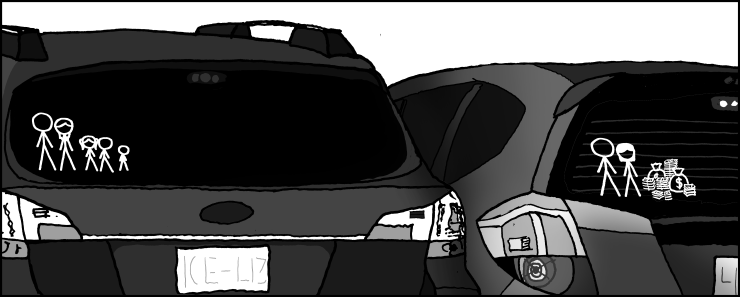
Friday, September 02, 2011
David Sloan Wilson's Curious Theological Claims
David Sloan Wilson is a successful popularizer of Darwinism in such books as Evolution for Everyone and Darwin's Cathedral. In his new book, The Neighborhood Project, he offers some surprisingly uncompromising theological claims for an avowed atheist. He writes:
The second part of this claim is entailed by the Darwinian position. They believe that evolution shows no progress, and is not developing toward any teleological end, but is simply a series of adaptations to local conditions.
The first claim, though, is the one that caught my eye. Wilson simply asserts that a creator would have created all the varieties of creatures at once. This lets him show that some variants (in this case, of insects) seem to have developed later than others, thus disproving creation and proving evolution.
Wilson's victory, though, is over a straw man. The vast majority of Americans believe that God created the universe. Yet very few would claim that all of the kinds of creatures were created at the same time. The Bible tells the story as successive days of creating one kind of thing after another, whether you read those days at ages or as twenty-four-hour periods. The most hard-core Young Earth creationists allow for all extensive micro-evolution within the various "kinds" that the Bible notes. Mainline Christians believe in a longer and more intertwined form of evolution, most accepting at least the main points of the Darwinian theory.
The creationist majority differs from the secular minority over whether evolution is guided by God, and whether it is going someplace.
That is the argument that Wilson needs to address.
An omniscient God would have created the different kinds of hymenopterans in a single stroke, but evolution exhibits a property that in technical jargon is called path dependence and in more familiar terms could be called you can’t always get there from here.
The second part of this claim is entailed by the Darwinian position. They believe that evolution shows no progress, and is not developing toward any teleological end, but is simply a series of adaptations to local conditions.
The first claim, though, is the one that caught my eye. Wilson simply asserts that a creator would have created all the varieties of creatures at once. This lets him show that some variants (in this case, of insects) seem to have developed later than others, thus disproving creation and proving evolution.
Wilson's victory, though, is over a straw man. The vast majority of Americans believe that God created the universe. Yet very few would claim that all of the kinds of creatures were created at the same time. The Bible tells the story as successive days of creating one kind of thing after another, whether you read those days at ages or as twenty-four-hour periods. The most hard-core Young Earth creationists allow for all extensive micro-evolution within the various "kinds" that the Bible notes. Mainline Christians believe in a longer and more intertwined form of evolution, most accepting at least the main points of the Darwinian theory.
The creationist majority differs from the secular minority over whether evolution is guided by God, and whether it is going someplace.
That is the argument that Wilson needs to address.
Wednesday, August 31, 2011
Happy Calvinism
Regular reader Ceemac posted this question:
I think one of the reasons the Calvinists tend to be so critical is that we find it exasperating that other worldviews do not see the good order God made in the world. Calvinists are stewards of the world in order to work with and bring out the good order that the sovereign God made.
I have toyed with the idea of writing The Happy Calvinist. That happiness is chastened by the knowledge of sin and the Fall, but nonetheless remains cheerful knowing that God triumphs, first and last.
Do you think it is in the DNA of Calvinists to be disgruntled? After all we have a commitment to always be working to reform church and culture. So we are inclined to look at a situation and focus on what needs to be fixed and not what is working.I do think that a worldview that began with protest and reform does tend to emphasize the negative. Nonetheless, the core of the scripture that Calvinists confess is that God created the world and called it good, and Christ ultimately triumphs over sin. The basic message of Christianity from beginning to end is pretty positive, and Calvinists embrace that message.
I think one of the reasons the Calvinists tend to be so critical is that we find it exasperating that other worldviews do not see the good order God made in the world. Calvinists are stewards of the world in order to work with and bring out the good order that the sovereign God made.
I have toyed with the idea of writing The Happy Calvinist. That happiness is chastened by the knowledge of sin and the Fall, but nonetheless remains cheerful knowing that God triumphs, first and last.
Tuesday, August 30, 2011
Rick Perry is Who George W. Bush Was Trying to Be
I thought from the moment that Rick Perry mused that Texas might secede from the Union (again) that he was going to be the Republican nominee for president in 2012. I still think so.
George W. Bush was a good-old-boy in the making from a small town in Texas. Then they sent him off, against his will, to the fancy prep school and university that his northeastern blue-blood family traditionally attended. He didn't like either one, spending his real energy on social life and cheerleading. He even got a further degree from another fancy northeastern school. He was a military pilot, but mostly to avoid the war. But as I read his history, George W. Bush never really came into his own until he got to be head cheerleader again for a sports team. That job used his best, Texas-honed sales skills. His Texas Methodist wife finally helped him straighten out, dry up, find Jesus, and become a stand-up guy. He was always a political amateur, but he caught the eye of a political professional, Karl Rove, who recruited the money and borrowed other professional politicians from Bush, Sr.'s shop.
Rick Perry was a good-old-boy in the making from a small town in Texas. Except his Texas roots went back generations, proletarian and petite bourgeois all the way. He went to the local high school, was an Eagle Scout, married a Texas Methodist who was his elementary school sweetheart. He then went to an iconic Texas school, where he majored in social life and cheerleading. He became a military pilot, but for real. His real education, as he tells it, came from his boss when Perry was a door-to-door salesman. Perry was a serious and competent Democratic politician, supporting Al Gore for president and backing Bill Clinton's health care plan. Perry switched parties when the opportunities were better, and drew the attention of Karl Rove. When Perry and Rove fell out, Rove picked up George W. Bush.
George W. Bush represented what the activated part of the Republican Party wanted, but in him it was an overlay that went against most of his training. Rick Perry, on the other hand, really is a white Christian businessman who supports government spending for people and interests like his, but is suspicious of government spending for others. And he is a competent politician who can learn enough about government to make just-in-time executive decisions.
I think Gov. Perry will give the Republican base a chance to try to replay the Bush administration, only this time make it come out better.
George W. Bush was a good-old-boy in the making from a small town in Texas. Then they sent him off, against his will, to the fancy prep school and university that his northeastern blue-blood family traditionally attended. He didn't like either one, spending his real energy on social life and cheerleading. He even got a further degree from another fancy northeastern school. He was a military pilot, but mostly to avoid the war. But as I read his history, George W. Bush never really came into his own until he got to be head cheerleader again for a sports team. That job used his best, Texas-honed sales skills. His Texas Methodist wife finally helped him straighten out, dry up, find Jesus, and become a stand-up guy. He was always a political amateur, but he caught the eye of a political professional, Karl Rove, who recruited the money and borrowed other professional politicians from Bush, Sr.'s shop.
Rick Perry was a good-old-boy in the making from a small town in Texas. Except his Texas roots went back generations, proletarian and petite bourgeois all the way. He went to the local high school, was an Eagle Scout, married a Texas Methodist who was his elementary school sweetheart. He then went to an iconic Texas school, where he majored in social life and cheerleading. He became a military pilot, but for real. His real education, as he tells it, came from his boss when Perry was a door-to-door salesman. Perry was a serious and competent Democratic politician, supporting Al Gore for president and backing Bill Clinton's health care plan. Perry switched parties when the opportunities were better, and drew the attention of Karl Rove. When Perry and Rove fell out, Rove picked up George W. Bush.
George W. Bush represented what the activated part of the Republican Party wanted, but in him it was an overlay that went against most of his training. Rick Perry, on the other hand, really is a white Christian businessman who supports government spending for people and interests like his, but is suspicious of government spending for others. And he is a competent politician who can learn enough about government to make just-in-time executive decisions.
I think Gov. Perry will give the Republican base a chance to try to replay the Bush administration, only this time make it come out better.
Sunday, August 21, 2011
Saturday, August 20, 2011
Chesterton Is Wise About What is Wrong With the World
I am treating myself to a dose of G.K. Chesterton, who I always find insightful and funny. Today I am finishing What's Wrong With the World, which begins with a fine slam on sociology:
Chesterton is a very healthy minded thinker, especially after his conversion to Christianity. He ends his introductory chapter with this wonderfully gruntled declaration:
A book of modern social inquiry has a shape that is somewhat sharply defined. It begins as a rule with an analysis, with statistics, tables of population, decrease of crime among Congregationalists, growth of hysteria among policemen, and similar ascertained facts; it ends with a chapter that is generally called "The Remedy." It is almost wholly due to this careful, solid, and scientific method that "The Remedy" is never found. For this scheme of medical question and answer is a blunder; the first great blunder of sociology. It is always called stating the disease before we find the cure. But it is the whole definition and dignity of man that in social matters we must actually find the cure before we find the disease.The "definition and dignity of man" is really what the book is about, offering a stout defense of human beings against social schemes of left and right to make (poor) people adjust to some new order of the world.
Chesterton is a very healthy minded thinker, especially after his conversion to Christianity. He ends his introductory chapter with this wonderfully gruntled declaration:
I have called this book "What Is Wrong with the World?" and the upshot of the title can be easily and clearly stated. What is wrong is that we do not ask what is right.
Friday, August 19, 2011
Black Women's Marriage Rate of 75% Is Good News
About 75% of black women have married by 35. This is a higher marriage rate than is often reported, which is pretty good news.
For comparison, about 87% of white women have married by 40 (the closest comparison I have, which will not be way off the "by 35" rate).
The black divorce rate is higher than the white rate, so the long-term marriage gap is wider than these ever-married figures suggest.
Still the black marriage picture is better than the 58% rate one often reads. Ivory Toldson and Bryant Marks, the researchers responsible for these new numbers, note that black women marry later, on average, than white women do, so a comparison of marriage rates for younger women makes the gap look larger than it eventually will be.
For comparison, about 87% of white women have married by 40 (the closest comparison I have, which will not be way off the "by 35" rate).
The black divorce rate is higher than the white rate, so the long-term marriage gap is wider than these ever-married figures suggest.
Still the black marriage picture is better than the 58% rate one often reads. Ivory Toldson and Bryant Marks, the researchers responsible for these new numbers, note that black women marry later, on average, than white women do, so a comparison of marriage rates for younger women makes the gap look larger than it eventually will be.
Thursday, August 18, 2011
"Last-Place Aversion" Drives Welfare Haters
The most conservative class is normally the petite bourgeoisie. Not the top, not the bottom, but one up from the bottom. The lower-middles are especially opposed to benefits for the bottom class - even if it means giving massive breaks to the rich.
The Economist cites new research on this puzzle. It is not that Joe the Plumber('s assistant) really expects to be in the top tax bracket someday that makes him oppose raising taxes on the rich. It is because he doesn't want there to be any money redistributed to the class below him, which might raise them up to his level.
"Last-place aversion," more than rich envy, makes the petite bourgeoisie so passionately opposed to welfare.
The Economist cites new research on this puzzle. It is not that Joe the Plumber('s assistant) really expects to be in the top tax bracket someday that makes him oppose raising taxes on the rich. It is because he doesn't want there to be any money redistributed to the class below him, which might raise them up to his level.
"Last-place aversion," more than rich envy, makes the petite bourgeoisie so passionately opposed to welfare.
Wednesday, August 17, 2011
The Gruntleds' TV Choices Show Our Centrism
Which of these shows, if any, do you watch?
Desperate Housewives
The Mentalist
Extreme Makeover: Home Edition
CSI:Miami
NCIS
Criminal Minds
According to the YouGov/Polimetrix poll, Democrats and Republicans differ significantly in their preferences among these shows.
Republicans favor NCIS and Criminal Minds.
Democrats favor Desperate Housewives and The Mentalist.
This confirmed to the Gruntleds our centrist credentials: we are Democrats who watch NCIS and Criminal Minds regularly, but Desperate Housewives and The Mentalist not at all.
Desperate Housewives
The Mentalist
Extreme Makeover: Home Edition
CSI:Miami
NCIS
Criminal Minds
According to the YouGov/Polimetrix poll, Democrats and Republicans differ significantly in their preferences among these shows.
Republicans favor NCIS and Criminal Minds.
Democrats favor Desperate Housewives and The Mentalist.
This confirmed to the Gruntleds our centrist credentials: we are Democrats who watch NCIS and Criminal Minds regularly, but Desperate Housewives and The Mentalist not at all.
Tuesday, August 16, 2011
Shall the Religious Inherit the Earth 2
Eric Kaufmann, in Shall the Religious Inherit the Earth? notes that secularism's growth has come mostly at the expense of liberalized versions of traditional faith which tried to accommodate secular thought. Fundamentalism is actually a modern movement, using modern means of thinking about religious "facts," which fights secularism directly. Kaufmann offers a striking metaphor for the ecology of modern secular vs. religion fights:
“Secularism, like DDT, wiped out much of its opposition but also gave rise to new, resistant strains of religion.”
Monday, August 15, 2011
Shall the Religious Inherit the Earth 1
Eric Kaufmann, in Shall the Religious Inherit the Earth, explores what he calls the "soft underbelly of secularism: demography." Secularism has been growing in all developed nations, and there are secularized pockets among the educated in all countries. Northern Europe, especially, has gone a long way down to the road to irreligion. Since the Enlightenment began, intellectuals, both secular and religious, have been predicting the decline and disappearance of religion.
Kaufmann points out, though, that even in the most secularized society, secular people do not have enough children to replace themselves. In most societies, the moderate or mainline religious groups also have sub-replacement fertility. On the other hand, fundamentalists in every religious tradition have enough children to grow - some of them by gigantic accumulating rates.
Moreover, secularity grows by conversion, mostly from the slightly or moderately religious. The strongly religious, by contrast, typically build strong religious communities to go with their firm faith, which helps them retain their children.
The numbers from American Protestants can represent those from other countries and religious traditions. For a population to be stable and replace itself, each fertile woman needs to have, on average, 2.1 children. This is the magic number of the Total Fertility Rate (TFR). The TFR of secular and Protestant Americans:
Secular: 1.5
Moderate Protestant: 2.0
Conservative Protestant: 2.5
Kaufmann predicts that secularists will continue to grow as a proportion of the U.S. population to mid-century. Then, though, the higher fertility and higher retention of religious conservatives (not all of them Protestants, of course) will catch up and become a larger and larger portion of the American population.
Kaufmann points out, though, that even in the most secularized society, secular people do not have enough children to replace themselves. In most societies, the moderate or mainline religious groups also have sub-replacement fertility. On the other hand, fundamentalists in every religious tradition have enough children to grow - some of them by gigantic accumulating rates.
Moreover, secularity grows by conversion, mostly from the slightly or moderately religious. The strongly religious, by contrast, typically build strong religious communities to go with their firm faith, which helps them retain their children.
The numbers from American Protestants can represent those from other countries and religious traditions. For a population to be stable and replace itself, each fertile woman needs to have, on average, 2.1 children. This is the magic number of the Total Fertility Rate (TFR). The TFR of secular and Protestant Americans:
Secular: 1.5
Moderate Protestant: 2.0
Conservative Protestant: 2.5
Kaufmann predicts that secularists will continue to grow as a proportion of the U.S. population to mid-century. Then, though, the higher fertility and higher retention of religious conservatives (not all of them Protestants, of course) will catch up and become a larger and larger portion of the American population.
Subscribe to:
Posts (Atom)
