Wednesday, September 07, 2011

Is There an American Trollope?

Anthony Trollope is my favorite novelist. I enjoy his Barsetshire novels very much. I am now working through his Parliamentary novels in sequence.

Which led to this question: Which novelist is the American Trollope?

I put this question to my colleagues in American literature, asking for their gut reaction. Their responses are helpful and fascinating, though not quite the answer I was hoping for. The first wrote:

Gut reaction: We don’t have a Trollope.

I assume you mean writes about family and community life from a generally optimistic perspective. The first name that comes to mind is Howells, but even in him there’s more darkness than there is in the Trollope I’ve read.


Yes, that is exactly what I was looking for, though I did not know that until my friend put it that way.

Well, I was going to give you Updike, but I’m sure you’ve read the Rabbit books. His life deteriorates—his family’s full of dysfunction. You could try Harold Fredericks’ The Damnation of Theron Ware (Updike rewrote it for his In the Beauty of the Lilies), but that’s (not surprisingly) about disintegration too. Do try Howells: if you haven’t read The Rise of Silas Lapham or A Hazard of New Fortunes, you should—you’d appreciate, if not necessarily like, them.

There are more contemporary social realists who love their characters too much to let them come to any real harm.
I have tried William Dean Howells' The Hazard of New Fortunes, which I found rather stuffy (and I like Victorian novels) - I will give it another go.

A second colleague offered this theory of why there is no American Trollope:

Our rather different culture doesn’t have a Trollope—or an Austen, for that matter. Which is exactly why I usually listen to either of these (right now, I’m in the middle of Emma) whenever I’m in the car alone. Both are so wonderfully sane and intelligent and basically comic in outlook, comedy always having to do with community. We’re too goddamned individualistic. No Brit could ever have written “Self-Reliance” or “Huck Finn.”

Our best stuff is darker, more philosophical, and more profound than Trollope or Austen were capable of. America is a great place to visit, but you wouldn’t want to live here.

I do appreciate Trollope for his optimistic comic sanity. As a sociologist I am especially drawn to his portrayal of social types as they interact, which he does with remarkable even-handedness. I think an American novelist could write in all of those ways. Optimism is a famous American trait. Comic and sane writing about family and community should be within any culture's reach.

I am halted, though, by the idea that American individualism really does make it hard to write about social types within the stable social institutions of Trollope's world.

What I am wrestling with now is whether American social structures have always been so fluid that a Trollope could not have set his eternal dramas of marriage and status in them, or if this fluidity is something that afflicts all late-modern or post-modern societies.

Tuesday, September 06, 2011

A Happy Convergence of William James and G.K. Chesterton

I am reading William James' Pragmatism. I am hoping that it will be a good philosophical text to teach in conjunction with the current empirical work that shows that the practical lives of most populations are, in fact, improving.

In this connection I also recently read G.K. Chesterton's What's Wrong With the World. Chesterton and James were contemporaries, but I had not previously thought of them as conversation partners with one another. Yet James quotes Chesterton approvingly at the opening of this book to the effect that the most important thing to know about someone is his philosophy.

The point of James' pragmatism is that all we can know of truth is what kind of practical action it leads to. He says that pragmatism is a method, and is not wedded to any particular conclusions about what will prove practical. In making this claim, he reviews the argument between materialism and idealism or spiritualism. What impressed me in this argument is how much William James sounds like G.K. Chesterton, both in his tone and in his conclusions, to wit:

A world with a God in it to say the last word, may indeed burn up or freeze, but we then think of him as still mindful of the old ideals and sure to bring them elsewhere to fruition; so that, where he is, tragedy is only provisional and partial, and shipwreck and dissolution not the absolutely final things.

Monday, September 05, 2011

The Most Trusting Kids Are From the Middle

David Sloan Wilson ran a "cooperation" game with public school students in Binghamton, NY, as reported in The Neighborhood Project. This game paired kids, and set up the rules such that they would each benefit the most if they cooperated - if the first kid trustingly gave more, and the second kid proved trustworthy and gave more back.

He found that the richest kids and the poorest kids were the least trusting. The most trusting kids were from middle income neighborhoods that gave their children high levels of social support.

Saturday, September 03, 2011

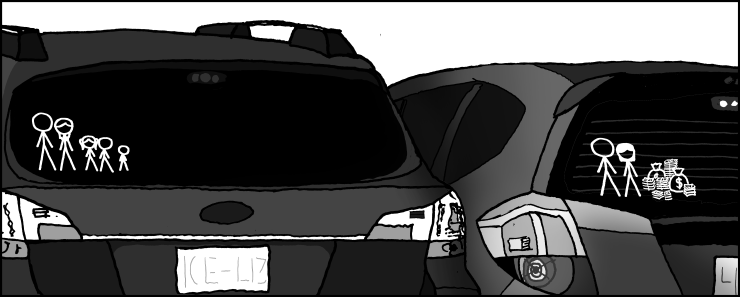
Penny-wise and Pound Foolish


Some family humor from the wonderful xkcd (click the picture to see the full image).


Friday, September 02, 2011

David Sloan Wilson's Curious Theological Claims

David Sloan Wilson is a successful popularizer of Darwinism in such books as Evolution for Everyone and Darwin's Cathedral. In his new book, The Neighborhood Project, he offers some surprisingly uncompromising theological claims for an avowed atheist. He writes:

An omniscient God would have created the different kinds of hymenopterans in a single stroke, but evolution exhibits a property that in technical jargon is called path dependence and in more familiar terms could be called you can’t always get there from here.

The second part of this claim is entailed by the Darwinian position. They believe that evolution shows no progress, and is not developing toward any teleological end, but is simply a series of adaptations to local conditions.

The first claim, though, is the one that caught my eye. Wilson simply asserts that a creator would have created all the varieties of creatures at once. This lets him show that some variants (in this case, of insects) seem to have developed later than others, thus disproving creation and proving evolution.

Wilson's victory, though, is over a straw man. The vast majority of Americans believe that God created the universe. Yet very few would claim that all of the kinds of creatures were created at the same time. The Bible tells the story as successive days of creating one kind of thing after another, whether you read those days at ages or as twenty-four-hour periods. The most hard-core Young Earth creationists allow for all extensive micro-evolution within the various "kinds" that the Bible notes. Mainline Christians believe in a longer and more intertwined form of evolution, most accepting at least the main points of the Darwinian theory.

The creationist majority differs from the secular minority over whether evolution is guided by God, and whether it is going someplace.

That is the argument that Wilson needs to address.

Wednesday, August 31, 2011

Happy Calvinism

Regular reader Ceemac posted this question:

Do you think it is in the DNA of Calvinists to be disgruntled? After all we have a commitment to always be working to reform church and culture. So we are inclined to look at a situation and focus on what needs to be fixed and not what is working.
I do think that a worldview that began with protest and reform does tend to emphasize the negative. Nonetheless, the core of the scripture that Calvinists confess is that God created the world and called it good, and Christ ultimately triumphs over sin. The basic message of Christianity from beginning to end is pretty positive, and Calvinists embrace that message.

I think one of the reasons the Calvinists tend to be so critical is that we find it exasperating that other worldviews do not see the good order God made in the world. Calvinists are stewards of the world in order to work with and bring out the good order that the sovereign God made.

I have toyed with the idea of writing The Happy Calvinist. That happiness is chastened by the knowledge of sin and the Fall, but nonetheless remains cheerful knowing that God triumphs, first and last.


Tuesday, August 30, 2011

Rick Perry is Who George W. Bush Was Trying to Be

I thought from the moment that Rick Perry mused that Texas might secede from the Union (again) that he was going to be the Republican nominee for president in 2012. I still think so.

George W. Bush was a good-old-boy in the making from a small town in Texas. Then they sent him off, against his will, to the fancy prep school and university that his northeastern blue-blood family traditionally attended. He didn't like either one, spending his real energy on social life and cheerleading. He even got a further degree from another fancy northeastern school. He was a military pilot, but mostly to avoid the war. But as I read his history, George W. Bush never really came into his own until he got to be head cheerleader again for a sports team. That job used his best, Texas-honed sales skills. His Texas Methodist wife finally helped him straighten out, dry up, find Jesus, and become a stand-up guy. He was always a political amateur, but he caught the eye of a political professional, Karl Rove, who recruited the money and borrowed other professional politicians from Bush, Sr.'s shop.

Rick Perry was a good-old-boy in the making from a small town in Texas. Except his Texas roots went back generations, proletarian and petite bourgeois all the way. He went to the local high school, was an Eagle Scout, married a Texas Methodist who was his elementary school sweetheart. He then went to an iconic Texas school, where he majored in social life and cheerleading. He became a military pilot, but for real. His real education, as he tells it, came from his boss when Perry was a door-to-door salesman. Perry was a serious and competent Democratic politician, supporting Al Gore for president and backing Bill Clinton's health care plan. Perry switched parties when the opportunities were better, and drew the attention of Karl Rove. When Perry and Rove fell out, Rove picked up George W. Bush.

George W. Bush represented what the activated part of the Republican Party wanted, but in him it was an overlay that went against most of his training. Rick Perry, on the other hand, really is a white Christian businessman who supports government spending for people and interests like his, but is suspicious of government spending for others. And he is a competent politician who can learn enough about government to make just-in-time executive decisions.

I think Gov. Perry will give the Republican base a chance to try to replay the Bush administration, only this time make it come out better.

Sunday, August 21, 2011

Saturday, August 20, 2011

Chesterton Is Wise About What is Wrong With the World

I am treating myself to a dose of G.K. Chesterton, who I always find insightful and funny. Today I am finishing What's Wrong With the World, which begins with a fine slam on sociology:
A book of modern social inquiry has a shape that is somewhat sharply defined. It begins as a rule with an analysis, with statistics, tables of population, decrease of crime among Congregationalists, growth of hysteria among policemen, and similar ascertained facts; it ends with a chapter that is generally called "The Remedy." It is almost wholly due to this careful, solid, and scientific method that "The Remedy" is never found. For this scheme of medical question and answer is a blunder; the first great blunder of sociology. It is always called stating the disease before we find the cure. But it is the whole definition and dignity of man that in social matters we must actually find the cure before we find the disease.
The "definition and dignity of man" is really what the book is about, offering a stout defense of human beings against social schemes of left and right to make (poor) people adjust to some new order of the world.

Chesterton is a very healthy minded thinker, especially after his conversion to Christianity. He ends his introductory chapter with this wonderfully gruntled declaration:

I have called this book "What Is Wrong with the World?" and the upshot of the title can be easily and clearly stated. What is wrong is that we do not ask what is right.

Friday, August 19, 2011

Black Women's Marriage Rate of 75% Is Good News

About 75% of black women have married by 35. This is a higher marriage rate than is often reported, which is pretty good news.

For comparison, about 87% of white women have married by 40 (the closest comparison I have, which will not be way off the "by 35" rate).

The black divorce rate is higher than the white rate, so the long-term marriage gap is wider than these ever-married figures suggest.

Still the black marriage picture is better than the 58% rate one often reads. Ivory Toldson and Bryant Marks, the researchers responsible for these new numbers, note that black women marry later, on average, than white women do, so a comparison of marriage rates for younger women makes the gap look larger than it eventually will be.

Thursday, August 18, 2011

"Last-Place Aversion" Drives Welfare Haters

The most conservative class is normally the petite bourgeoisie. Not the top, not the bottom, but one up from the bottom. The lower-middles are especially opposed to benefits for the bottom class - even if it means giving massive breaks to the rich.

The Economist cites new research on this puzzle. It is not that Joe the Plumber('s assistant) really expects to be in the top tax bracket someday that makes him oppose raising taxes on the rich. It is because he doesn't want there to be any money redistributed to the class below him, which might raise them up to his level.

"Last-place aversion," more than rich envy, makes the petite bourgeoisie so passionately opposed to welfare.

Wednesday, August 17, 2011

The Gruntleds' TV Choices Show Our Centrism

Which of these shows, if any, do you watch?

Desperate Housewives
The Mentalist
Extreme Makeover: Home Edition
CSI:Miami
NCIS
Criminal Minds

According to the YouGov/Polimetrix poll, Democrats and Republicans differ significantly in their preferences among these shows.

Republicans favor NCIS and Criminal Minds.
Democrats favor Desperate Housewives and The Mentalist.

This confirmed to the Gruntleds our centrist credentials: we are Democrats who watch NCIS and Criminal Minds regularly, but Desperate Housewives and The Mentalist not at all.

Tuesday, August 16, 2011

Shall the Religious Inherit the Earth 2

Eric Kaufmann, in Shall the Religious Inherit the Earth? notes that secularism's growth has come mostly at the expense of liberalized versions of traditional faith which tried to accommodate secular thought. Fundamentalism is actually a modern movement, using modern means of thinking about religious "facts," which fights secularism directly. Kaufmann offers a striking metaphor for the ecology of modern secular vs. religion fights:

“Secularism, like DDT, wiped out much of its opposition but also gave rise to new, resistant strains of religion.”

Monday, August 15, 2011

Shall the Religious Inherit the Earth 1

Eric Kaufmann, in Shall the Religious Inherit the Earth, explores what he calls the "soft underbelly of secularism: demography." Secularism has been growing in all developed nations, and there are secularized pockets among the educated in all countries. Northern Europe, especially, has gone a long way down to the road to irreligion. Since the Enlightenment began, intellectuals, both secular and religious, have been predicting the decline and disappearance of religion.

Kaufmann points out, though, that even in the most secularized society, secular people do not have enough children to replace themselves. In most societies, the moderate or mainline religious groups also have sub-replacement fertility. On the other hand, fundamentalists in every religious tradition have enough children to grow - some of them by gigantic accumulating rates.

Moreover, secularity grows by conversion, mostly from the slightly or moderately religious. The strongly religious, by contrast, typically build strong religious communities to go with their firm faith, which helps them retain their children.

The numbers from American Protestants can represent those from other countries and religious traditions. For a population to be stable and replace itself, each fertile woman needs to have, on average, 2.1 children. This is the magic number of the Total Fertility Rate (TFR). The TFR of secular and Protestant Americans:
Secular: 1.5
Moderate Protestant: 2.0
Conservative Protestant: 2.5

Kaufmann predicts that secularists will continue to grow as a proportion of the U.S. population to mid-century. Then, though, the higher fertility and higher retention of religious conservatives (not all of them Protestants, of course) will catch up and become a larger and larger portion of the American population.

Saturday, August 13, 2011

Tocqueville: Liberty Over Equality in the Happy Society

My annual Theory Camp is reading Tocqueville's Democracy in America.

I chose Tocqueville with an eye to including his great work in the course on "The Happy Society" that I am developing. We would read it after Aristotle and John Stuart Mill. Aristotle says happiness is the end of human life. Mill says that society should be organized to promote the greatest collective pleasure. Both Aristotle and Mill think that some pleasures are higher than others.

Tocqueville does not say that happiness is the end of human life. He does not say that happiness is the end of social life. So why is this text useful for “The Happy Society”? Tocqueville argues that Americans have a passion for equality. They value it highly. Its rewards are immediate. They had a revolution to get equality and defend the social arrangements that make it possible. Equality is at least the analogue of what Aristotle and the utilitarians say happiness means to people.

Tocqueville’s concern does not end with equality, but is even more interested in liberty. He shows how Americans promote equal liberty – equality as the basis for each individual to have a fair chance to exercise liberty. Yet Tocqueville believes that the masses tend to value equality too much – even to the point of sacrificing liberty to keep equality. Only the enlightened and far-seeing appreciate the true value of liberty as the more precious of the two core values of modernity. I read Tocqueville as saying that liberty is a higher pleasure than equality. This is at least analogous to Mill’s argument about higher and lower pleasures. It may also be analogous to Aristotle’s contention that contemplation is a higher happiness than action.

Thursday, August 11, 2011

Tocqueville: The Social Theory God Wants, Not What I Want

My annual Theory Camp is reading Tocqueville's Democracy in America.

Tocqueville the liberty-loving aristocrat works very hard to appreciate the value of equality. Throughout the book he makes the claim that democracy is a better form of social organization than aristocracy because democracy reduces many great harms for the mass of people, even at the cost of limiting some of the excellences achieved by the best.

At the end of the book he raises the stakes for this argument, by arguing that God favors equality.

“It is natural to believe that what is most satisfying to the eye of man’s creator and keeper is not the singular prosperity of a few but the greater well-being of all: what seems decadence to me is therefore progress in his eyes; what pains me pleases him. Equality is less lofty, perhaps, but more just, and its justice is the source of its grandeur and beauty.”


The spectacle of Tocqueville wrestling to subordinate his class prejudice to his theological conviction is a fine example of the distinctive virtues of a religious social theory.

Wednesday, August 10, 2011

Tocqueville: Who Wants War in a Democratic Society?

My annual Theory Camp is reading Tocqueville's Democracy in America.

Tocqueville says that aristocratic societies glorify war and disparage greed. Democratic societies disparage war, but glorify ambition. The danger for democratic societies is that their armies do seek, if not glorify, war. Armies in democratic societies are prone to coups if not given an external enemy to fight.

In the United States we have a very professional military, not at all likely to stage a coup due to inaction. This is due, in part, to the fact that they are frequently engaged in wars - we have two and a half going at the moment. When we do have peace, our military is not likely to agitate for war.

So if business in a democracy is against war because it is bad for business, and our military is not eager for war since they get tested enough, in what structural location in our society would we expect to find promoters of war? Military contractors. And if military contractors should become disproportionately influential in any particular party or administration - perhaps through a revolving door that put, say, a defense secretary in charge of a large military contractor, and then back into government as de facto head of warmaking - we might expect that kind of government to start more voluntary wars.

Tuesday, August 09, 2011

Tocqueville: Taking Domestic Liberty Through War Powers

My annual Theory Camp is reading Tocqueville's Democracy in America.

Tocqueville says that democracy calls for a new kind of political science. He rarely talks about that science directly in the rest of the book - except for this point:

“All who seek to destroy liberty in a democratic nation should know that war offers them the surest and shortest route to success. This is the first axiom of science.”


I think the truth of this point has been shown many times, most recently by the massive expansion of the government's power to spy on American citizens that was instituted by a "small-government conservative" administration as part of the "war on terror."

As interesting, though, is that Tocqueville's one direct reference to making a new political science in Democracy in America is to how to scientifically destroy liberty.

Monday, August 08, 2011

Tocqueville: God vs. Gold as Guarantors of Value

My annual Theory Camp is reading Tocqueville's Democracy in America.

Tocqueville says that the American conception of democracy (in his day, anyway) rested on a widespread belief that God is the guarantor of the trust and commitments that a democratic people make to one another. He thought that, from society's perspective, the particulars of religion did not matter so much as the fact that nearly all believed.

In other words, democracy depends on something outside of democracy itself, some source of fixed and absolute value.

It strikes me that this is what "goldbugs" think the gold standard does for money. They think gold is something that stands outside of the money system, some source of fixed and absolute value.

Except that God really does have the capacity to guarantee the value of a society's values. Gold, on the other hand, has no intrinsic and absolute value. The only "value" that gold has comes from the money system itself.


Friday, August 05, 2011

Tocqueville: The Dogma of Popular Sovereignty

My annual Theory Camp began this week. We are reading Tocqueville's Democracy in America.

At the end of the first volume, Tocqueville ties together the great themes of the macro and the micro aspects of democracy in America in this account of the core dogma of the American creed, popular sovereignty.

Providence equipped each individual, whoever he might be, with the degree of reason necessary to guide his conduct in matters of exclusive interest to himself alone. This is the great maxim on which civil and and political society in the United States is based: fathers apply it to their children, masters to their servants, towns to the people the administer, provinces to towns, to Union to the states. Extended to the whole nation, it becomes the dogma of popular sovereignty.


Democracy is deep in the bones, the mores, of Americans, because we believe that individuals have sufficient reason to work for their self interest. Popular sovereignty is the sum of those individual reasons, at whatever level of organization we are working.

Believing that individuals reason sufficiently well to discern their own self interest is a dogma. Believing that society is well served by accepting whatever those individual reasons add up to is an even more daring dogma. These articles of faith cannot be proven. They can also be dangerous, which is why he spends much of the rest of the book talking about the useful restraints on majority tyranny. But no society can exist without dogma. This is ours.

Wednesday, August 03, 2011

Tocqueville: The Majority Desire the Good of the Country

My annual Theory Camp began this week. We are reading Tocqueville's Democracy in America.

Tocqueville argues that in a democracy, the majority predominates. Moreover,

“That majority consists mainly of peaceful citizens who, whether by taste or interest, sincerely desire what is good for the country. Around them political parties constantly contend for their adherence and support.”


We considered the profound importance of the idea that most citizens sincerely desire what is good for the country. The parties then contend for the support of these good-willed citizens. I believe that party competition tends to hide the fact that the supporters of the other party are just as good-willed as we are.

To be sure, some individuals on the other side are venal and selfish; so are some individuals on our side. Nonetheless, American politics is much more civil when we can remember that our opponents sincerely desire what is good for the country. And even if I can't make American politics better by myself by holding to an even-handed civility about the contending parties, I can make myself happier and more contented if I stick to that view.

Tocqueville: America Was Always a Nation With a National Government

My annual Theory Camp began this week. We are reading Tocqueville's Democracy in America.

We chewed on this line:

“The American government is not a federal government but an incomplete national government.”

I had been used to thinking that the United States really become one united nation as a result of the Civil War, and that the federal government really became the national government as a result of the New Deal and the Second World War.

However, I think Tocqueville is right that the United States, and the US government, really were a nation and a national government from the start - in an incomplete form. Our patriotism, and our extraordinarily complex government, did grow organically from a unity and power that were there in principle from the beginning.

Monday, August 01, 2011

Tocqueville: Democracy Requires "Equality of Conditions"

My annual Theory Camp began this week. We are reading Tocqueville's Democracy in America.

Tocqueville launches his discussion of American democracy from this point:

“I therefore came increasingly to see the equality of conditions as the original fact from which each particular fact seemed to derive. It stood constantly before me as the focal point toward which all my observations converged.”
The students, naturally, asked how Tocqueville could see in America "equality of conditions" when some were rich and some were poor. Tocqueville's answer is that, unlike in aristocratic societies, citizens of a democracy regard themselves as all the same kind of being. The differences, especially of wealth, did not touch the essence of the person.

Now Tocqueville was well aware that slaves were not treat as equal in condition, nor were the Indians. He treats these themes as conflicts inherent in American democracy. But the principle of equality of conditions is the starting point for the new idea of democracy. The fact that this point seems to obvious now is testimony to the overwhelming success of the American experiment.

Thursday, July 28, 2011

"Lying for Justice"

Bradley Wright, in Upside: The Surprising Good News About the State of Our World, documents the many ways in which the world is actually doing pretty well. Which naturally leads to the question, why don't most people realize this?

Some of the reasons are psychological tricks we play on ourselves. One of the big reasons is that the media makes a living by telling bad news. But the one that made the normally cheerful Wright mad (and I agree with him here) is that advocates often lie. Even the advocates for good causes have an interest in making us believe that things are bad and not getting better. So when things are not really so bad, and when they do get better - which is the case in nearly every category of social problem that Americans worry about - the advocates "lie - for justice."

This is wrong, no matter what the cause. And if you are dedicated to solving a problem, finding out that things are getting better - or were not so bad to begin with - should be delightful news that you shout from the housetops.

Wednesday, July 27, 2011

The World is a Better Place Than It Was

Bradley Wright has a nifty new book, Upside: Surprising Good News About the State of our World.

He points out that most Americans think there own lives are good and getting better. We think most things will be better in the future (except morals). We think things were good in the past.

What we can't admit is that things are getting better in the nation and the world now.

This leads me to propose a first step:

The simplest way to make the world a better place than it is now is to see that the world is a better place than it was before.

Tuesday, July 26, 2011

Do Mothers Suffer More Because They Anticipate Pains More?

At the International Positive Psychology Association congress, Richard Davidson gave a fascinating presentation on the many good effects that becoming an expert at meditation and generating compassionate feeling can have on your life.

One study he shared compared expert meditators - Buddhist monks sent by the Dalai Lama - with a matched control group of novices. Their brains were monitored as they went from a neutral state where they were just trying to be "in the moment," to a warning that they were about to be touched with something hot, to being touched with the hot thing.

The expert meditators had low brain activity in the pain and suffering parts of the brain until they were actually touched with the hot probe. The control group, by contrast, started firing up the pain and suffering parts of the brain when they were given the warning. That is, the novices increased their suffering by anticipating pain.

This made me wonder whether mothers suffer more than other people because they worry more than other people. That is, they are anticipating pain for themselves and those they love (whose pain causes the mother suffering, too). Mothers may even go out of their way to think of things to worry about - that is, to think of unlikely pains to suffer from - as a way of being loving.

Monday, July 25, 2011

A Timely Study About Integrating Immigrants.

John Berry, a Canadian researcher on acculturation of immigrants, gave a report to the World Congress on Positive Psychology that I am attending. He studied the different ways immigrant youth in Canada dealt with the tension between their old and new societies. He identified four ways this tension could be resolved.

The best way, for both the immigrants and the host society, is integration of the two cultures. Some immigrant groups encounter more discrimination, and are more inclined to keep their own culture, leading to separation. A few immigrants favor assimilation to the new society - mostly refugees who fled a bad situation in the old country. Most dangerous for both immigrants and natives is the marginalization of the immigrants, who feel no attachment to either their new or old culture.

The results for his survey of Canadian immigrant youth:
Integration 36%
Separation 23%
Assimilation 18%
Marginalization 23%

This seemed a very timely study to me in the light of the right-wing anti-immigrant terrorism in Norway that happened as the Congress is meeting. Berry reported that settler societies, such as Canada and the United States, promote integration of immigrants, which reduces tensions between the two groups. European nations, by contrast, fall into separation, or worse, which heightens tensions between the two groups - and sometimes leads to nativist terrorism against immigrants and those who welcome them.

Saturday, July 23, 2011

Fighting Army Suicides With Positive Psychology

The most interesting thing I learned at the World Congress of Positive Psychology today was reported by the founder of the discipline, Martin Seligman. The Army has been working with several big names in the field, including Seligman, to test and train soldiers to make them more resilient, and to identify people needing help early.

A well-being test developed by Chris Peterson and colleagues was given to all soldiers last year. Two of the crucial measures of well-being ask people whether they think their life has meaning, and whether they think their work has meaning. Those soldiers who scored in the bottom one percent on both measures had the worst subjective well-being in the Army.

They then looked at the test results for the 84 soldiers who committed suicide during the year. Half the suicides were in the lowest one percent on both well-being measures.

The Army is training drill sergeants to teach soldiers to be more resilient. With results like these, the Army can know where to pinpoint its training so it will do the most good.

Friday, July 22, 2011

The Happy Society Needs a Fluid Economy and Stable Families

I am strongly attracted to the view, expressed by Matt Ridley in The Rational Optimist, that a fluid world benefits workers as workers, and benefits everyone as consumers.

At the same time, I know that families benefit from a stable world, especially when they are raising young children.

Families benefit from cheap goods reliably delivered. But families are hurt by unstably employed parents.

I do not know how to balance the exhilaration of the creative destruction of capitalism with the fulfillment of the creative nurture of families. But I think I have identified a central problem of the happy society.

Thursday, July 21, 2011

The Rightly Ordered and Disciplined Happy Society

The other day I started what I think will become a major thread of "exploring the happy society," by arguing that

The quest for the happy society begins with the courage to proclaim that the world is better off now than it ever has been, and is getting better.

Regular reader ceemac asked this rich question: "I am curious how your concept of 'happy society' either meshes with or conflicts with the Calvinist quest for a society that is 'rightly ordered and disciplined.'"

My short answer is that a rightly ordered and disciplined society is one in which people are free to pursue what makes them happy.

I will go further to claim that most people, if free to choose, will get sick of the lower pleasures and work their way toward the higher ones.

I believe that there are lower and higher forms of happiness. I think Aristotle is right that contemplation is, or is the form of, the highest happiness. I think that Thomas Aquinas is right that what we contemplate in the highest happiness is the beatific vision.

Few people will reach that highest happiness in this life. But a rightly ordered and disciplined society can help people develop habits that lead toward virtues - and therefore happiness. How, exactly, people reach the contemplation of the divine is, I believe, beyond what any merely social theory can explain.

Wednesday, July 20, 2011

Millennials are Appealingly Conventional

Penelope Trunk held back from criticizing Gen Y, today's youth and young adults, when she was giving them career advice on Brazen Careerist. Now that she has moved on, she let fly with a few mostly just points.

The main point is that Gen Y like to fit in, be part of the team, do what is normal and conventional. Howe and Strauss, who called this generation Millennials, said they are like the '50s Silent Generation, their structural counterparts in the cycle of generations.

My students now are Millennials. I like them. Their distinctive qualities are about 90% beneficial. They are weak on critical thinking and innovation - but so are most people in most generations. They are nice and want to work together (unlike Gen X at the same age).

The mission of Gen X is to rebuild basic institutions after the Boomers' cultural revolution. The task of the Millennials will be to consolidate an appealing normal life within those renewed basic institutions.

Tuesday, July 19, 2011

The World Is Just Awesome

We Can Only See the Happy Society If We Accept That the World Is Better Off Now Than It Has Ever Been

My main project for this sabbatical and for the years to follow is to explore the idea of the happy society. I changed the subtitle of this blog to reflect that new quest.

I am reading Matt Ridley's The Rational Optimist. He argues that life for the vast majority of people is better now than it has ever been, due to specialization and exchange.

The idea that this reading, and many others like it, has led me to is this:

The quest for the happy society begins with the courage to proclaim that the world is better off now than it ever has been, and is getting better.


I believe this is true no matter how materialist or spiritual your standard of happiness is.

Monday, July 18, 2011

Tiger Mom vs. Selfish Reasons to Have More Kids

Our Centre College alumni study group considered Amy Chua's The Battle Hymn of the Tiger Mother and Bryan Caplan's Selfish Reasons to Have More Kids. They are, in effect, arguing with each other.

I have given my overall assessment of each book here and here.

Chua is right that her children would not have been great child musicians if she had not pushed them to an extreme degree.

Caplan is right that upper-middle class children with competent, loving homes will not turn out very much differently as adults if they are pushed to achieve early, or not.

On the whole, I think Caplan has the better argument. I am all for helping your children to pursue their passion to get good at it. And everyone, at every age, needs to be held to high standards. But I don't think that pushing children to either be prodigies by sheer effort, or to spend their youth on something that the parents have the passion for, is worth it.

Sunday, July 17, 2011

Selfish Reasons to Have More Kids

Bryan Caplan's Selfish Reasons to Have More Kids is a wonderfully gruntled book.

Based on twin and adoption studies, Caplan concludes that middle-class parents really don't need to overwhelm themselves and their children with a scheduled and directed childhood. In the long run, if you give your kids a vaguely normal childhood, they will turn out like you. The intense interventions have an effect in the short run, but tend to wash out in the long run.

Therefore, raising kids is easier than you probably thought. And kids are great fun for most parents. ERGO: have more than you were originally planning on.

The best advice he gives is that you should think long-term about your own parenthood. Sure, kids have lots of up-front costs in money, time, effort, and sleep, but the payoff later is huge. In fact, Caplan argues, you should pick the number of children you have based on the number of grandchildren you want to end up with.

Saturday, July 16, 2011

Unnatural Selection 5: The Worst News, and the Best

This week I will be blogging Mara Hvistendahl's Unnatural Selection: Choosing Boys Over Girls, and the Consequences of a World Full of Men.

The biggest danger of masses of men who will never marry is that they will be violent and commit crimes. It is possible they will be used for war, but that is not so predictable from the sheer demographic facts.

The best news is that Hvistendahl thinks the massive sex imbalance is a temporary stage in a country's economic development. As evidence she cites the fact that in 2007, South Korea had a natural sex ratio for the first time in twenty years. It is the first country to start to come back from a massive sex imbalance. They still have super low fertility - 1.22 children per woman - but South Korea seems to have turned a corner in both its sex ratio and its overall fertility. This gives hope that the other massively imbalanced countries can begin to walk back from the precipice.

Thursday, July 14, 2011

Unnatural Selection 4: The Silver Lining

This week I will be blogging Mara Hvistendahl's Unnatural Selection: Choosing Boys Over Girls, and the Consequences of a World Full of Men.

The shortage of women in many Asian and Eastern European countries does have some silver linings.

In India, the need for brides is leading to some cross-caste marriages that would have been unthinkable a generation or so ago.

In East Asia, "foreign brides" make up so large a percentage of new marriages that old national prejudices are being modified or even given up.

The poor women who marry out of poor countries, such as Vietnam, into developing countries can make a better life for their children than they could have at home.

Wednesday, July 13, 2011

Unnatural Selection 3: Why Republicans Promoted Abortion

This week I will be blogging Mara Hvistendahl's Unnatural Selection: Choosing Boys Over Girls, and the Consequences of a World Full of Men.

Gen. William Draper was a friend of Eisenhower and a staunch conservative Republican. When he oversaw the occupation of Japan just after the war he became a big proponent of abortion – for Asians. He saw it as a way to prevent poverty, and therefore communism. First in Japan, and then in South Korea, he pushed abortion and supported eugenics.

The ruling classes in those countries also supported abortion, thinking only the poor would use it. However, it was the educated women of the urban middle class who were especially drawn to abortion as a part of their planned parenthood. Though abortion was contrary to Confucian and Buddhist ethics, the developing Asian economies, under pressure from the Western aid agencies to aggressively control their population growth in exchange for aid, normalized abortion.

The ruling class in this country, as in other countries, supported abortion in the '50s and '60s . They did so not as a feminist movement for women's control of themselves. They supported abortion as a eugenic movement to control the poor.

Tuesday, July 12, 2011

Unnatural Selection 2: Both Sexism and Feminism Support Sex-Selection Abortion

This week I will be blogging Mara Hvistendahl's Unnatural Selection: Choosing Boys Over Girls, and the Consequences of a World Full of Men.

In the '60s, when men were in charge of population planning and sexism was the norm, Western public health agencies thought sex-selection abortions in developing countries were an uncontroversial and rational way to help families get the boy they wanted without producing unnecessary girls on the way. This seemed like a more ethical path to population control than the more coercive measures they considered because the families were doing the choosing.

By the '80s, when women were in charge of population planning and feminism was the norm, Western public health agencies thought sex-selection abortions in developing countries were an uncontroversial and rational way to help women control their bodies. Sex-selection was a small price to pay for securing the right to abortion.

Monday, July 11, 2011

Unnatural Selection 1: Sex Selection Begins With the Second Pregnancy

This week I will be blogging Mara Hvistendahl's Unnatural Selection: Choosing Boys Over Girls, and the Consequences of a World Full of Men.

Hvistendahl is trying to figure out why, exactly, there have been so many fewer female births in some Asian countries over the past generation.

She thinks that smaller family size in developing countries means that the risks of having no boys by natural means goes up from about one in 10 if you have three children, to one in four if you have only two. Thus, richer, smaller families are going with nature in first births, but in each successive pregnancy are more likely to abort a girl, but keep a boy.

She cites as evidence the sex ratio of boys to girls at birth in South Korea in 1989. The natural ratio is about 105 boys for every 100 girls.

First birth: 104/100
Second birth: 113/100
Third birth: 185/100
Fourth birth: 206/100

Sunday, July 10, 2011

The Reality of Two-Year-Old Octuplets

Nadya Suleman, the "Octomom," was on television with her eight famous children, with some help from her oldest daughter.

The images of eight infants was staggering enough when they were born. The reality of eight two year olds is wonderfully captured in this bit of film from the "Today" show.

Saturday, July 09, 2011

Why I Like Cop Shows Better Than Murder Mysteries or Thrillers

I recently listened to a James North Patterson story while on a long car trip alone. I was dissatisfied with the experience. I discovered that I do not like stories in which the protagonist takes foolish risks, and acts alone. What I want is an intelligent team acting together to beat unreason and selfishness.

I put the question to my Facebook friends. I asked for police procedurals in which the cops act together and rationally. A friend pointed out that it is hard to have a novel about a team, because it is difficult to keep all the people straight. There are some such novels - my wife has been reading Louise Penny's "Inspector Gamache" stories to me, and my mother is a fan of Henning Mankell's "Kurt Wallandar" stories (though he often does crazy things alone).

Which led me to this insight: television and film can tell the stories of teams better than novels can, because the visuals, and the voices, help you keep the group members straight.

Which is why Mrs. G. and I have been particularly enjoying "The Wire," one of the best cop shows ever.

Friday, July 08, 2011

Practical Wisdom is Helpful to a Happy Life, But Not the Highest Happiness

Barry Schwartz and Kenneth Sharpe's Practical Wisdom is an excellent book. I find their argument that practical wisdom is superior to both rules and incentives as a way to organize social practices is compelling. They are right that Aristotle's case for practical wisdom is something that is in the grasp of all and very helpful to happiness. In this Schwartz and Sharpe align their argument with the positive psychology of Martin Seligman, with whom they say they have often talked, about what makes for authentic happiness.

But Aristotle goes on at the end of the Nicomachean Ethics to say that the greatest happiness does not come from practical wisdom or the exercise of the moral virtues - the subject of the first 9/10ths of the book. Instead, he concludes that the greatest happiness comes from contemplation. This has posed a puzzle for those trying to follow Aristotle for millennia, as he seems to negate in his conclusion the whole argument he had been building.

Aristotle says that contemplation is what the gods do. When we contemplate, we participate, as we are able, in the divine.

I think there is great wisdom in the idea that our highest happiness comes from participating in the divine. And this wisdom is something that even very smart secular approaches to happiness, and to wisdom, will miss.

Thursday, July 07, 2011

The Class Use of Rules, Incentives, and Wisdom

I am reading Barry Schwartz and Kenneth Sharpe's excellent Practical Wisdom: The Right Way to Do the Right Thing. They promote Aristotle's vision of doing things according to practical wisdom. They contrast practical wisdom with the two dominant ways that we try to motivate and regulate action today - rules and incentives.

So here is my half-developed thought from reading this contrast:

Rules regulate proles.

Incentives motivate managers.

Wisdom guides professionals.

Tuesday, July 05, 2011

Sheryl Sandberg as Model Top Executive

The New Yorker has a wonderful profile of Sheryl Sandberg, the chief operating officer of Facebook. Sandberg pushes women who want to have "C-level jobs" - CEO, COO, CFO, etc. - to lean in, to seek new assignments, new challenges, new problems, despite the fact that they feel unprepared. Sandberg and her husband, himself a CEO of Survey Monkey, have two children and what she calls a 50-50 marriage. Ken Auletta notes in the magazine profile that

Some critics, however, note that Sandberg is not exactly a typical working mother. She has a nanny at home and a staff at work. Google made her very rich; Facebook may make her a billionaire. If she and her husband are travelling or are stuck at their desks, there is someone else to feed their kids and read to them.

That is true. Sandberg is not a typical working mother. She is, though, a typical working top executive, male or female. She concentrates on her job. Someone else does the bulk of the work running her house and, especially, minding her children.

Male top executives have lived this way since there were top executives. Female top executives will, I believe, need to live the same way. This is not from sexism or the male norms in executive life. This is from the very demanding life of being a top executive. The organization has more demands than there are minutes in the day.

Men and women who want to primarily raise their own children cannot also be top executives of large organizations. They have to choose. I believe that there will always be some men and women willing to make that choice. But I also believe that men and women will never make that choice in the same proportion. Not voluntarily, anyway.

Sheryl Sandberg is an excellent role model for women who want to be top executives. Her advice to such women is excellent. But there will never be as many women like her as there are men.


Sunday, July 03, 2011

One Cheer for Marriage Liberals

Mark Oppenheimer has a thoughtful piece in the New York Times Magazine on whether marriages would be stronger if we were not so absolute about fidelity. He is wrestling with the views of marriage liberals like Stephanie Coontz, Judith Stacey, and, especially, Dan Savage.

Marriage liberals argue that societies have always harbored a variety of practices about marriage. Savage, writing from a gay man's perspective, promotes a "monogamish" approach, expecting that some relationships would be more stable if they openly accepted straying. Savage argues that is some people have sexual desires that cannot be satisfied by their partners, they need to change the marriage in order to get them satisfied some other way.

I think the marriage liberals are certainly right that in practice every society does have within it a variety of approaches to marriage, not all of which are strictly monogamous. Men especially, find strict fidelity tough going. Gay men and rich men are more prone to find sexual outlets in addition to their spouses. As a description of reality, it is hard to disagree with this picture.

However, what the marriage liberals usually fudge is a clear sense of proportion about who is monogamous - and even more so about who can be monogamous. Most marriages are monogamous - even in societies in which that is not strictly required. Most people, and especially most women, do want and hold to a strong standard of fidelity. I think Savage goes wrong when he treats sexual desires as needs that must be met, within the marriage or not.

Savage holds that the marriage is more important than strict fidelity, especially if the couple has children. I agree with that. I think adultery would cause searing pain to most married people, and they would be right to feel painful betrayal. Nonetheless, I honor those couples who have been able to work back from an affair to a functioning marriage again. I do not think it is possible in all cases, but I honor the moral heroism of those who try.

Friday, July 01, 2011

Marriage as a Modest Home

When an unmarried couple with children gets married, it is like when Habitat for Humanity helps a family replace their shack with a modest house.

It doesn't solve all of their problems, but is sure makes a better structure to live in.

Thursday, June 30, 2011

Marriage Means More Money, Even for the Poorest

Another dispatch from the Schreyer Seminar on Marriage, Family, and Social Sciences.

Jeffrey Dew, as sociologist at Utah State, shared some findings from his forthcoming paper, "The Relationship Between Family Structure and Economic Wellbeing."

It has been well established the married couples have more income and more wealth than unmarried couples, and married parents have much more wealth than single parents. It is also well known that few households in the lowest income quartile have any wealth at all. However, Dew found married couples in the lowest income quartile still have more wealth than other households in that bottom income group.

Women who grew up poor but got married were no more likely to be poor than other women are. But women who grew up poor and did not get married were a third more likely to end up poor than other women are.

Dew estimates that family structure change accounts for at least 10%, and perhaps 25%, of the growing inequality between the richest and poorest households.


Wednesday, June 29, 2011

Flexible Work Helps Families and Produces More Work

Another dispatch from the Schreyer Seminar on Marriage, Family, and Social Sciences.

Jeff Hill, now a Brigham Young professor after a career at IBM, had some of the most interesting detailed studies of the seminar, from his work on the effect of telecommuting at IBM.

The white collar professionals of IBM like to work. However, when they had to report to an office during specified hours, they had stresses from not being able to control when and where they worked, and from the rush-hour commute they had to endure. As the expected hours of work rose, Hill found a break point - the number of work hours per week at which half the workers felt the stress was too great to be worth it. With inflexible work space and time, that break point was, on average, 52 hours per week.

However, when IBM - out of dire economic necessity - instituted flexibility, they got more work out of their employees, with less stress.

For one thing, eliminating the commute removed what other researchers have found to be a chronic source of unhappiness that people do not adapt to. Hill found that when people no longer had to commute, they tended to add about half of that previously unproductive time to their work hours.

Second, the number of number of hours that IBMers could work rose until they hit a new break point of 60 hours per week.

Hill also found that women tended to make more use of flexibility in time, arranging work at home around their family schedules. Men, on the other hand, made more use of flexibility in space, working more from locations that were neither home nor office.

Monday, June 27, 2011

The U.S. Has Had Stable Replacement Fertility for Forty Years

Another dispatch from the Schreyer Seminar on Marriage, Family, and Social Sciences

So argues Philip Morgan, an eminent Duke sociologist.

He says that the big decline in fertility has come from the disappearance of the third and fourth children that parents had during the Baby Boomer. There has not been a huge increase in women having no children at all in this country.

There is also the appearance of a decline in fertility because women have been delaying having their first child by about a year per decade. This means that fertility so far of women in their twenties is much lower than it used to be. However, most women will have those delayed kids, eventually.

The United States also benefits from the somewhat higher fertility of immigrants, especially from Mexico and points south. This higher fertility only lasts a generation, and will probably decline as the fertility of the sending countries goes down. Morgan estimates that higher Hispanic fertility accounts for about 9% of total U.S. fertility.

These elements - most women eventually have a couple of kids, and some women have more - has, Morgan argued, actually kept U.S. fertility at about a steady replacement level of 2.1 children per women for more than a generation. Moreover, he believes, we can keep this level of fertility steady, to produce long-term population stability. This would be a new thing in the history of America. Morgan believes it would be a good thing.

Saturday, June 25, 2011

Professionals Who Can Work Flexibly Around Their Families' Schedules Do More Work

Another dispatch from the Schreyer Seminar on Marriage, Family, and Social Sciences

Jeffrey Hill (BYU) reported on what happens when work demands so many hours that it interferes too much with most worker's family lives. In a study of a large white-collar corporation, he found that if workers have no flexibility about when and where they work - if they must be in the office during certain hours - then the break point is about 52 hours of work per week. Beyond that they are either so unhappy that their work suffers, or they leave.

If, however, workers have greater flexibility about when and where they work, they can and do work more - until they come to a new break point of about 60 hours per week.

Hill also found that women tended to want to work from home, but with flexible hours - especially flexing around their children's schedules. Men were more likely to work closer to standard hours, but they moved among various locations, flexing around their family's and their client's schedules.

A great savings from telecommuting came from eliminating physical commuting, which is a source of unhappiness for most people who have long drives to work. Hill found that workers who eliminated their commute through telecommuting tended to give half of the time saved to more work.

Friday, June 24, 2011

Workers Live Longer; Why Don't They Work Longer?

This post, and the next few, come from the excellent Shreyer Seminar on Marriage, Family, and the Social Sciences.

Some economists think that, since people live longer, they should work longer: work brings money and that is what matters most. In most countries the retirement age was set long ago, at what was then the average life expectancy. Today, most people who are working at middle age will be healthy long past that threshold. They could work and make more money. This would bring a personal benefit to them, and would help fend off the financial crisis of the retirement systems of all developed countries as the Baby Boom starts to exit the workforce.

Alicia Adsera, a Princeton economist, reviewed the actual retirement patterns of all the European countries. In almost none did the average person - male or female - retire at the official retirement age. In a couple of Baltic states they worked past the age when retirement benefits began. But in all the other countries, most people retired well before the official retirement age. Making more money was not enough to keep them working.

This makes sense to me. In societies with secure pension systems (which includes just about all developed societies), most people do not need to keep working in old age just to survive. So what do they work for? Primarily, for their families. And when most people get to the point where their children are grown and launched, the main motivation to keep working full time grows up and moves out, too.

The chance for old people to make more money will not solve the pension problem, because money-making is not the main thing that motivates most people. Family is.

Wednesday, June 22, 2011

Women's Doctoral Rate is a Huge Success Story


Women earn nearly half of all Ph.D.s in the United States. They vary from 3/4ths of Psychology and English Literature doctorates, to about 1/4th of Physics and Computer Science doctorates.

I believe this distribution reflects the distribution of women's interests.

The overall proportion of Ph.D.s earned by women is what I would expect. More women come out as top students in college, which should lead to women getting more than half of all doctorates. But the normal timing and duration of a doctoral program conflicts directly with having children, which affects women more than men. This combination of push and pull factors leads me to expect that slightly under half of all Ph.D.s would be earned by women.

This chart seems to me certify a huge success story.

Monday, June 20, 2011

Armies of Crippled Old People

Philip Longman has a fine piece in Foreign Policy about the graying of the world population. The drastic decline in the number of babies, and the growing proportion of the population that is old, is a story I have written about before.

It is also well known that Americans, and the world population in general, is growing dangerously fat.

Longman offers a new detail that I had not considered before.

The unprecedented rates of obesity means that middle-aged people are more disabled now than they were in the past. This, in turn, means that they will be even more disabled when they are old. Which will come very soon.

Sunday, June 19, 2011

Father's Day is a Pretty Good Civil Religion Holiday

Even if it is blatantly commercial in origin, Father's Day has taken root as a genuinely popular family holiday. It is suitably low key. And it does encourage fathers to take their duties seriously. Everyone notices.

Saturday, June 18, 2011

Responding to the Tiger Mom

Amy Chua, The Battle Hymn of the Tiger Mother

This is a hard book to analyze.
 
Chua is right that her daughters could not have achieved the level of excellence that they did if she had not pushed them very hard. What she does not offer any real account of is why she chose those things – piano, violin, and schoolwork (content never addressed) – as the kinds of excellences to insist on. She says her acid test that Chinese parenting is best is the reverence that Chinese adults have for their parents. But she admits that this only works when it does.

Chinese motherhood works best when motherhood is the mother’s only job. How she sustained her demanding career while investing in these insane levels of watching and pushing her kids is hard to understand. I don’t know how she had enough hours.


She says what she likes about the violin and classical music is that is hard, has clear high standards, and offers control. It is not clear why she disdains sports, which is what most demanding Western parents focus on. It is not clear to me why it does not occur to her to focus the same attention on the intellectual subjects that any member of her family – herself, her husband, or her father, most obviously – made a career of. Her sister appears to have approached her career with full attention, which is a counterpart of her father’s career.


I think Chua does not take her own intellectual work with the same seriousness that she takes her daughter’s music. She only mentions her books as an angle for a successful career that would have her at the same place as her husband. She never mentions her teaching, and only barely mentions her students.

I think the hidden critical edge of this book is that she thinks brilliant Western academics – her peers, teachers, and competitors – fail if they merely succeed in their careers, but do not have hugely successful and obedient children. She seems to assume that Western kids will be lame. She gives us tantalizing hints that her career is, in fact, successful – which she passes off with admirable Western casualness – around the edges of how hard she works on her children.

This is why I want the tiger mom to make a case for why this content – any content – is worth that level of insane intensity and unpleasant social relations.

Friday, June 17, 2011

Big-Spending Men Not Seen as Good Husband Material

Women view flashy spending men as good for a fling, but not for a husband.

This is not so surprising - I am glad to have the study, by Jill Sundie, confirming it.

What surprised me about the Live Science story on this study was that they thought the right question to ask was whether men view flashy spending women as good for a fling. They don't.

The right question, I think, is whether men view sexually displaying women as good for a fling, but not for a wife.

I think I know the answer to that question.

Thursday, June 16, 2011

Teen Deflowering Doubles the Divorce Rate

Half the girls who have sex before they turn 18 are divorced within ten years.

Only a quarter of those who wait are divorced within ten years.

(From Anthony Pauk's study. The nuances are interesting, but the headline is really gripping.)

Wednesday, June 15, 2011

Exuberance Binds Us In Marriage

One of Kay Jamison's central ideas in Exuberance is that emotions are the glue of society, and the happy emotions bind us the most. She extends this idea down to the thickest and most important of cultural bonds, held together by the most powerful of happy emotions:

Exuberance attracts and then bonds animal to animal; in doing so, it helps create the emotional ties necessary not only for communities to thrive but for potential breeding pairs to commit genes and energy to mate, reproduce, and raise young together.

Tuesday, June 14, 2011

Why Do Males Fight the Dragon?

'Cause chicks dig it. [Fish version]

Guppies, even, show a range of intrepidness. Most, sensibly, will keep their distance when placed near larger fish. A fearless and curious few males, however, will swim toward a potential predator. Not surprisingly, they are more likely to be eaten, but those who are not prove to be more attractive mates to the surviving female guppies. Trepidation cuts both ways.

Kay Redfield Jamison, Exuberance: The Passion for Life

Monday, June 13, 2011

Gratitude as High Thought

I ran across this wonderful sentiment from G.K. Chesterton:

I would maintain that thanks are the highest form of thought, and that gratitude is happiness doubled by wonder.

Sunday, June 12, 2011

Powerful Women Rarely Have Sex Scandals

Why don't women politicians have nearly as many sex scandals as men?

A New York Times article on this subject offers two interesting points.

“The shorthand of it is that women run for office to do something, and men run for office to be somebody,” said Debbie Walsh, director of the Center for American Women and Politics at Rutgers University.

Men are more likely to view the sexual opportunities that come from power as a fruit of the "somebody" they have become, rather than as an obstacle to the "something" they want to do.

Second, Dee Dee Meyers, who survived the Bill Clinton sex scandal when she was his press secretary, says that men in power feel invincible.

I connect this idea with Susan Pinker's contention that women, no matter how powerful, are more likely to feel like imposters.

This makes me expect that men ease up on their self-control as they become more powerful, whereas women increase their self-control as they become more powerful. This increased self-control would explain why women in power as so much less likely to engage in scandalous sex. And because power requires increasing vigilance for women, but not for men, that would contribute to why fewer women than men are willing to seek power in the first place.

Saturday, June 11, 2011

Brass Band Day in Danville

Danville, Kentucky's, own contribution is the Great American Brass Band Festival. It runs all this weekend. You can still make the parade at 11 this morning. I'll be in the Hub.

Friday, June 10, 2011

The Freedom to Live Virtuously

Daniel Haybron, writing about philosophy in The Science of Subjective Well-Being, offered this helpful distinction:

The ancients apparently took it as a given that individuals are not, in general, authorities about their own welfare. ... The standard economic view of modernity - that well-being consists roughly in people getting whatever they happen to want - would have seemed childish if not insane to most ancient thinkers.


I find myself halfway between the ancients and the moderns on this one.

On the one hand, I do think human beings, as a group, are designed to flourish by living a distinctive way. This way is broadly defined and forgiving of missteps. It is not, though, simply whatever anyone happens to want. If we live the good life, we will flourish. If we do not, we will have a worse time, in the way that trying to run a car without oil means the car will not run well.

On the other hand, I don't see any psychological process that could make people live as they were designed to if they don't want to. And I don't see any just social structure that should try to constrain people so much that they could only live one way.

I think the great benefit of a free society is not that everyone is free to do what he or she wants. I think the great benefit of a free society is that those who want to flourish by living virtuously are free to do so, amidst other ways of living.

Thursday, June 09, 2011

A Bipartisan Marriage Idea: End All Marriage Penalties

The Heritage Foundation has proposed a "Marshall Plan for Marriage." The first item is to end the marriage penalty in several tax or benefit programs of the federal government. The marriage penalty occurs when married couples pay more than the same couple would if cohabited without marriage because their combined incomes push them into a higher bracket than each of their incomes would be if taken separately.

For two of their three proposed improvements there is already bipartisan support. The marriage penalty was largely eliminated in the federal income tax and the Earned Income Tax Credit in the last decade. The budget compromise reached last fall extended those fixes until 2012. Heritage proposes making those fixes permanent. This seems to me a sensible move that majorities in both parties can support.

The third proposal is to eliminate a marriage penalty in the health reform act. There has not already been a bipartisan move to fix this problem. However, since this marriage penalty is like that in the income tax and the EITC, I think both sides could agree to work together to fix this problem, too.

Legislation that brings the parties together and supports marriage seems like a win-win.

Wednesday, June 08, 2011

My Thirty Years of "Presbyterian Pluralism" - Vindicated

In college I became very interested in the problem of pluralism. How can an organization both believe in truth, and believe that different understandings of truth can coexist in the same institution?

This led me to study the Presbyterian Church, which has both an official confession of what it believes, and an established practice of accepting a fairly broad range of views within the church. My dissertation was published as Presbyterian Pluralism: Competition in a Protestant House. I came to see that the one confession that all officers of the church adhere to was balanced by a practice of allowing the presbyteries - the regional governing bodies at the heart of the Presbyterian Church - some leeway in judging how strictly any given officer had to adhere to that one confession. Liberal presbyteries tolerated more diversity, conservative presbyteries tolerated less diversity. When ministers moved from one presbytery to another they could be in for some sharp questioning, and even be denied permission to "preach within the bounds" of the new presbytery.

Over time, this balanced system broke down. The authority of the one confession was watered down by adding many other confessions. Liberal political correctness limited leeway on some issues, which led to conservative political correctness limiting leeway on other issues. The fights in the denomination shifted from the confessional standards to the administrative rules of the church. The fights got bigger, more regular, and exhausting. The church started a decline that has only sped up in recent years.

A few years ago the wiser heads in the church proposed a new Form of Government (nFOG), which would restore the leeway that presbyteries used to have in judging their own officers. Instead of providing detailed rules on what all officers must and must not do, the church's constitution would lay out the general principles of the whole church. The presbyteries could follow model manuals and rules provided by the denomination, or adapt them to local circumstances.

This week the new Form of Government was adopted by a majority of presbyteries. As of July 10, 2011, it will become the constitutional rule of the Presbyterian Church (U.S.A.).

Now if we can get back to having one confession that we actually believe in, I will feel fully vindicated.