C. Wright Mills, in The Sociological Imagination, tries to engage students by connecting the personal problems of individuals with the social issues of society as a whole. This is an effective approach to encouraging a sociological imagination in highly individualistic people.
The Sociological Imagination is a classic in the field, probably the single most influential introduction that American sociology has produced. I read it again recently and was struck by something that Mills' approach leaves out. He gets students to think about how their personal problems are connected to social issues. Mills does not ask us to consider how our personal blessings are connected to social issues.
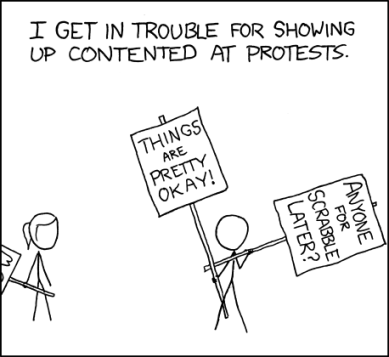
I see the makings of a truly centrist approach to the sociological imagination: an equal emphasis on problems and blessings, vices and virtues, structures of oppression and structures of good order. Sociology has a strong bias toward criticism; we need a balancing passion for appreciation.
Tuesday, September 09, 2008


Monday, September 08, 2008
Not Making a Fetish of Planning
I believe that Everything Will Work Out Just Fine.
I do not want to make a fetish of planning.
Nonetheless, I do like to plan ahead. I value other people planning ahead, especially when their plans take account of other people's plans. I think planning is a basic bourgeois virtue. Planning is the counterpart of being able to defer gratification, one of the defining bourgeois virtues.
People who plan ahead are more likely to succeed in this life.
I think it is reasonable to wish to that people in positions of power plan ahead, and try to act according to a plan.
Still, when we were in college, Mrs. G. and I discovered that our lovely, wonderful, caring friends in Christian Fellowship were never on time, never fully prepared, never really planned ahead. They had the vice of their virtues. They were never on time because they lived life able to drop everything for someone in need. We had to say to one another "They toil not, neither do they spin ..." to remember Jesus' admonition to properly appreciate the lilies of the field. This is the old conflict of Mary and Martha. So we tried not to sweat it when planned activities came off half-baked. And we brought extras and allowed extra time, knowing what was likely to happen.
What inspires this self-reminder about the proportionate value of planning is that I have been reading with various classes a set of excellent books about poor people, in the slums, on welfare, and how many of them got that way. Truthfully, how most of them got that way. Visit the characters in American Dream or Code of the Street or Promises I Can Keep. They have little, and are building for nothing, because they do not live according to a plan.
So I consider the lilies.
I still plan, but try not to be an insufferable prig about it.
I do not want to make a fetish of planning.
Nonetheless, I do like to plan ahead. I value other people planning ahead, especially when their plans take account of other people's plans. I think planning is a basic bourgeois virtue. Planning is the counterpart of being able to defer gratification, one of the defining bourgeois virtues.
People who plan ahead are more likely to succeed in this life.
I think it is reasonable to wish to that people in positions of power plan ahead, and try to act according to a plan.
Still, when we were in college, Mrs. G. and I discovered that our lovely, wonderful, caring friends in Christian Fellowship were never on time, never fully prepared, never really planned ahead. They had the vice of their virtues. They were never on time because they lived life able to drop everything for someone in need. We had to say to one another "They toil not, neither do they spin ..." to remember Jesus' admonition to properly appreciate the lilies of the field. This is the old conflict of Mary and Martha. So we tried not to sweat it when planned activities came off half-baked. And we brought extras and allowed extra time, knowing what was likely to happen.
What inspires this self-reminder about the proportionate value of planning is that I have been reading with various classes a set of excellent books about poor people, in the slums, on welfare, and how many of them got that way. Truthfully, how most of them got that way. Visit the characters in American Dream or Code of the Street or Promises I Can Keep. They have little, and are building for nothing, because they do not live according to a plan.
So I consider the lilies.
I still plan, but try not to be an insufferable prig about it.
Sunday, September 07, 2008
Palin's Religion
I think it is great that there is a pentecostal on a major party ticket. A hundred years after the pentecostal movement was born, it has become the leading edge of world Christianity. For my money, the worldwide pentecostal/holiness movement is the most important unknown story of the twentieth century, and shows no signs of slowing in the twenty-first. The Assemblies of God is now the largest of the Pentecostal denominations, so it stands to reason that the first pentecostal on the top political ticket would be a child of the AG church.
The Palins have since gentrified into a non-denominational Bible church that is not quite so emotional and demonstrative as her home congregation. I don't hold that against them -- people grow and change in their faith all the time. And she has not repudiated her old denomination, but goes back to speak to the kids and her old pastor with evident pride. I honor that, too.
The great strength of Holy Spirit churches is that they connect me with God in a powerful way. The weakness of Holy Spirit churches is that they can easily slip into connecting God with me to serve me. One of the reasons that I moved from Quakerism, a Holy Spirit church from way back, to Presbyterianism is that the God found in the Quaker meeting was so often too small. When you are waiting on the Holy Spirit to speak through you, most of the time you find the Holy Spirit only talks about stuff that you are - I was - concerned about. The thing I like about Calvinist theology is the continuous reminder that God is the sovereign of all Creation and far beyond our petty concerns.
There are videos on the web of Sarah Palin addressing her old church. The whole speech is very interesting, and I commend it to you. There is one bit that has been debated on some of the religion and politics blogs. Ron Dreher at Crunchy Con asks whether this prayer is "weird":
The crucial line is "God's will has to be done in unifying people and companies to get that gas line built."
Dreher argues that this is not weird; "This is not how I talk about God's sovereignty. But it's how a lot of ordinary people -- educated people -- in my part of the world talk. And I see nothing especially strange about it." I think Dreher is right that many people do talk this way. But I can't agree with them, or Gov. Palin. In fact, I can think of few theological ideas more dangerous than the notion that God is on my side, that God works on others to achieve what I want.
It would be too much to say that there is a developed theology behind saying that God's will requires building my gas line. This is not a thought out position, but a felt one. I am passionately connected to God, so God is passionately connected to me. I am loyal to God, so God is loyal to me. I back God's will, so God backs my will. Nothing weird about it. The most human way of thinking about morality in the world. But theologically very dangerous.
The Palins have since gentrified into a non-denominational Bible church that is not quite so emotional and demonstrative as her home congregation. I don't hold that against them -- people grow and change in their faith all the time. And she has not repudiated her old denomination, but goes back to speak to the kids and her old pastor with evident pride. I honor that, too.
The great strength of Holy Spirit churches is that they connect me with God in a powerful way. The weakness of Holy Spirit churches is that they can easily slip into connecting God with me to serve me. One of the reasons that I moved from Quakerism, a Holy Spirit church from way back, to Presbyterianism is that the God found in the Quaker meeting was so often too small. When you are waiting on the Holy Spirit to speak through you, most of the time you find the Holy Spirit only talks about stuff that you are - I was - concerned about. The thing I like about Calvinist theology is the continuous reminder that God is the sovereign of all Creation and far beyond our petty concerns.
There are videos on the web of Sarah Palin addressing her old church. The whole speech is very interesting, and I commend it to you. There is one bit that has been debated on some of the religion and politics blogs. Ron Dreher at Crunchy Con asks whether this prayer is "weird":
The crucial line is "God's will has to be done in unifying people and companies to get that gas line built."
Dreher argues that this is not weird; "This is not how I talk about God's sovereignty. But it's how a lot of ordinary people -- educated people -- in my part of the world talk. And I see nothing especially strange about it." I think Dreher is right that many people do talk this way. But I can't agree with them, or Gov. Palin. In fact, I can think of few theological ideas more dangerous than the notion that God is on my side, that God works on others to achieve what I want.
It would be too much to say that there is a developed theology behind saying that God's will requires building my gas line. This is not a thought out position, but a felt one. I am passionately connected to God, so God is passionately connected to me. I am loyal to God, so God is loyal to me. I back God's will, so God backs my will. Nothing weird about it. The most human way of thinking about morality in the world. But theologically very dangerous.
Saturday, September 06, 2008
Palin-Fest
Last Sunday I blogged on Sarah Palin. I praised her genuine pro-life commitment in her own life. At that time, the "babygate" puzzle was hot. I had read on a blog that her daughter, Bristol, was pregnant now. I wrote that that settled the mystery of whether Trig Palin was really Bristol's child. The news of Bristol Palin's pregnancy had not yet hit the news, though, and the comments on that post, which were meant as partial praise, got tangled in the then-unresolved babygate question. For the first time in the three years I have been writing this blog, I pulled a post.
Since then I have watched and read with great care just about everything that has come out from and about Gov. Palin. The comments in the blog this week, on posts that were about something else, nonetheless raised many questions about Palin. So today I want to give a more considered response to the one-week celebrity of the Republican ticket.
I believe that we all have the vices of our virtues. Our weaknesses are usually the complements of our strengths. The list below, therefore, alternates what I see as Gov. Palin's strengths with her related weaknesses.
She is smart, charismatic, and attractive.
She did a good job reading a speech written by others, but has so far refused to answer questions in her own voice, speaking her own mind.
She seems to have a strong marriage, has devoted herself to her family.
She has used her office to persecute those she thinks threatened her family.
She has really walked the pro-life talk, having a baby in her 40s that she knew would be very challenging to raise.
She took crazy risks with that baby's birth. I still think there is something fishy about the whole "fly home from Texas" story.
Finding her teen-age daughter pregnant, she pressed the couple to get married, which is her grandchild's best shot at a stable family life.
She said having the baby was her daughter's choice. She has also said she would sign a law banning all abortions.
She has walked the pro-military talk, supporting her son into the Army in wartime.
She has not thought in any depth about the war her son is being sent to fight.
She is a strong Christian and is not afraid to own it.
She believes God supports what she supports -- the president, the war, the gas pipeline (!)
She has walked the pro-community talk, getting involved in her PTA, serving on the city council of her hometown, and serving as mayor.
She used her power ruthlessly - firing the chief of police because he intimidated her, pressuring the librarian to censor books, putting the city in debt for money pit projects like a sports arena instead of necessities like a sewage treatment plant. And she attacks community organizing, the most basic kind of community involvement. This is a real puzzle to me. Up until now, faith-based community service has something Republicans were for.
She has opposed corruption in her own Republican party, including that of its leader, Sen. Ted Stevens.
She ran a campaign for Stevens. She supported the "Bridge to Nowhere" that he championed. She actively sought earmarks for her town, some of which Sen. McCain singled out as examples of abusive pork-barrel spending. I don't mind politicians changing their minds, or even bowing to reality. I do think it a real character flaw when they pretend that they always had the position they have now.
She opposed the oil cartel that controls Alaskan politics.
She has brought in different oil companies to carry out her pet project, the gas pipeline. She does not support freeing America from oil dependence, she favors freeing America from foreign oil dependence -- which means more sales for the main commodity of her state.
She pushed stronger ethics laws, and undid some of the excesses of her predecessor as governor.
She keeps saying that she sold the governor's jet on eBay for a profit, knowing that this is not true. Knowing that anyone who follows politics knows this is not true. She got rid of the governor's driver -- but she makes phone calls and sends text messages while driving (this may be a pet peeve of mine).
She has mobilized many ordinary people who were lukewarm about participating in this election.
In defending small town, evangelical, gun-using Americans, she sneers at cosmopolitan, mainline, violence-fearing Americans.
She has helped normalize the idea of women in every political office, include President.
She praised Hillary Clinton for putting those 18 million cracks in the glass ceiling. This line brought boos. I expect she will not say that again.
She is a Gen-X "just do it" person who might actually accomplish something.
She doesn't seem to have a plan for anything she does. She reacts to events, doing the opposite of whatever stands in her way.
Since then I have watched and read with great care just about everything that has come out from and about Gov. Palin. The comments in the blog this week, on posts that were about something else, nonetheless raised many questions about Palin. So today I want to give a more considered response to the one-week celebrity of the Republican ticket.
I believe that we all have the vices of our virtues. Our weaknesses are usually the complements of our strengths. The list below, therefore, alternates what I see as Gov. Palin's strengths with her related weaknesses.
She is smart, charismatic, and attractive.
She did a good job reading a speech written by others, but has so far refused to answer questions in her own voice, speaking her own mind.
She seems to have a strong marriage, has devoted herself to her family.
She has used her office to persecute those she thinks threatened her family.
She has really walked the pro-life talk, having a baby in her 40s that she knew would be very challenging to raise.
She took crazy risks with that baby's birth. I still think there is something fishy about the whole "fly home from Texas" story.
Finding her teen-age daughter pregnant, she pressed the couple to get married, which is her grandchild's best shot at a stable family life.
She said having the baby was her daughter's choice. She has also said she would sign a law banning all abortions.
She has walked the pro-military talk, supporting her son into the Army in wartime.
She has not thought in any depth about the war her son is being sent to fight.
She is a strong Christian and is not afraid to own it.
She believes God supports what she supports -- the president, the war, the gas pipeline (!)
She has walked the pro-community talk, getting involved in her PTA, serving on the city council of her hometown, and serving as mayor.
She used her power ruthlessly - firing the chief of police because he intimidated her, pressuring the librarian to censor books, putting the city in debt for money pit projects like a sports arena instead of necessities like a sewage treatment plant. And she attacks community organizing, the most basic kind of community involvement. This is a real puzzle to me. Up until now, faith-based community service has something Republicans were for.
She has opposed corruption in her own Republican party, including that of its leader, Sen. Ted Stevens.
She ran a campaign for Stevens. She supported the "Bridge to Nowhere" that he championed. She actively sought earmarks for her town, some of which Sen. McCain singled out as examples of abusive pork-barrel spending. I don't mind politicians changing their minds, or even bowing to reality. I do think it a real character flaw when they pretend that they always had the position they have now.
She opposed the oil cartel that controls Alaskan politics.
She has brought in different oil companies to carry out her pet project, the gas pipeline. She does not support freeing America from oil dependence, she favors freeing America from foreign oil dependence -- which means more sales for the main commodity of her state.
She pushed stronger ethics laws, and undid some of the excesses of her predecessor as governor.
She keeps saying that she sold the governor's jet on eBay for a profit, knowing that this is not true. Knowing that anyone who follows politics knows this is not true. She got rid of the governor's driver -- but she makes phone calls and sends text messages while driving (this may be a pet peeve of mine).
She has mobilized many ordinary people who were lukewarm about participating in this election.
In defending small town, evangelical, gun-using Americans, she sneers at cosmopolitan, mainline, violence-fearing Americans.
She has helped normalize the idea of women in every political office, include President.
She praised Hillary Clinton for putting those 18 million cracks in the glass ceiling. This line brought boos. I expect she will not say that again.
She is a Gen-X "just do it" person who might actually accomplish something.
She doesn't seem to have a plan for anything she does. She reacts to events, doing the opposite of whatever stands in her way.

Friday, September 05, 2008
American Dream 4: What Welfare Reform Still Needs
Jason DeParle concludes that welfare reform really did work in reducing the rolls, way beyond what anyone expected. And it has not led to masses of destitute people, in part because so many on welfare were already working when the new law forced them to "find" work. As DeParle says, the poor had more options than the reformers expected.
If welfare reform is to keep working, the bureaucracy and the policymakers will have to maintain the will to uphold the time limits and lifetime limits on welfare eligibility.
DeParle admits that he and the other poverty reporters missed the other half of what has worked in welfare reform: the Earned Income Tax Credit. EITC gives money back to working parents. It is the largest poverty reduction program in the country. Both parties support it because it gives money to working poor parents, proportionate to their work and their earnings. Sen. Obama proposes to expand EITC, and many states have or are considering their own versions to supplement the federal program.
The big domestic policy debate, for the poor and everyone else, is over health insurance. The Child Health Insurance Program is the foot in the door for federally supported health care for all. The debate is over whether to expand it to poor adults or not.
DeParle says what welfare reform still needs is more for child care, wage supplements, and transportation. He also thinks that the work requirement, though vitally important, has gone too far in eliminating most job training programs.
DeParle mentions in passing what I think is the biggest failing of welfare reform: it is only aimed at women. Welfare reform drove poor women from welfare to work; not men. This is especially true for African Americans. DeParle reports that about half of all black men are without regular legal employment, compared to perhaps a fifth of white and Hispanic men. The black illegitimacy rate is nearly 70%, vs. less than half than for the other groups. In the black slums, marriage has all but disappeared. For the women in DeParle's study, marriage was a dream on par with wanting a unicorn; none of them had ever been to a wedding.
I think what welfare reform needs if it is ever to actually reduce poverty and dependency is a way to promote marriage, fatherhood, and responsibility among poor men.
If welfare reform is to keep working, the bureaucracy and the policymakers will have to maintain the will to uphold the time limits and lifetime limits on welfare eligibility.
DeParle admits that he and the other poverty reporters missed the other half of what has worked in welfare reform: the Earned Income Tax Credit. EITC gives money back to working parents. It is the largest poverty reduction program in the country. Both parties support it because it gives money to working poor parents, proportionate to their work and their earnings. Sen. Obama proposes to expand EITC, and many states have or are considering their own versions to supplement the federal program.
The big domestic policy debate, for the poor and everyone else, is over health insurance. The Child Health Insurance Program is the foot in the door for federally supported health care for all. The debate is over whether to expand it to poor adults or not.
DeParle says what welfare reform still needs is more for child care, wage supplements, and transportation. He also thinks that the work requirement, though vitally important, has gone too far in eliminating most job training programs.
DeParle mentions in passing what I think is the biggest failing of welfare reform: it is only aimed at women. Welfare reform drove poor women from welfare to work; not men. This is especially true for African Americans. DeParle reports that about half of all black men are without regular legal employment, compared to perhaps a fifth of white and Hispanic men. The black illegitimacy rate is nearly 70%, vs. less than half than for the other groups. In the black slums, marriage has all but disappeared. For the women in DeParle's study, marriage was a dream on par with wanting a unicorn; none of them had ever been to a wedding.
I think what welfare reform needs if it is ever to actually reduce poverty and dependency is a way to promote marriage, fatherhood, and responsibility among poor men.
Thursday, September 04, 2008
American Dream 3: Why Welfare Reform Worked
Jason DeParle shows in American Dream that the 1996 welfare reform was a huge success -- way beyond the expectations of either the Clinton Democrats or the Gingrich Republicans who worked together to create it. The combination of time limits, lifetime limits, and work requirements led to a 90% reduction in the welfare rolls.
The main thing that worked, DeParle concludes, was the work requirement. Even threatening to require work was enough to get many people to get -- and keep -- jobs, instead of trying to get welfare. And that worked, DeParle believes, because the women getting welfare didn't think of themselves as dependent on it. They saw themselves as workers. Most of them had jobs, off and on, which they lied about to the welfare office. They saw themselves as workers, even if they had never worked regularly. They saw themselves as survivors, even if most of the troubles they had to survive were of their own making.
The hard part of welfare reform comes now, when we have to sustain the will to stick to the lifetime limits as the economy recedes from the Clinton-era high. The easiest thing for welfare establishment to do is just give money to people who ask for it. Enforcing welfare is even more of a hassle for caseworkers than it is for welfare recipients.
That is why DeParle's account is so helpful: welfare reform has been a success for the former welfare recipients. That is why we should stick to it.
The main thing that worked, DeParle concludes, was the work requirement. Even threatening to require work was enough to get many people to get -- and keep -- jobs, instead of trying to get welfare. And that worked, DeParle believes, because the women getting welfare didn't think of themselves as dependent on it. They saw themselves as workers. Most of them had jobs, off and on, which they lied about to the welfare office. They saw themselves as workers, even if they had never worked regularly. They saw themselves as survivors, even if most of the troubles they had to survive were of their own making.
The hard part of welfare reform comes now, when we have to sustain the will to stick to the lifetime limits as the economy recedes from the Clinton-era high. The easiest thing for welfare establishment to do is just give money to people who ask for it. Enforcing welfare is even more of a hassle for caseworkers than it is for welfare recipients.
That is why DeParle's account is so helpful: welfare reform has been a success for the former welfare recipients. That is why we should stick to it.
Wednesday, September 03, 2008
American Dream 2: The Black Working Class as the Crossroads
One implicit question in Jason DeParle’s American Dream is why the black welfare class was so large a proportion of all African Americans to begin with, and why it wasn’t shrinking faster.
Some of the single welfare mothers he studied had grown up in working class neighborhoods with two employed parents. Children of white working class neighborhoods are likely to move up in class, or reproduce their parents’ lives in new working class areas. Children of the black working class, by contrast, have been much less likely to reproduce their parents’ lives.
DeParle says that the main demographic difference between black working class neighborhoods and other working class neighborhoods is the high proportion of black single mothers. In the particular working class neighborhood that some of his subjects came from, about a third of the African American children grew up with single mothers. This is higher than the single-parent rate in non-black families (the national average is about a fifth), but much lower than the average for all black families, which runs to over half. Children in single-parent households are more vulnerable to the lure of the street.
DeParle also believes that there is another risk factor that black families have that is not so obvious. Almost all of the black working class families he studied had many connections, through family and friends, to the ghetto underclass. For the black working class, the “street” was never far away. This is much less true for the much larger white working class, and is still true when we consider the many different ethnic groups within the non-black majority. In Milwaukee in the ‘90s, the main area of DeParle’s book, half the black families in the city got some kind of welfare. The black working class is, of necessity, a minority among the minority. Moreover, black working class neighborhoods were typically right next to the slums, bringing the street literally to their door.
DeParle says the black working class is more precarious than other working classes because it is the “crossroads” between the middle class and the slums.
Some of the single welfare mothers he studied had grown up in working class neighborhoods with two employed parents. Children of white working class neighborhoods are likely to move up in class, or reproduce their parents’ lives in new working class areas. Children of the black working class, by contrast, have been much less likely to reproduce their parents’ lives.
DeParle says that the main demographic difference between black working class neighborhoods and other working class neighborhoods is the high proportion of black single mothers. In the particular working class neighborhood that some of his subjects came from, about a third of the African American children grew up with single mothers. This is higher than the single-parent rate in non-black families (the national average is about a fifth), but much lower than the average for all black families, which runs to over half. Children in single-parent households are more vulnerable to the lure of the street.
DeParle also believes that there is another risk factor that black families have that is not so obvious. Almost all of the black working class families he studied had many connections, through family and friends, to the ghetto underclass. For the black working class, the “street” was never far away. This is much less true for the much larger white working class, and is still true when we consider the many different ethnic groups within the non-black majority. In Milwaukee in the ‘90s, the main area of DeParle’s book, half the black families in the city got some kind of welfare. The black working class is, of necessity, a minority among the minority. Moreover, black working class neighborhoods were typically right next to the slums, bringing the street literally to their door.
DeParle says the black working class is more precarious than other working classes because it is the “crossroads” between the middle class and the slums.
Tuesday, September 02, 2008
American Dream 1: Pre-Welfare Chaos
This week I will be blogging on Jason DeParle's American Dream: Three Women, Ten Kids, and a Nation’s Drive to End Welfare.
One of the debates in welfare reform has been about whether the welfare system created the social chaos that led many people to go on welfare in the first place. DeParle traces the families of three women who were single welfare moms in Milwaukee in the '90s back to the Mississippi plantation their ancestors came lived on a century ago. DeParle shows that the pattern of social disorganization of the "welfare plantation" was already well established on the sharecropping plantation, long before the great migration of black peasants to the northern cities and long before the invention of welfare. Women had children with temporary boyfriends, families moved often, the men were often violent and unreliable, and hard drinking was widespread. Moving north made things worse - the loose controls of extended family, country churches, and sheer social surveillance of the rural South broke down in the anonymous cities. But the basic pattern was already set.
This brings us to a central puzzle in the study of African-American family life. W.E.B. DuBois and E. Franklin Frazier, the fathers of black sociology in this country, thought the weak marriages and high out-of-wedlock birthrates among African Americans were a legacy of slavery, carried on with little change under Jim Crow. Herbert Gutman, by contrast, changed the debate when he argued that the black marriage rate was about the same as the white rate in the 1950s, so the subsequent black family breakdown must be due to recent causes. Indeed, it was from the leftist Gutman's argument that conservatives like Charles Murray would argue that welfare caused black family breakdown. Recently, though, James Q. Wilson and others have revisited Gutman's argument, returning to the more intuitively plausible DuBois/Frazier line that slavery had long-term destructive effects on black families.
DeParle is a journalist, using illustrative anecdotes to discuss the effects of social policy (welfare reform). He is not trying to settle the sociological argument about the long-term trajectory of African-American family structure. Still, I think DeParle's case shows strong support for the DuBois-to-J.Q.Wilson side of the argument.
One of the debates in welfare reform has been about whether the welfare system created the social chaos that led many people to go on welfare in the first place. DeParle traces the families of three women who were single welfare moms in Milwaukee in the '90s back to the Mississippi plantation their ancestors came lived on a century ago. DeParle shows that the pattern of social disorganization of the "welfare plantation" was already well established on the sharecropping plantation, long before the great migration of black peasants to the northern cities and long before the invention of welfare. Women had children with temporary boyfriends, families moved often, the men were often violent and unreliable, and hard drinking was widespread. Moving north made things worse - the loose controls of extended family, country churches, and sheer social surveillance of the rural South broke down in the anonymous cities. But the basic pattern was already set.
This brings us to a central puzzle in the study of African-American family life. W.E.B. DuBois and E. Franklin Frazier, the fathers of black sociology in this country, thought the weak marriages and high out-of-wedlock birthrates among African Americans were a legacy of slavery, carried on with little change under Jim Crow. Herbert Gutman, by contrast, changed the debate when he argued that the black marriage rate was about the same as the white rate in the 1950s, so the subsequent black family breakdown must be due to recent causes. Indeed, it was from the leftist Gutman's argument that conservatives like Charles Murray would argue that welfare caused black family breakdown. Recently, though, James Q. Wilson and others have revisited Gutman's argument, returning to the more intuitively plausible DuBois/Frazier line that slavery had long-term destructive effects on black families.
DeParle is a journalist, using illustrative anecdotes to discuss the effects of social policy (welfare reform). He is not trying to settle the sociological argument about the long-term trajectory of African-American family structure. Still, I think DeParle's case shows strong support for the DuBois-to-J.Q.Wilson side of the argument.
Monday, September 01, 2008
Teach Labor Day
Today we honor those who labor -- especially those who do the physically hard jobs.
At Centre College, we honor labor by laboring. Centre is its own world. We often begin the term on Labor Day. I think this is appropriate. One of the ways we can honor physical labor is by teaching the privileged (who will probably not be doing much of it) to treat their fellow workers with respect.
Those of you not laboring this day, enjoy your civil sabbath.
At Centre College, we honor labor by laboring. Centre is its own world. We often begin the term on Labor Day. I think this is appropriate. One of the ways we can honor physical labor is by teaching the privileged (who will probably not be doing much of it) to treat their fellow workers with respect.
Those of you not laboring this day, enjoy your civil sabbath.
Saturday, August 30, 2008
Fight the Dragon. Or Housefly.
To stop men from peeing on the floor, authorities at Schiphol Airport in Amsterdam have etched the image of a black housefly into each urinal. It seems that men usually do not pay much attention to where they aim, which can create a bit of a mess. But if you give them a target, they can’t help but try to hit it. Similar designs have been implemented in urinals around the world, including mini soccer goals, bulls-eyes, and urine video games (seriously). Do they work? Since the bugs were etched into the airport urinals, spillage has decreased by 80 percent.
(From the very gruntled GOOD magazine.)
(From the very gruntled GOOD magazine.)
Friday, August 29, 2008
On the Forbes College Rankings
This is my final back-to-school story.
Forbes magazine just published its first college rankings. Centre College did exceptionally well -- 13th among all colleges and universities in the United States -- so you can imagine that we have been pleased. Still, modesty compels us to be a little skeptical of such a result.
A closer look at the method they used, though, increases my confidence in the result. The great weakness of the U.S. News rankings, the standard in the field, is that they are based almost entirely on inputs to education, such as endowment per student or student-teacher ratios, and not on measures of the outcomes of education. Forbes, by contrast, uses outcome measures. Specifically, the Forbes rankings, compiled by The Center for College Affordability and Productivity (CCAP), used these five components:
1. Listing of Alumni in the 2008 Who's Who in America (25%)
2. Student Evaluations of Professors from Ratemyprofessors.com (25%)
3. Four- Year Graduation Rates (16 2/3%)
4. Enrollment-adjusted numbers of students and faculty receiving nationally competitive awards (16 2/3%)
5. Average four year accumulated student debt of those borrowing money (16 2/3%)
Outcome measures are, in principle, better than inputs in figuring out what real effect a school has on students. And each of these outcome measures is not a bad one. Even the Rate My Professors score, which seems the sketchiest, is (as they show) well correlated with more commonly used measures of teaching effectiveness.
Forbes measured outcomes while controlling for the size of the school. This sensible procedure demonstrates that small liberals arts colleges really do stand out. Sure, every big U has some great student successes, but on a base of tens of thousands who pass through the ed factory. A small college with a good faculty, of which there are many, offers better teaching for most students than even the best universities. Sure, the University of Virginia (43) gets some really great students, but Centre College (13) does more with the fine students we get -- all of them, not just the stars.
I hope Forbes will push all the college rankers to focus more on outcomes, especially long-term outcomes.
Here, then, are the Forbes top 25:
1 Princeton University
2 California Institute of Technology
3 Harvard University
4 Swarthmore College
5 Williams College
6 United States Military Academy
7 Amherst College
8 Wellesley College
9 Yale University
10 Columbia University
11 Northwestern University
12 Wabash College
13 Centre College
14 Massachusetts Institute of Technology
15 Bowdoin College
16 United States Air Force Academy
17 Middlebury College
18 University of Chicago
19 Smith College
20 Pomona College
21 Wesleyan University
22 Haverford College
23 Stanford University
24 Hamilton College
25 Sarah Lawrence College
Forbes magazine just published its first college rankings. Centre College did exceptionally well -- 13th among all colleges and universities in the United States -- so you can imagine that we have been pleased. Still, modesty compels us to be a little skeptical of such a result.
A closer look at the method they used, though, increases my confidence in the result. The great weakness of the U.S. News rankings, the standard in the field, is that they are based almost entirely on inputs to education, such as endowment per student or student-teacher ratios, and not on measures of the outcomes of education. Forbes, by contrast, uses outcome measures. Specifically, the Forbes rankings, compiled by The Center for College Affordability and Productivity (CCAP), used these five components:
1. Listing of Alumni in the 2008 Who's Who in America (25%)
2. Student Evaluations of Professors from Ratemyprofessors.com (25%)
3. Four- Year Graduation Rates (16 2/3%)
4. Enrollment-adjusted numbers of students and faculty receiving nationally competitive awards (16 2/3%)
5. Average four year accumulated student debt of those borrowing money (16 2/3%)
Outcome measures are, in principle, better than inputs in figuring out what real effect a school has on students. And each of these outcome measures is not a bad one. Even the Rate My Professors score, which seems the sketchiest, is (as they show) well correlated with more commonly used measures of teaching effectiveness.
Forbes measured outcomes while controlling for the size of the school. This sensible procedure demonstrates that small liberals arts colleges really do stand out. Sure, every big U has some great student successes, but on a base of tens of thousands who pass through the ed factory. A small college with a good faculty, of which there are many, offers better teaching for most students than even the best universities. Sure, the University of Virginia (43) gets some really great students, but Centre College (13) does more with the fine students we get -- all of them, not just the stars.
I hope Forbes will push all the college rankers to focus more on outcomes, especially long-term outcomes.
Here, then, are the Forbes top 25:
1 Princeton University
2 California Institute of Technology
3 Harvard University
4 Swarthmore College
5 Williams College
6 United States Military Academy
7 Amherst College
8 Wellesley College
9 Yale University
10 Columbia University
11 Northwestern University
12 Wabash College
13 Centre College
14 Massachusetts Institute of Technology
15 Bowdoin College
16 United States Air Force Academy
17 Middlebury College
18 University of Chicago
19 Smith College
20 Pomona College
21 Wesleyan University
22 Haverford College
23 Stanford University
24 Hamilton College
25 Sarah Lawrence College
Thursday, August 28, 2008
High School Graduation Peaked Last Year
A third back-to-school story:
All the public and private high schools in the United States graduated about 3.34 million students last year. That is likely to be the peak number for the foreseeable future, projecting out to 2022. This is the finding reported in the most recent edition of the Western Interstate Commission on Higher Education's series of high school and college projections.
The declining number of high school graduates will put further pressure on the massive expansion of college and college-like training to go deeper into the pool of warm bodies just to sustain the credentialing apparatus we now have.
Still, it is a very good thing that there are more high school graduates than ever before.
All the public and private high schools in the United States graduated about 3.34 million students last year. That is likely to be the peak number for the foreseeable future, projecting out to 2022. This is the finding reported in the most recent edition of the Western Interstate Commission on Higher Education's series of high school and college projections.
The declining number of high school graduates will put further pressure on the massive expansion of college and college-like training to go deeper into the pool of warm bodies just to sustain the credentialing apparatus we now have.
Still, it is a very good thing that there are more high school graduates than ever before.
Wednesday, August 27, 2008
Murray is Right: Too Many Go to "College"
Here is another good back-to-school subject.
Charles Murray has written another provocative book, Real Education. A few months ago he gave a summary of his argument in the Wall Street Journal.
He argues that liberal arts education is for the intellectual elite. Our society is already good at seeing that the smartest kids get channeled toward the best colleges. We are not so good at channeling the vast middle of kids to vocational education. We do not give vocational education the same status. This inflates the value of college degrees socially and economically, and forces liberal arts colleges to try to provide job training for which they are ill equipped.
I am a sociology professor at a liberal arts college. Murray specifically slams a B.A. in sociology as telling you nothing about what the degree holder knows. I agree. In a liberal arts education, where you went to school matters more than which discipline you studied most.
And if you don't need a liberal arts education, or aren't ready for one now, by all means don't go to college just for social reasons. Vocational education, if it really teaches its craft, is honorable education, just as craft works of all kinds is honorable work.
Charles Murray has written another provocative book, Real Education. A few months ago he gave a summary of his argument in the Wall Street Journal.
He argues that liberal arts education is for the intellectual elite. Our society is already good at seeing that the smartest kids get channeled toward the best colleges. We are not so good at channeling the vast middle of kids to vocational education. We do not give vocational education the same status. This inflates the value of college degrees socially and economically, and forces liberal arts colleges to try to provide job training for which they are ill equipped.
I am a sociology professor at a liberal arts college. Murray specifically slams a B.A. in sociology as telling you nothing about what the degree holder knows. I agree. In a liberal arts education, where you went to school matters more than which discipline you studied most.
And if you don't need a liberal arts education, or aren't ready for one now, by all means don't go to college just for social reasons. Vocational education, if it really teaches its craft, is honorable education, just as craft works of all kinds is honorable work.
Tuesday, August 26, 2008
Faculty Moderation
The New York Times reported in the dead of summer on the increasing moderation of professors. This seems like an excellent back-to-school story to me.
On a liberal-moderate-conservative scale, professors as a whole are more liberal than conservative, with a strong body of self-described moderates. Within disciplines, social scientists are the most liberal, with just over half reporting that position. Business professors have the most conservatives - about a quarter. The middle-most disciplines are computer science and engineering, which report nearly 90% moderation.
When we look by generation, the Baby Boomers, now aged 50 to shading off to retirement at 65, are the most liberal. Boomer humanities professors are the most liberal group of all, with nearly three quarters choosing that label and negligible percentages choosing "conservative."
The younger generations, though, are notably less liberal than the Boomers, and more moderate. Gen X humanities professors, for example, have only half the rate of liberals that their elders show.
There are significant variations by disciplinary area. The Boomer scientists are not nearly as liberal as their humanities counterparts are; Gen X scientists, though, show more liberals than their elders. My guess is that this reflects the massive increase in women in science after the Baby Boom generation.
The general trend across all disciplines, though, is that the professoriate will get less liberal and more moderate as the older generations retire. This is good news for centrism.
On a liberal-moderate-conservative scale, professors as a whole are more liberal than conservative, with a strong body of self-described moderates. Within disciplines, social scientists are the most liberal, with just over half reporting that position. Business professors have the most conservatives - about a quarter. The middle-most disciplines are computer science and engineering, which report nearly 90% moderation.
When we look by generation, the Baby Boomers, now aged 50 to shading off to retirement at 65, are the most liberal. Boomer humanities professors are the most liberal group of all, with nearly three quarters choosing that label and negligible percentages choosing "conservative."
The younger generations, though, are notably less liberal than the Boomers, and more moderate. Gen X humanities professors, for example, have only half the rate of liberals that their elders show.
There are significant variations by disciplinary area. The Boomer scientists are not nearly as liberal as their humanities counterparts are; Gen X scientists, though, show more liberals than their elders. My guess is that this reflects the massive increase in women in science after the Baby Boom generation.
The general trend across all disciplines, though, is that the professoriate will get less liberal and more moderate as the older generations retire. This is good news for centrism.
Sunday, August 17, 2008
Gone to Capon Springs
Like most Americans, I take two weeks of real vacation a year. Christmas week is one of those weeks. This week is another. The Gruntleds are off to lovely Capon Springs, WV, a fine, mineral-spring-fed family reunion.
See you in a week.
See you in a week.
Saturday, August 16, 2008
Obama and McCain's Favorite Songs
I can see why Obama would favor Ready or Not. It could work as a campaign anthem.
But John McCain's favorite song is Dancing Queen? Seriously? I guess if he is just discovering the internet now, maybe he is really a teenager. Let's watch for OMG to start appearing in his speeches.
Blender magazine asked the presidential candidates to name their top ten favorite songs.
Sen. Barack Obama
1. Ready or Not Fugees
2. What's Going On Marvin Gaye
3. I'm On Fire Bruce Springsteen
4. Gimme Shelter Rolling Stones
5. Sinnerman Nina Simone
6. Touch the Sky Kanye West
7. You'd Be So Easy to Love Frank Sinatra
8. Think Aretha Franklin
9. City of Blinding Lights U2
10. Yes We Can will.i.am
Sen. John McCain
1. Dancing Queen ABBA
2. Blue Bayou Roy Orbison
3. Take a Chance On Me ABBA
4. If We Make It Through December Merle Haggard
5. As Time Goes By Dooley Wilson
6. Good Vibrations The Beach Boys
7. What A Wonderful World Louis Armstrong
8. I've Got You Under My Skin Frank Sinatra
9. Sweet Caroline Neil Diamond
10. Smoke Gets In Your Eyes The Platters
But John McCain's favorite song is Dancing Queen? Seriously? I guess if he is just discovering the internet now, maybe he is really a teenager. Let's watch for OMG to start appearing in his speeches.
Blender magazine asked the presidential candidates to name their top ten favorite songs.
Sen. Barack Obama
1. Ready or Not Fugees
2. What's Going On Marvin Gaye
3. I'm On Fire Bruce Springsteen
4. Gimme Shelter Rolling Stones
5. Sinnerman Nina Simone
6. Touch the Sky Kanye West
7. You'd Be So Easy to Love Frank Sinatra
8. Think Aretha Franklin
9. City of Blinding Lights U2
10. Yes We Can will.i.am
Sen. John McCain
1. Dancing Queen ABBA
2. Blue Bayou Roy Orbison
3. Take a Chance On Me ABBA
4. If We Make It Through December Merle Haggard
5. As Time Goes By Dooley Wilson
6. Good Vibrations The Beach Boys
7. What A Wonderful World Louis Armstrong
8. I've Got You Under My Skin Frank Sinatra
9. Sweet Caroline Neil Diamond
10. Smoke Gets In Your Eyes The Platters
Friday, August 15, 2008
The Marriage Movement in the Civil Sphere
Jeffrey Alexander envisions the civil sphere as driven by social movements that realize the basic civil values against intrusions from the uncivil spheres. All of his examples of such movements are “progressive” in the liberal sense. They are movement to remove hierarchy, exclusion, restriction.
Marriage, by its nature, is exclusive and restrictive. Parenthood, by its nature, is hierarchical. Could a movement to restore marriage and married parenthood to the center of the civil sphere’s understanding of family life succeed in Alexander’s conception of the civil sphere?
Marriage is an institution. Alexander lays out what he thinks are the basic binaries governing institutions.
A marriage movement would need to make a convincing case that marriage is the more legitimate institution of the available alternatives.
The first thing an Alexandrian marriage movement would need, therefore, is a good enemy. Ideally, the enemy would be an institution with the same functions as marriage, but embodying the bad side of the binaries. I think the main, irreplaceable function of marriage is to bind a man and woman together in a uniquely powerful way so that they can endure the sacrifice and stress of raising their children in the way that serves society best.
The name of the enemy institution, therefore, is cohabitation.
Let’s contrast marriage and cohabitation in the terms of Alexander’s binary of institutions:
Marriage is strongly rule regulated: all of your resources belong by rule and definition to the marriage, with your children having first claim on their use. Cohabitation is arbitrary, because either party can declare some resources to be personal, and there is nothing in the rules of cohabitation that can be appealed to to prohibit that claim. This applies especially to the rule of sexual exclusivity.
Marriage is a relationship recognized by law. It is not a private arrangement between two individuals, but a social relationship recognized in public and protected by law from anyone who would pull it asunder – including the parties themselves. Cohabitation is regulated only by the relative power of the two parties, with the less committed party having more power to get his or her (usually his) way by the threatening to unilaterally withdraw.
Marriage requires equality in the couple. To take the biblical metaphor of what a marriage is, two become one flesh. In one flesh, as St. Paul says in another place, it makes no sense for one part of the body to claim superiority over another, because both (all) parts are necessary to the whole. Cohabitation, by contrast, produces inequality in the relationship. In practice, the one who contributes more money controls the decisions. Alexander, in discussing the movement for women’s equality, describes patriarchy as coming from the family sphere. Yet patriarchy is not essential to marriage, nor to family life. We should see this move on Alexander’s part as his attempt to pollute the family sphere as a whole as uncivil in order to bolster his case that the civil sphere is egalitarian and therefore civil.
When we get to the inclusive/exclusive binary, we run into a problem. The best I can think of is that marriage includes a concern with the public good, especially for raising children as citizens, whereas cohabitation excludes a concern for the public good because it is exclusively oriented to the private benefit of the couple. This is true, but a bit of a stretch. I am inclined to think that Alexander is just wrong that inclusive/exclusive is one of the basic binaries of society. In particular, I think any theory that aims at solidarity has to treat an exclusive commitment to the solidary whole as a good thing.
Alexander says institutions are civil if they are impersonal contracts – meaning that they are valuable regardless of the specific people embodying the institution and the specific relations they have with one another. Uncivil institutions reward only those who have personal bonds of loyalty to the specific people in them. Marriage as an institution is a civil contract that is supported by society because it benefits society as a whole, impersonally. Cohabitation is a private relationship that only benefits those with a personal bond of loyalty from the cohabiters.
Married parents form a powerful group in society with a permanent interest is seeing that all of society has public schools, public health, public safety, public security, and so forth. Cohabiters can, at best, form a temporary faction arguing for this policy or that, and usually for their own benefit rather than for the permanent public good.
To be a husband or a wife is to occupy an office through which the civil sphere regulates the uncivil sphere of family life. To be shacking up means you do what you want according to whatever personality you happen to have, with no point of leverage for civil regulation.
Thinking about a marriage movement in the Alexandrian civil sphere makes me notice another quality of all of his examples: they are all movements that promote solidarity. This is not so surprising, since he tells us first and last that social solidarity is the utopia we seek. What he did not make clear is that the values of the civil sphere would lead one to reject the libertarian values of sheer individualism. Alexander does not support social movements that aim to produce less social solidarity. The “leave me alone” movements simply have no place in Alexander’s civil sphere. They are anti-solidarity, and thus self-polluting.
A marriage movement could beat a cohabitation movement on the grounds that marriage is more civil (though we would have to wrestle about the relevance of the inclusive/exclusive standard to either one). A marriage movement could beat a cohabitation practice – or worse, a practice that left kids with divorced parents, never-married parents, sometime parents, or sheer chaos – on the grounds that all the disorganized forms of parenting were anti-social, were a threat to solidarity itself.
Marriage, by its nature, is exclusive and restrictive. Parenthood, by its nature, is hierarchical. Could a movement to restore marriage and married parenthood to the center of the civil sphere’s understanding of family life succeed in Alexander’s conception of the civil sphere?
Marriage is an institution. Alexander lays out what he thinks are the basic binaries governing institutions.
A marriage movement would need to make a convincing case that marriage is the more legitimate institution of the available alternatives.
The first thing an Alexandrian marriage movement would need, therefore, is a good enemy. Ideally, the enemy would be an institution with the same functions as marriage, but embodying the bad side of the binaries. I think the main, irreplaceable function of marriage is to bind a man and woman together in a uniquely powerful way so that they can endure the sacrifice and stress of raising their children in the way that serves society best.
The name of the enemy institution, therefore, is cohabitation.
Let’s contrast marriage and cohabitation in the terms of Alexander’s binary of institutions:
Marriage is strongly rule regulated: all of your resources belong by rule and definition to the marriage, with your children having first claim on their use. Cohabitation is arbitrary, because either party can declare some resources to be personal, and there is nothing in the rules of cohabitation that can be appealed to to prohibit that claim. This applies especially to the rule of sexual exclusivity.
Marriage is a relationship recognized by law. It is not a private arrangement between two individuals, but a social relationship recognized in public and protected by law from anyone who would pull it asunder – including the parties themselves. Cohabitation is regulated only by the relative power of the two parties, with the less committed party having more power to get his or her (usually his) way by the threatening to unilaterally withdraw.
Marriage requires equality in the couple. To take the biblical metaphor of what a marriage is, two become one flesh. In one flesh, as St. Paul says in another place, it makes no sense for one part of the body to claim superiority over another, because both (all) parts are necessary to the whole. Cohabitation, by contrast, produces inequality in the relationship. In practice, the one who contributes more money controls the decisions. Alexander, in discussing the movement for women’s equality, describes patriarchy as coming from the family sphere. Yet patriarchy is not essential to marriage, nor to family life. We should see this move on Alexander’s part as his attempt to pollute the family sphere as a whole as uncivil in order to bolster his case that the civil sphere is egalitarian and therefore civil.
When we get to the inclusive/exclusive binary, we run into a problem. The best I can think of is that marriage includes a concern with the public good, especially for raising children as citizens, whereas cohabitation excludes a concern for the public good because it is exclusively oriented to the private benefit of the couple. This is true, but a bit of a stretch. I am inclined to think that Alexander is just wrong that inclusive/exclusive is one of the basic binaries of society. In particular, I think any theory that aims at solidarity has to treat an exclusive commitment to the solidary whole as a good thing.
Alexander says institutions are civil if they are impersonal contracts – meaning that they are valuable regardless of the specific people embodying the institution and the specific relations they have with one another. Uncivil institutions reward only those who have personal bonds of loyalty to the specific people in them. Marriage as an institution is a civil contract that is supported by society because it benefits society as a whole, impersonally. Cohabitation is a private relationship that only benefits those with a personal bond of loyalty from the cohabiters.
Married parents form a powerful group in society with a permanent interest is seeing that all of society has public schools, public health, public safety, public security, and so forth. Cohabiters can, at best, form a temporary faction arguing for this policy or that, and usually for their own benefit rather than for the permanent public good.
To be a husband or a wife is to occupy an office through which the civil sphere regulates the uncivil sphere of family life. To be shacking up means you do what you want according to whatever personality you happen to have, with no point of leverage for civil regulation.
Thinking about a marriage movement in the Alexandrian civil sphere makes me notice another quality of all of his examples: they are all movements that promote solidarity. This is not so surprising, since he tells us first and last that social solidarity is the utopia we seek. What he did not make clear is that the values of the civil sphere would lead one to reject the libertarian values of sheer individualism. Alexander does not support social movements that aim to produce less social solidarity. The “leave me alone” movements simply have no place in Alexander’s civil sphere. They are anti-solidarity, and thus self-polluting.
A marriage movement could beat a cohabitation movement on the grounds that marriage is more civil (though we would have to wrestle about the relevance of the inclusive/exclusive standard to either one). A marriage movement could beat a cohabitation practice – or worse, a practice that left kids with divorced parents, never-married parents, sometime parents, or sheer chaos – on the grounds that all the disorganized forms of parenting were anti-social, were a threat to solidarity itself.
Thursday, August 14, 2008
The Civil Religion of the Civil Sphere
Jeffrey Alexander treats religion as one of the uncivil spheres that surrounds the civil sphere. Religion makes a contribution to society, but it produces its own peculiar beliefs and hierarchies that ever threaten to intrude into the civil sphere. The civil sphere must do constant boundary maintenance and civil repair to keep religion in its place.
The civil sphere itself, in Alexander's account, has its own distinctive values and moral aspirations. It is, as he says several times, a project to create a democratic society. The overarching values of society reside there, which can be mobilized to trump and regulate the values of the uncivil spheres.
The values of a society get enacted and celebrated in rituals, something that Alexander, a good Durkheimian, would acknowledge. Celebrating the rituals of civil life helps create and renew solidarity in society as a whole.
In other words, the faith and practice of the civil sphere is the civil religion of society.
Civil religion is not part of the state, any more than voting, parties, or the norms of office are part of the state. Civil religion is one the ways in which the civil sphere regulates the other spheres, especially the state.
Civil religion has a complex relation with the universal religions that are (barely) contained in the religious sphere. They differ primarily in their Ultimate Concern -- God or Enlightenment in the case of universal religions, society itself in the case of civil religion.
Contrary to Alexander's hopeful, but maddeningly vague, picture of the contents of the civil values, it is not right to say that the ultimate concern of every civil sphere is democracy. As he notes repeatedly, each society's civil sphere is specific and historical. Its concerns are those of that society first, and perhaps of some higher global civil society only at the edges. And the object of veneration of civil religion, even the civil religion of a democratic society, is not democracy. It is the veneration of that particular society, its particular people, history, and manifest destiny.
The civil sphere does not put religion in its place. The civil sphere has a civil religion of its own.
The civil sphere itself, in Alexander's account, has its own distinctive values and moral aspirations. It is, as he says several times, a project to create a democratic society. The overarching values of society reside there, which can be mobilized to trump and regulate the values of the uncivil spheres.
The values of a society get enacted and celebrated in rituals, something that Alexander, a good Durkheimian, would acknowledge. Celebrating the rituals of civil life helps create and renew solidarity in society as a whole.
In other words, the faith and practice of the civil sphere is the civil religion of society.
Civil religion is not part of the state, any more than voting, parties, or the norms of office are part of the state. Civil religion is one the ways in which the civil sphere regulates the other spheres, especially the state.
Civil religion has a complex relation with the universal religions that are (barely) contained in the religious sphere. They differ primarily in their Ultimate Concern -- God or Enlightenment in the case of universal religions, society itself in the case of civil religion.
Contrary to Alexander's hopeful, but maddeningly vague, picture of the contents of the civil values, it is not right to say that the ultimate concern of every civil sphere is democracy. As he notes repeatedly, each society's civil sphere is specific and historical. Its concerns are those of that society first, and perhaps of some higher global civil society only at the edges. And the object of veneration of civil religion, even the civil religion of a democratic society, is not democracy. It is the veneration of that particular society, its particular people, history, and manifest destiny.
The civil sphere does not put religion in its place. The civil sphere has a civil religion of its own.
Wednesday, August 13, 2008
Are the Melting Pot and Hyphenated-Identity the Same?
Jeffrey Alexander argues that out-groups can get included in civil society in three ways: assimilation, hyphenation, and multiculturalism. These modes of incorporation form a spectrum. Every group experiences a bit of each - which predominates in each era and for a specific group is an empirical question. Alexander cites the case of Jews in America as a successful case of incorporation that moved from assimilation prior to the twentieth century, through hyphenation in the early part of the twentieth century, to a remarkable form of multicultural acceptance of difference since World War Two.
Alexander treats the middle term of this sequence as hyphenation, which he says is better known as the melting pot. Yet on the face of it, hyphenating a group's identity, or amalgamating it into the whole, are different processes. They may be opposites. Both ideas were, in fact, developed by Jewish Americans to understand and theorize Jewish-American experience.
In Israel Zangwill's popular play, "The Melting Pot," all the national identities that the peoples of America bring are melted together to form an amalgam, an alloy, that is different from any of the source identities. This is the critical difference between amalgamation and assimilation. Even when there is a clear difference between the host society and the newcomers being incorporated, it makes a big difference whether the outcome of incorporating the out group leaves the host society unchanged. The host society assimilates the out group by stripping off their cultural distinctives, leaving only their naked personhood to be remade in the host's image. The host society amalgamates the out group, by contrast, by melting both together to produce something new, including a new culture for the host society.
"Pluralism" as a social theory was primarily developed by Horace Kallen. He argued for hyphenated identities -- a group could be both loyally American and still distinctively itself. The two identities, though, are clearly in a hierarchy: American is the overarching identity, modified by the hyphenated variant. In becoming Newcomer-Americans, the newcomers have clearly given up some elements from the old country. They have gained a new way of being Newcomers (whatever that means in a cultural sense).
Alexander argues, and I agree, that the civil sphere of the United States is actually pretty healthy. We are good at incorporating newcomers. We are getting better at incorporating them (us) in a way that makes them real Americans, but with the distinctive flavor of their group culture. The outsider is converted from “a strange intruder to a familiar friend.”
Alexander rejects the extreme kind of multiculturalism that sees each group remaining separate. He does not denigrate America society as inherently oppressive, to be resisted in the name of identity politics.
As I look at it, Alexander's multiculturalism (the good kind) is the same as what he describes as hyphenated incorporation. Hyphenation is not the same as the melting pot. Hyphenation is the same as multiculturalism.
Alexander treats the middle term of this sequence as hyphenation, which he says is better known as the melting pot. Yet on the face of it, hyphenating a group's identity, or amalgamating it into the whole, are different processes. They may be opposites. Both ideas were, in fact, developed by Jewish Americans to understand and theorize Jewish-American experience.
In Israel Zangwill's popular play, "The Melting Pot," all the national identities that the peoples of America bring are melted together to form an amalgam, an alloy, that is different from any of the source identities. This is the critical difference between amalgamation and assimilation. Even when there is a clear difference between the host society and the newcomers being incorporated, it makes a big difference whether the outcome of incorporating the out group leaves the host society unchanged. The host society assimilates the out group by stripping off their cultural distinctives, leaving only their naked personhood to be remade in the host's image. The host society amalgamates the out group, by contrast, by melting both together to produce something new, including a new culture for the host society.
"Pluralism" as a social theory was primarily developed by Horace Kallen. He argued for hyphenated identities -- a group could be both loyally American and still distinctively itself. The two identities, though, are clearly in a hierarchy: American is the overarching identity, modified by the hyphenated variant. In becoming Newcomer-Americans, the newcomers have clearly given up some elements from the old country. They have gained a new way of being Newcomers (whatever that means in a cultural sense).
Alexander argues, and I agree, that the civil sphere of the United States is actually pretty healthy. We are good at incorporating newcomers. We are getting better at incorporating them (us) in a way that makes them real Americans, but with the distinctive flavor of their group culture. The outsider is converted from “a strange intruder to a familiar friend.”
Alexander rejects the extreme kind of multiculturalism that sees each group remaining separate. He does not denigrate America society as inherently oppressive, to be resisted in the name of identity politics.
As I look at it, Alexander's multiculturalism (the good kind) is the same as what he describes as hyphenated incorporation. Hyphenation is not the same as the melting pot. Hyphenation is the same as multiculturalism.
Tuesday, August 12, 2008
The Civil Rights Movement Proves Alexander's Case
The most convincing part of Jeffrey Alexander's The Civil Sphere is his account of the civil rights movement as, at heart, a struggle for the culture of America. Alexander's "strong program of cultural sociology" is at its best in showing the cultural competition that lies under the struggle for power and resources.
Traditional social movement theory emphasizes that movements win by mobilizing resources and seizing power. The model of success, Alexander argues, is the storming of the Bastille. Yet the issues in a real struggle to change a society are, at root, about how the basic values of society should be lived and institutionalized. The main struggle is cultural. If it is waged right, on both sides, it can stay cultural and remain in the civil sphere. It is only when a struggle fails that it turns violent. Sometimes revolutionary violence is necessary, but as the last, last resort -- not the exciting ideal.
Looking at the civil rights movement as a cultural movement makes clear that America had deep cultural resources for racial equality, as well as a long practice of the opposite. This, indeed, was the American Dilemma that Gunnar Myrdal exposed in the book of that name. Not every society starts with a commitment to equality in its cultural DNA. But we did.
What was needed was an inspired moral leader who could stick to the high road in calling America to live out its own values. This is why Martin Luther King, Jr., was the indispensable man at that moment. He kept the movement civil -- a cultural struggle in the civil sphere -- despite intense provocation to turn to violence and direct power struggles, which would have been suicidal for the movement.
Alexander also successfully shows how the civil rights movements created the organizations that could mobilize people on the basis of the commitments they already had. The key act of the leadership, King and others, was to translate those commitments into action -- most importantly, into non-violent action consistent with Christian morality.
Alexander's cultural theory rests on a claim that our society already is committed to a set of values, in positive and negative binaries; cultural movements just get us to realize them. The South was so twisted by racism that all the institutions that should have defended racial equality were coopted. So the civil rights movement appealed to the non-South, acting through the federal government, to bring reasonable Southerners to their senses about the contradiction between the values they already held and the practices of Jim Crow. For this reason, King would break any state law that needed to be broken, but not a federal law or federal court order, even when it would have seemed justified to do so.
The civil rights movement worked because it healed the breach the let racist values intrude on an essentially non-racist American civil sphere. This is a powerful argument.
Traditional social movement theory emphasizes that movements win by mobilizing resources and seizing power. The model of success, Alexander argues, is the storming of the Bastille. Yet the issues in a real struggle to change a society are, at root, about how the basic values of society should be lived and institutionalized. The main struggle is cultural. If it is waged right, on both sides, it can stay cultural and remain in the civil sphere. It is only when a struggle fails that it turns violent. Sometimes revolutionary violence is necessary, but as the last, last resort -- not the exciting ideal.
Looking at the civil rights movement as a cultural movement makes clear that America had deep cultural resources for racial equality, as well as a long practice of the opposite. This, indeed, was the American Dilemma that Gunnar Myrdal exposed in the book of that name. Not every society starts with a commitment to equality in its cultural DNA. But we did.
What was needed was an inspired moral leader who could stick to the high road in calling America to live out its own values. This is why Martin Luther King, Jr., was the indispensable man at that moment. He kept the movement civil -- a cultural struggle in the civil sphere -- despite intense provocation to turn to violence and direct power struggles, which would have been suicidal for the movement.
Alexander also successfully shows how the civil rights movements created the organizations that could mobilize people on the basis of the commitments they already had. The key act of the leadership, King and others, was to translate those commitments into action -- most importantly, into non-violent action consistent with Christian morality.
Alexander's cultural theory rests on a claim that our society already is committed to a set of values, in positive and negative binaries; cultural movements just get us to realize them. The South was so twisted by racism that all the institutions that should have defended racial equality were coopted. So the civil rights movement appealed to the non-South, acting through the federal government, to bring reasonable Southerners to their senses about the contradiction between the values they already held and the practices of Jim Crow. For this reason, King would break any state law that needed to be broken, but not a federal law or federal court order, even when it would have seemed justified to do so.
The civil rights movement worked because it healed the breach the let racist values intrude on an essentially non-racist American civil sphere. This is a powerful argument.
Monday, August 11, 2008
Class and Status in the Civil Sphere
Where do class and status fit in Jeffrey Alexander's Civil Sphere? They are not a separate sphere of their own. They are not simply part of the economic sphere. They matter a great deal in people's lives - they can't be ignored. He is not a Marxist, so he can't use classes as the basic building blocks of the social structure. Like all Durkheimians, he has a tough time translating the individual differentials created by the division of labor into the social groups - the layered, hierarchical social groups -- of the social classes.
I think Weber can be helpful here, as he usually is. Weber, against Marx, says that classes, defined as those who share an income level, are not really social groups at all except under rare circumstances. Status groups, on the other hand, are real social groups. They share a conception of how to live. They are measured at the same level of honor.
The civil sphere is where campaigns about the basic values of society are conducted. The basic values are coded, Alexander says, in binaries that underlie the motives, relations, and institutions of society. The normal form of a value competition is to argue that our side embodies the good side of the binary, while the other side is polluted by the bad side. And vice-versa. The outcome of the competition is decided when a majority, or perhaps a strategic minority (Alexander is not clear on this) accepts one side's characterization of good vs. bad, and rejects the other.
If one group in society is regularly and routinely thought by most people to embody the good side of the binaries, and another group is thought to embody the bad -- with many groups in the gradations in between -- then society would have a status hierarchy. This is a social structure. And in Alexander's theory, the natural place - maybe the only place -- this status structure could be located is in the civil sphere.
Alexander has resisted describing any social structures in the civil sphere. Structure, and especially hierarchical structures, are the uncivil tools of the uncivil spheres. Yet if there is a status structure in society (and it would be hard to find a complex society without one), and if the status structure is related to the actual values of society, then the civil sphere must be built on a hierarchy of status.
I think Weber can be helpful here, as he usually is. Weber, against Marx, says that classes, defined as those who share an income level, are not really social groups at all except under rare circumstances. Status groups, on the other hand, are real social groups. They share a conception of how to live. They are measured at the same level of honor.
The civil sphere is where campaigns about the basic values of society are conducted. The basic values are coded, Alexander says, in binaries that underlie the motives, relations, and institutions of society. The normal form of a value competition is to argue that our side embodies the good side of the binary, while the other side is polluted by the bad side. And vice-versa. The outcome of the competition is decided when a majority, or perhaps a strategic minority (Alexander is not clear on this) accepts one side's characterization of good vs. bad, and rejects the other.
If one group in society is regularly and routinely thought by most people to embody the good side of the binaries, and another group is thought to embody the bad -- with many groups in the gradations in between -- then society would have a status hierarchy. This is a social structure. And in Alexander's theory, the natural place - maybe the only place -- this status structure could be located is in the civil sphere.
Alexander has resisted describing any social structures in the civil sphere. Structure, and especially hierarchical structures, are the uncivil tools of the uncivil spheres. Yet if there is a status structure in society (and it would be hard to find a complex society without one), and if the status structure is related to the actual values of society, then the civil sphere must be built on a hierarchy of status.
Sunday, August 10, 2008
Civil Sphere and Naked Public Square
Reader Corky asked this question of my previous post on Jeffrey Alexander's seeming ban on hierarchy in the civil sphere: "So how is Alexander's desire for nonintrusion different from the ugliness of the 'naked public square?'" This is an excellent question.
I have been wondering as I read whether Alexander is simply defining "civil" as "secular." On the rare occasions when he does mention religion, he usually says that religious understanding is either a negative intrusion that needs to be overcome as a dangerous essentialism of (falsely) primordial groups, or is a positive kind of social action that nonetheless needs to be translated into an idiom appropriate for modern secular societies.
So is the civil sphere the naked public square? In the sense that Richard John Neuhaus meant in the book of the same name, clearly yes. Alexander's civil sphere needs, he believes, to be defended from "intrusions" from the religious sphere; intrusions in the other direction are legitimate regulatory "inputs."
In another sense, though, the civil sphere is not a naked public square. Alexander fills his civil sphere with all kinds of moral content, even moral aspirations. Political campaigns, social movements, and other sorts of interpretive arguments take place within the civil sphere. In this version, it sounds like the marketplace of ideas, though perhaps with a bit more institutional muscle. Even religious arguments seem to be permitted in this civil sphere, as long as those who make them claim no authority as religious leaders.
In Alexander's long account of the civil rights movement as an exemplary case of "civil repair," he does allow that Martin Luther King's faith, and that of other religious figures who were leaders in the movement, may be taken seriously as a motive. The movement was not simply about power, and it did not proceed simply by mobilizing material resources. Yet Alexander himself seems tone deaf -- perhaps we should say "religiously unmusical," using Weber's wonderful phrase -- when trying to deal with the content of that (or any) faith.
I will return to this question when I consider his treatment of anti-semitism and the Holocaust.
I have been wondering as I read whether Alexander is simply defining "civil" as "secular." On the rare occasions when he does mention religion, he usually says that religious understanding is either a negative intrusion that needs to be overcome as a dangerous essentialism of (falsely) primordial groups, or is a positive kind of social action that nonetheless needs to be translated into an idiom appropriate for modern secular societies.
So is the civil sphere the naked public square? In the sense that Richard John Neuhaus meant in the book of the same name, clearly yes. Alexander's civil sphere needs, he believes, to be defended from "intrusions" from the religious sphere; intrusions in the other direction are legitimate regulatory "inputs."
In another sense, though, the civil sphere is not a naked public square. Alexander fills his civil sphere with all kinds of moral content, even moral aspirations. Political campaigns, social movements, and other sorts of interpretive arguments take place within the civil sphere. In this version, it sounds like the marketplace of ideas, though perhaps with a bit more institutional muscle. Even religious arguments seem to be permitted in this civil sphere, as long as those who make them claim no authority as religious leaders.
In Alexander's long account of the civil rights movement as an exemplary case of "civil repair," he does allow that Martin Luther King's faith, and that of other religious figures who were leaders in the movement, may be taken seriously as a motive. The movement was not simply about power, and it did not proceed simply by mobilizing material resources. Yet Alexander himself seems tone deaf -- perhaps we should say "religiously unmusical," using Weber's wonderful phrase -- when trying to deal with the content of that (or any) faith.
I will return to this question when I consider his treatment of anti-semitism and the Holocaust.
Saturday, August 09, 2008
Raise the Red Lantern
There was a film joke in the middle of the spectacular opening ceremony of the Olympics yesterday. Zhang Yimou, China's greatest film director, directed the ceremony, which just had topper after topper. Toward the end, a giant globe, in the form of a paper lantern, was raised high in the air. It was big enough that a dozen dancers on wires could run horizontally around it in multiple layers. The globe changed colors, and had many images projected on the surface as well.
At one point, though, it was red. A giant red Chinese lantern, raised high in the air. Like Zhang Yimou's early big-time film.
At one point, though, it was red. A giant red Chinese lantern, raised high in the air. Like Zhang Yimou's early big-time film.
Friday, August 08, 2008
Is Hierarchy Uncivil
Jeffrey Alexander reluctantly admits that some hierarchy is necessary to get the job done - but only in the uncivil spheres. The state, the economy, religious institutions, family life, and perhaps other spheres, all need functional hierarchies.
These functional hierarchies lose their begrudged legitimacy when they cross the boundary into the civil sphere. Alexander argues that the civil sphere needs to be defended from illegitimate intrusions by these hierarchies of the other spheres. Elites from the other spheres may enter the civil sphere, but only as individuals, equal with all others.
Alexander never comes out and says so, but he seems to be assuming that egalitarianism is a necessary value of the civil sphere -- in any society, not just our own. He appears to think that hierarchy is just undemocratic. He otherwise makes very sophisticated and historically rooted arguments, so it is surprising that Alexander seems to be smuggling in such a major value commitment into the very definition of the civil sphere.
I see a further problem with banning hierarchy from the civil sphere: the social movements that compete in the civil sphere need leaders. That need produces as much of a functional hierarchy as we find in any of the "uncivil" spheres.
These functional hierarchies lose their begrudged legitimacy when they cross the boundary into the civil sphere. Alexander argues that the civil sphere needs to be defended from illegitimate intrusions by these hierarchies of the other spheres. Elites from the other spheres may enter the civil sphere, but only as individuals, equal with all others.
Alexander never comes out and says so, but he seems to be assuming that egalitarianism is a necessary value of the civil sphere -- in any society, not just our own. He appears to think that hierarchy is just undemocratic. He otherwise makes very sophisticated and historically rooted arguments, so it is surprising that Alexander seems to be smuggling in such a major value commitment into the very definition of the civil sphere.
I see a further problem with banning hierarchy from the civil sphere: the social movements that compete in the civil sphere need leaders. That need produces as much of a functional hierarchy as we find in any of the "uncivil" spheres.
Thursday, August 07, 2008
Polluting Your Enemies
Jeffrey Alexander rests his strong program for cultural sociology on the claim that we have to take the content of culture seriously. In The Civil Sphere he delivers what he thinks are the core binary pairs of American civil-uncivil values.
Alexander argues that we use these civil/uncivil binaries in just the way that Durkheim said we use the deep opposition of sacred and profane: we conduct ritual purity struggles. In the civil sphere we find campaigns of Us versus Them, in which we clothe our position in the positive side of the binary, and try to wrap our opponents' position in the negative side. Alexander describes this as polluting your enemy.
I was put off by this phrase at first, but I quickly came to find it useful. We usually describe polluting in a more indirect or bureaucratic way. We might say that someone is polluting "the environment," or even just polluting, without specifying what. But it is more powerful and direct to say Smith pollutes Jones by connecting Jones with a bad value or an embodiment of bad values ("He's just like Hitler!").
Alexander argues that we use these civil/uncivil binaries in just the way that Durkheim said we use the deep opposition of sacred and profane: we conduct ritual purity struggles. In the civil sphere we find campaigns of Us versus Them, in which we clothe our position in the positive side of the binary, and try to wrap our opponents' position in the negative side. Alexander describes this as polluting your enemy.
I was put off by this phrase at first, but I quickly came to find it useful. We usually describe polluting in a more indirect or bureaucratic way. We might say that someone is polluting "the environment," or even just polluting, without specifying what. But it is more powerful and direct to say Smith pollutes Jones by connecting Jones with a bad value or an embodiment of bad values ("He's just like Hitler!").
Wednesday, August 06, 2008
We, the People - the Voice of the Civil Sphere
One of the difficulties in grasping what Jeffrey Alexander is getting at in The Civil Sphere is that he is very coy about describing what the civil sphere is. He defines it mostly by what it is not, or by criticizing previous definitions as not quite right, or by naming the other spheres that it defends its boundaries against.
The main spheres of social life that the civil sphere is distinguished from seem to be the state and the market. He also suggests that religion, family life, and perhaps race will be distinguished more fully hereafter.
The civil sphere is the place in public life in which there is a "public" -- where the People can develop a consciousness of themselves and voice their opinion. The insight of Theory Camp yesterday was that "We, the People ..." in the opening phrase of the Constitution is a powerful instance of the way in which the amorphous and ephemeral public of the civil sphere finds voice and remakes reality.
I am very interested in how Alexander is developing this idea. I may sound critical here, but really I am intrigued by the idea and am hoping he can pull it off.
The main spheres of social life that the civil sphere is distinguished from seem to be the state and the market. He also suggests that religion, family life, and perhaps race will be distinguished more fully hereafter.
The civil sphere is the place in public life in which there is a "public" -- where the People can develop a consciousness of themselves and voice their opinion. The insight of Theory Camp yesterday was that "We, the People ..." in the opening phrase of the Constitution is a powerful instance of the way in which the amorphous and ephemeral public of the civil sphere finds voice and remakes reality.
I am very interested in how Alexander is developing this idea. I may sound critical here, but really I am intrigued by the idea and am hoping he can pull it off.
Tuesday, August 05, 2008
Solidarity Rests on a Feeling For Ideas
The first day of Theory Camp reminded me why I like to study collaboratively with people different from me.
Jeffrey Alexander and Philip Smith argue that social solidarity rests on a shared commitment to basic values. The sophistication of their approach is that the values are expressed as antinomies, pairs of opposing ideas. These pairs are not quite identical relations to one another, but they are homologous relations. The work of culture is drawing analogies from what one pair would lead one to do in one situation, to what a homologous pair would lead one to do in an analogous situation. Since we have to do the work of making these analogies, and there are alternative analogies that others could draw, we are free to make different choices from other people even within our shared culture.
I was caught up short by Olivia's summary: culture rests on feelings. My first reaction was, no, culture rests on ideas. The more I thought about it, though, the more I could see that she was right. Culture does rest on ideas. But solidarity rests on our feelings of attachment to these ideas. The ideas don't automatically generate their own emotional attachment. People are not normally willing to live and die for ideas alone, but for the imagined community of people who passionately share those ideas. Moreover, as Alexander makes clear in several works, most of us are not consciously aware of what the pairs of opposing ideas are that we live by -- we just work with them as we need to.
Thank you, Olivia - Theory Camp has paid for itself already.
Jeffrey Alexander and Philip Smith argue that social solidarity rests on a shared commitment to basic values. The sophistication of their approach is that the values are expressed as antinomies, pairs of opposing ideas. These pairs are not quite identical relations to one another, but they are homologous relations. The work of culture is drawing analogies from what one pair would lead one to do in one situation, to what a homologous pair would lead one to do in an analogous situation. Since we have to do the work of making these analogies, and there are alternative analogies that others could draw, we are free to make different choices from other people even within our shared culture.
I was caught up short by Olivia's summary: culture rests on feelings. My first reaction was, no, culture rests on ideas. The more I thought about it, though, the more I could see that she was right. Culture does rest on ideas. But solidarity rests on our feelings of attachment to these ideas. The ideas don't automatically generate their own emotional attachment. People are not normally willing to live and die for ideas alone, but for the imagined community of people who passionately share those ideas. Moreover, as Alexander makes clear in several works, most of us are not consciously aware of what the pairs of opposing ideas are that we live by -- we just work with them as we need to.
Thank you, Olivia - Theory Camp has paid for itself already.
Monday, August 04, 2008
The Strong Program in Cultural Sociology
Today begins our annual intellectual feast/boot camp, Theory Camp. For the next two weeks I will be sitting down each day with a group of students to work through a big theory book. This year we will take on Jeffrey Alexander's The Civil Sphere. As a run-up to the book itself we are starting with two earlier articles that Alexander wrote with Philip Smith, "The Discourse of American Civil Society: A New Proposal for Cultural Studies" and "The Strong Program in Cultural Sociology: Elements of a Structural Hermeneutics."
Alexander is a rising star in sociology. He now teaches at Yale, though he came there after my time. He and Smith are directors of the Center for Cultural Sociology, which "provides a focus for meaning-centered analysis in the social science tradition."
Alexander and Smith draw a distinction between the sociology of culture, and a true cultural sociology. The former treats culture as the dependent variable, produced by deeper forces in the social structure. Cultural sociology, by contrast, treats culture as the cause of why people act as they do.
Alexander and Smith's beef with other attempts at cultural sociology is that they don't take meaning seriously enough. That is, they see that people act on the basis of what they believe is true and meaningful, but the sociologist takes the content of that meaning as, in Pierre Bourdieu's phrase, a "cultural arbitrary." Against several "weak programs" of cultural sociology, of which they think Bourdieu's is the best, Alexander and Smith propose a strong program.
I am very interested in a sociology that takes the content of what people believe seriously. I will report on how our Theory Camp conversations on this strong, meaning-oriented program in cultural sociology turn out.
Alexander is a rising star in sociology. He now teaches at Yale, though he came there after my time. He and Smith are directors of the Center for Cultural Sociology, which "provides a focus for meaning-centered analysis in the social science tradition."
Alexander and Smith draw a distinction between the sociology of culture, and a true cultural sociology. The former treats culture as the dependent variable, produced by deeper forces in the social structure. Cultural sociology, by contrast, treats culture as the cause of why people act as they do.
Alexander and Smith's beef with other attempts at cultural sociology is that they don't take meaning seriously enough. That is, they see that people act on the basis of what they believe is true and meaningful, but the sociologist takes the content of that meaning as, in Pierre Bourdieu's phrase, a "cultural arbitrary." Against several "weak programs" of cultural sociology, of which they think Bourdieu's is the best, Alexander and Smith propose a strong program.
I am very interested in a sociology that takes the content of what people believe seriously. I will report on how our Theory Camp conversations on this strong, meaning-oriented program in cultural sociology turn out.
Sunday, August 03, 2008
Christian Dignitarian Movements
The other day I wrote about "rankism," the abuse of rank to insult the dignity of others. In talking to Bob Fuller, who coined the term, it struck me that combating rankism requires more than just raising the consciousness of individuals that "that's not nice." To use rank without abusing it requires new social movement to create new social types.
Christian thought is full of movements and social types of those who respect those of lower rank. The notion that all souls are equal before God is the root of democracy. The servant-leader follows the model of Christ to lead by serving, even unto death. The great saints cheerfully serve "the least of these." Somewhat more secular version of Christian ethics, such as chivalry and the Lady Bountiful -- indeed, the whole idea of gentility as a way of ennobling the warrior code -- are fruits of the "dignitarian" impulse (to use another of Fuller's terms) in Christianity.
Nietzsche thought Christianity was itself the triumph of slave morality. I think it is rather a triumph of a dignitarian morality among the powerful. Christianity encourages the self-humbling of those of high rank.
Christian thought is full of movements and social types of those who respect those of lower rank. The notion that all souls are equal before God is the root of democracy. The servant-leader follows the model of Christ to lead by serving, even unto death. The great saints cheerfully serve "the least of these." Somewhat more secular version of Christian ethics, such as chivalry and the Lady Bountiful -- indeed, the whole idea of gentility as a way of ennobling the warrior code -- are fruits of the "dignitarian" impulse (to use another of Fuller's terms) in Christianity.
Nietzsche thought Christianity was itself the triumph of slave morality. I think it is rather a triumph of a dignitarian morality among the powerful. Christianity encourages the self-humbling of those of high rank.
Saturday, August 02, 2008
Freaks
One of the most remarkable cult movies, "Freaks" is now available to download. The image is small, but the whole film is there and watchable. It is a movie that would not be made today - deformed circus performers playing in a melodrama of love and betrayal among deformed circus performers. The melodrama is cheesy, but the freak angle is handled as respectfully as it could be. I had long read about this movie, and was glad to finally see it.
Friday, August 01, 2008
Abuse of Rank
The keynote speaker at the Sociological Imagination Group meeting in Boston this week is Robert Fuller, the former president of Oberlin and long-time social activist. He argues that the fundamental social problem at the root of all the other bad isms that we have been changing in modern societies is "rankism."
Fuller argues that there is nothing wrong with rank. The knee-jerk egalitarian movements that would throw out all functional hierarchies throw out the baby with the bath water. The real problem is the abuse of rank. Privileged people who use their rank to disrespect the dignity of those below them in the hierarchy do them an injury. Predictably, the injured resent, resist, and will do worse disrespect when they get the chance. Abuse of rank leads to a vicious social cycle.
Fuller told a story of walking along the street with this book, Somebodies and Nobodies. A woman saw the cover and called out "I ain't nobody." Fuller saw that she was drunk, in rags, living on the street. But she was not nobody. She asserted her dignity. But clearly she had been dissed as a human being often. And her next words were "That woman over there is a nobody."
Abuse of rank is rampant in all the divided political groups, insulting the intelligence and/or morality of Them. Fuller wants to promote a "dignitarian" consciousness.
Fuller argues that there is nothing wrong with rank. The knee-jerk egalitarian movements that would throw out all functional hierarchies throw out the baby with the bath water. The real problem is the abuse of rank. Privileged people who use their rank to disrespect the dignity of those below them in the hierarchy do them an injury. Predictably, the injured resent, resist, and will do worse disrespect when they get the chance. Abuse of rank leads to a vicious social cycle.
Fuller told a story of walking along the street with this book, Somebodies and Nobodies. A woman saw the cover and called out "I ain't nobody." Fuller saw that she was drunk, in rags, living on the street. But she was not nobody. She asserted her dignity. But clearly she had been dissed as a human being often. And her next words were "That woman over there is a nobody."
Abuse of rank is rampant in all the divided political groups, insulting the intelligence and/or morality of Them. Fuller wants to promote a "dignitarian" consciousness.
Wednesday, July 30, 2008
America is Doing Population Growth Right
The USA is the standout among industrialized populations. In the 1970s, our birthrate had drifted down to 1.7 kids per woman, as had happened in Europe. Europe kept going down, to the scary lows of 1.3 today. We, on the other hand, went back up. Currently the Total Fertility Rate of the United States is about 2.06 -- not quite replacement, but close.
In addition to having a respectable fertility rate, we do immigration right, as Ben Wattenberg writes in Fewer. We admit about 750,000 legal immigrants per year, and another quarter or half a million illegals. The illegal immigration is not, of course, "doing it right." Fixing that is a problem for another post. But the total number of immigrants we admit -- about a million a year, on a base of 300 million -- is a good number.
Alarmists claim we are being swamped by immigrants, but really we are absorbing the new Americans pretty well. Immigrants and their children make up a fifth of Americans today. In the 1920s, though, first and second generation immigrants made up a third of the U.S. population.
Immigrants have more kids than native-born Americans. Since our current TFR is a little low, this is a good thing. Yet the immigrants are not likely to bury the native-born demographically. Fertility rates fall to the national norm by the third generation. English speaking rises to national norms by the third generation. And intermarriage rates rise about 50% by the third generation for immigrants from Asia and Latin America.
The United States, alone among developed nations, is holding its population steady. It did so when world population was rising alarmingly, and is likely to do so now that world population may start to fall alarmingly.
In addition to having a respectable fertility rate, we do immigration right, as Ben Wattenberg writes in Fewer. We admit about 750,000 legal immigrants per year, and another quarter or half a million illegals. The illegal immigration is not, of course, "doing it right." Fixing that is a problem for another post. But the total number of immigrants we admit -- about a million a year, on a base of 300 million -- is a good number.
Alarmists claim we are being swamped by immigrants, but really we are absorbing the new Americans pretty well. Immigrants and their children make up a fifth of Americans today. In the 1920s, though, first and second generation immigrants made up a third of the U.S. population.
Immigrants have more kids than native-born Americans. Since our current TFR is a little low, this is a good thing. Yet the immigrants are not likely to bury the native-born demographically. Fertility rates fall to the national norm by the third generation. English speaking rises to national norms by the third generation. And intermarriage rates rise about 50% by the third generation for immigrants from Asia and Latin America.
The United States, alone among developed nations, is holding its population steady. It did so when world population was rising alarmingly, and is likely to do so now that world population may start to fall alarmingly.
Tuesday, July 29, 2008
Poor Country Population Decline
In the 1960s the Total Fertility Rate of the poor countries, the Third World in the terms of the day, was about 6 children per woman. Today, poor country fertility stands at 2.9. China has led the way with an aggressive one-child policy, which has pushed their TFR down to 1.8. India, with less coercion, has gone from about 5 children per woman down to 3, and falling. These are the world population leaders, the "population billionaires" as Ben Wattenberg calls them in Fewer. China and India have worked hardest to get control of their population growth as a matter of urgent national policy.
Yet many other developing nations have also seen their fertility drop dramatically. Brazil and Mexico have TFRs that are probably below the replacement level of 2.1. The rest of Latin America is not far behind. Several of the "-stans" of the former Soviet Union are down to replacement level. Black Africa is the standout in world fertility rates, but even there the TFRs are below their '60s peak. Moreover, because of AIDS and other endemic diseases, African mortality is actually increasing - the Malthusian dark side of population control.
Controlling poor country fertility is the single most important lever in controlling world population. Now that the rich countries are starting to grasp that their populations are likely to start falling, they look to the Third World for their future workers and parents. Yet if poor country populations drop, they will be sending fewer immigrants to the rich countries. Moreover, most poor countries are getting richer, especially the ones with more honest governments. This means that poor people who are willing to move to make a better life are more likely to move within their own country, rather than push on to a job-rich, population-poor country.
Yet many other developing nations have also seen their fertility drop dramatically. Brazil and Mexico have TFRs that are probably below the replacement level of 2.1. The rest of Latin America is not far behind. Several of the "-stans" of the former Soviet Union are down to replacement level. Black Africa is the standout in world fertility rates, but even there the TFRs are below their '60s peak. Moreover, because of AIDS and other endemic diseases, African mortality is actually increasing - the Malthusian dark side of population control.
Controlling poor country fertility is the single most important lever in controlling world population. Now that the rich countries are starting to grasp that their populations are likely to start falling, they look to the Third World for their future workers and parents. Yet if poor country populations drop, they will be sending fewer immigrants to the rich countries. Moreover, most poor countries are getting richer, especially the ones with more honest governments. This means that poor people who are willing to move to make a better life are more likely to move within their own country, rather than push on to a job-rich, population-poor country.
Monday, July 28, 2008
First-World Population Collapse
European fertility is down to 1.3 children per woman. That fact alone, if nothing else changes, means the population will be cut in half in two generations.
Fertility is not the only fact that determines population. People could have more babies. For Europe to maintain a stable population, the fertility rate would have to double right now. Think of every family you know. Their European equivalents would need to double their kids as quickly as possible. And the no-kid families - they need at least two right away. If the fertility rate changes by a tenth of a point in a decade that is big news. To double right away? Not gonna happen.
Perhaps many people could immigrate to Europe? Wattenberg, in Fewer, reports that the UN projected that Europe would need to increase its immigration rate 500% (and still up the birth rate a bit) to stay stable. Many European countries are already having riots about the immigrants they have. When the report came out with that helpful suggestion, the European Union told them never to write such a report again.
Things are no better in the Asian Tiger economies that have muscled into First World levels of development. Japan also has a 1.3 fertility rate, or worse, and they disdain immigrants even more than the Europeans do. South Korea is down to about 1.5. Singapore, 1.1. Macao, which is not a First World economy but is working on it, has the lowest Total Fertility Rate in the world: 1.0. One child per woman. For every two people now, only one will succeed them. That way lies social collapse.
The bright light in First World demography is the United States. With a fertility rate above 2 and immigration, legal and illegal, above 1 million per year, our population is likely to hold steady or even grow a bit by mid-century.
Fertility is not the only fact that determines population. People could have more babies. For Europe to maintain a stable population, the fertility rate would have to double right now. Think of every family you know. Their European equivalents would need to double their kids as quickly as possible. And the no-kid families - they need at least two right away. If the fertility rate changes by a tenth of a point in a decade that is big news. To double right away? Not gonna happen.
Perhaps many people could immigrate to Europe? Wattenberg, in Fewer, reports that the UN projected that Europe would need to increase its immigration rate 500% (and still up the birth rate a bit) to stay stable. Many European countries are already having riots about the immigrants they have. When the report came out with that helpful suggestion, the European Union told them never to write such a report again.
Things are no better in the Asian Tiger economies that have muscled into First World levels of development. Japan also has a 1.3 fertility rate, or worse, and they disdain immigrants even more than the Europeans do. South Korea is down to about 1.5. Singapore, 1.1. Macao, which is not a First World economy but is working on it, has the lowest Total Fertility Rate in the world: 1.0. One child per woman. For every two people now, only one will succeed them. That way lies social collapse.
The bright light in First World demography is the United States. With a fertility rate above 2 and immigration, legal and illegal, above 1 million per year, our population is likely to hold steady or even grow a bit by mid-century.
Saturday, July 26, 2008

Friday, July 25, 2008
1.85
Ben Wattenberg's Fewer: How the New Demography of Depopulation Will Shape Our Future, begins with a momentous observation. In 2002 the U.N. predicted that the Total Fertility Rate (TFR) of the world would soon drop to 1.85 children per woman. The replacement rate - the average number of children that each woman has to have to keep the population numbers steady - is 2.1.
Wattenberg calls this a Copernican revolution in the history of demography. The entire field of demography has been built on the assumption of growing world population. In the 20th century alone, world population grew from 1 billion to 6 billion. Population alarmists were predicting for the past forty years that world population would reach 11, or 15, or even 20 billion by the end of the 21st century. They usually then predicted a catastrophe.
Instead, the fertility rate has been falling below replacement level in country after country. In all the industrialized world, the rate has fallen to an alarming low level - well below 1.85 in most European countries and Japan. The US, almost alone of rich countries, has a near-replacement level of fertility. Now, the poor countries are getting in the act, too. China, with its brutal one-child policy, is down to 1.7. Mexico and Brazil, two population powerhouses, are probably below replacement. India has cut its TFR in half in the past generation, and will probably go down past replacement, too. And many other countries, large and small, even the quite poor ones, are headed the same way.
If the world TFR is 1.85 for even a generation, it is inevitable that the world population will decline. Wattenberg predicts that after hitting a peak of perhaps 8 billion in mid-century, the population will fall back to 6 billion (the current number) by the end of the 21st century. And it could be much lower.
The last time world population declined was due to the Black Death.
Wattenberg calls this a Copernican revolution in the history of demography. The entire field of demography has been built on the assumption of growing world population. In the 20th century alone, world population grew from 1 billion to 6 billion. Population alarmists were predicting for the past forty years that world population would reach 11, or 15, or even 20 billion by the end of the 21st century. They usually then predicted a catastrophe.
Instead, the fertility rate has been falling below replacement level in country after country. In all the industrialized world, the rate has fallen to an alarming low level - well below 1.85 in most European countries and Japan. The US, almost alone of rich countries, has a near-replacement level of fertility. Now, the poor countries are getting in the act, too. China, with its brutal one-child policy, is down to 1.7. Mexico and Brazil, two population powerhouses, are probably below replacement. India has cut its TFR in half in the past generation, and will probably go down past replacement, too. And many other countries, large and small, even the quite poor ones, are headed the same way.
If the world TFR is 1.85 for even a generation, it is inevitable that the world population will decline. Wattenberg predicts that after hitting a peak of perhaps 8 billion in mid-century, the population will fall back to 6 billion (the current number) by the end of the 21st century. And it could be much lower.
The last time world population declined was due to the Black Death.
Thursday, July 24, 2008
Population in Poor World
One of the most remarkable facts about the past century is that the population of the poor countries went from about one billion to about five billion. We are used to taking for granted that poor countries have a population explosion. The "population bomb" fears have not really been that NATO was getting too big too fast, but that the world was going to be overrun with poor people.
We sometimes forget what an amazingly positive sign this is about the world. There is enough wealth in the modern world that even poor countries can support huge numbers of children, with gigantic increases in their numbers. Sure, many people in those countries are malnourished. In some places they even starve to death, though that is more the result of some government trying to kill them than it is from an absolute shortage of food. The gigantic increase in population in the 20th century, which is without precedent in the history of the world, is a great testimony to the new wealth that modernity has created.
Most of the increase came from better sanitation and medicine for kids. The next step is to get control of how many kids we have, given the new reality that most will survive. This happened in the first world long ago. It is happening in the poor nations now. Livi-Bacci, in The Concise History of World Population, says the single most important variable in regulating births is, not surprisingly, what percentage of women use birth control. In rich countries, about 70% of women in childbearing years use birth control. In Latin America the rate is 57%, in Asia as a whole about 50% do (with huge variations by country). Africa is the continent that has reduced its birth rate the least; not surprisingly, only about 23% of African women practice birth control.
At the beginning of the modern era, and even into the 20th century, the North Atlantic countries were population leaders as well as economic and political powers. In the 21st century, Asia and Africa will be the population leaders, and their economic power will rise. Their political power will probably rise, especially for certain countries. This power and growth is, in part, the fruit of the world miracle of massive population growth.
Big populations do create problems. But people are good things, and lots of them are mostly the source of good things for the world.
We sometimes forget what an amazingly positive sign this is about the world. There is enough wealth in the modern world that even poor countries can support huge numbers of children, with gigantic increases in their numbers. Sure, many people in those countries are malnourished. In some places they even starve to death, though that is more the result of some government trying to kill them than it is from an absolute shortage of food. The gigantic increase in population in the 20th century, which is without precedent in the history of the world, is a great testimony to the new wealth that modernity has created.
Most of the increase came from better sanitation and medicine for kids. The next step is to get control of how many kids we have, given the new reality that most will survive. This happened in the first world long ago. It is happening in the poor nations now. Livi-Bacci, in The Concise History of World Population, says the single most important variable in regulating births is, not surprisingly, what percentage of women use birth control. In rich countries, about 70% of women in childbearing years use birth control. In Latin America the rate is 57%, in Asia as a whole about 50% do (with huge variations by country). Africa is the continent that has reduced its birth rate the least; not surprisingly, only about 23% of African women practice birth control.
At the beginning of the modern era, and even into the 20th century, the North Atlantic countries were population leaders as well as economic and political powers. In the 21st century, Asia and Africa will be the population leaders, and their economic power will rise. Their political power will probably rise, especially for certain countries. This power and growth is, in part, the fruit of the world miracle of massive population growth.
Big populations do create problems. But people are good things, and lots of them are mostly the source of good things for the world.
Wednesday, July 23, 2008
The Rationalization of the Life Course
Massimo Livi-Bacci's The Concise History of World Population talks about the "demographic transition" in modern societies, as all studies of population do. In pre-modern societies, most families had many children because quite a few of them would die before reaching adulthood. It was also common for women to die in childbirth, and the fathers to die before their children reached maturity. High fertility made sense in a world of high and uncertain mortality.
Modern societies made huge improvements in diet, sanitation, and, later in medicine. These improvements reduced deaths from infectious diseases, especially for children. As a result, the mortality rate at young ages went down, and life expectancy went up significantly. For a time, societies kept having lots of kids, but fewer of them died young. Thus, the population boomed. After a generation or so, culture caught up with the new facts of life, and people had fewer kids. The transition from high fertility/high mortality to low fertility/low mortality was complete.
All the rich societies made this transition a long time ago. Most poor societies are making this transition now. The massive population explosion of the 20th century is leveling off.
What interested me most about this familiar story was a second point that Livi-Bacci noted. Modern societies don't just live longer, they live more reliably. Modern societies have a more predictable life course. Not only is there a standard path (or several standard paths for different classes), but ordinary people were much more likely to actually live out that standard path.
The bedrock idea of Max Weber's sociology is that modern society has rationalized the world, has taken the disparate, organic, messy ways that people here and there did things and re-ordered them according to a rule. Weber famously connected the rationalization of religious life with the rationalization of economic life. Similar studies have been done about modern political rationalization, and rationalization in other cultural spheres, most notably in science.
What I saw in reading Livi-Bacci is that the modern world also rationalized the life course itself. When parents can expect their children to live, and can expect to live long enough themselves to see their grandchildren, their entire approach to life is changed. Hard work, savings, investment, planning, building up the rest of the social order all make more sense if most people can count on living out a rationalized life course.
And that is the greatest demographic transition of all.
Modern societies made huge improvements in diet, sanitation, and, later in medicine. These improvements reduced deaths from infectious diseases, especially for children. As a result, the mortality rate at young ages went down, and life expectancy went up significantly. For a time, societies kept having lots of kids, but fewer of them died young. Thus, the population boomed. After a generation or so, culture caught up with the new facts of life, and people had fewer kids. The transition from high fertility/high mortality to low fertility/low mortality was complete.
All the rich societies made this transition a long time ago. Most poor societies are making this transition now. The massive population explosion of the 20th century is leveling off.
What interested me most about this familiar story was a second point that Livi-Bacci noted. Modern societies don't just live longer, they live more reliably. Modern societies have a more predictable life course. Not only is there a standard path (or several standard paths for different classes), but ordinary people were much more likely to actually live out that standard path.
The bedrock idea of Max Weber's sociology is that modern society has rationalized the world, has taken the disparate, organic, messy ways that people here and there did things and re-ordered them according to a rule. Weber famously connected the rationalization of religious life with the rationalization of economic life. Similar studies have been done about modern political rationalization, and rationalization in other cultural spheres, most notably in science.
What I saw in reading Livi-Bacci is that the modern world also rationalized the life course itself. When parents can expect their children to live, and can expect to live long enough themselves to see their grandchildren, their entire approach to life is changed. Hard work, savings, investment, planning, building up the rest of the social order all make more sense if most people can count on living out a rationalized life course.
And that is the greatest demographic transition of all.
Tuesday, July 22, 2008
The Living Will Live A Fifth of All the Years Ever Lived
I am working through an excellent book, Massimo Livi-Bacci's A Concise History of World Population. The long history of human populations were governed by natural limits that kept growth slow and exercised formidable checks on rapid deviations from the norm. Since the Industrial Revolution, though, the rules have changed dramatically. The world population is significantly larger than any premodern civilizations could have contemplated. The rate of growth today is enormously faster than any previous era.
One of the measures that Livi-Bacci uses to make this change apparent is this proportion:
There are about 6 billion people alive today. There have been about 82 billion people ever born in the world. That means that 7% of all the people who have ever lived are alive today. However, since people today live much longer than people in the past did, people born since 1950 (most of the people alive today) will live about one fifth of all the years that people have ever lived.
One of the measures that Livi-Bacci uses to make this change apparent is this proportion:
There are about 6 billion people alive today. There have been about 82 billion people ever born in the world. That means that 7% of all the people who have ever lived are alive today. However, since people today live much longer than people in the past did, people born since 1950 (most of the people alive today) will live about one fifth of all the years that people have ever lived.
Monday, July 21, 2008
Creative Class vs. Knowledge Class
I am now studying the culture and way of life of the class that makes its living from the control of knowledge. The question arises: what shall we call it?
I have been using "knowledge class." There is a decent pedigree for this term. When scholars started talking about this class they simply called it the "new class." By the '70s they had started calling it the knowledge class. This term carried into the '80s or early '90s. Since then, though, it seems to have fallen into disfavor.
I think the main reason that it fell into a bad odor was that it became a term of abuse used by neo-conservative intellectuals to talk about liberal cultural producers, professors, and technocrats. (This was back when "neo-con" meant former liberals turned social conservatives on domestic policy, not foreign policy imperialists.) The irony of using knowledge class as a term of abuse is that the people hurling the insults were themselves members of the knowledge class.
I have had a Google alert for any use of "knowledge class" for the past half year. Most of what I get are false hits ("my Theory of Knowledge class met on Friday," or "I went to Bible Knowledge class Wednesday night"). The handful of references in the sense I mean have either been backwards-looking references to Peter Berger's work, one use of the term by neo-con columnist Charles Krauthammer (who read the same books I did 20 years ago), or citations of my own blog posts.
On the other hand, the term "creative class" seems to have some currency now. Richard Florida seems to publish a book each year with "creative class" in the title. Others are following the lead of his quite interesting research (including Bill Bishop in The Big Sort, which I wrote about last week). There are others tending the same grove, who have offered similar terms -- The Creatives, for example.
My mother doesn't like "knowledge class" as a term. She thinks it implies that other people have no knowledge. I have tried to make the case that sociologists start from Marx' criteria that a class is defined by its relations to the means of production. This cuts no ice with mom. And for similar reasons, I don't think she will like "creative class," for what it appears to imply about the creativity of those not in that class.
Nonetheless, there really is a class that makes its living from the control of knowledge. There really is a class that creates new stuff. And as our economy turns more and more on knowledge, this class, whatever we call it, grows in importance.
So, for the foreseeable, I will be studying "the creative class."
I have been using "knowledge class." There is a decent pedigree for this term. When scholars started talking about this class they simply called it the "new class." By the '70s they had started calling it the knowledge class. This term carried into the '80s or early '90s. Since then, though, it seems to have fallen into disfavor.
I think the main reason that it fell into a bad odor was that it became a term of abuse used by neo-conservative intellectuals to talk about liberal cultural producers, professors, and technocrats. (This was back when "neo-con" meant former liberals turned social conservatives on domestic policy, not foreign policy imperialists.) The irony of using knowledge class as a term of abuse is that the people hurling the insults were themselves members of the knowledge class.
I have had a Google alert for any use of "knowledge class" for the past half year. Most of what I get are false hits ("my Theory of Knowledge class met on Friday," or "I went to Bible Knowledge class Wednesday night"). The handful of references in the sense I mean have either been backwards-looking references to Peter Berger's work, one use of the term by neo-con columnist Charles Krauthammer (who read the same books I did 20 years ago), or citations of my own blog posts.
On the other hand, the term "creative class" seems to have some currency now. Richard Florida seems to publish a book each year with "creative class" in the title. Others are following the lead of his quite interesting research (including Bill Bishop in The Big Sort, which I wrote about last week). There are others tending the same grove, who have offered similar terms -- The Creatives, for example.
My mother doesn't like "knowledge class" as a term. She thinks it implies that other people have no knowledge. I have tried to make the case that sociologists start from Marx' criteria that a class is defined by its relations to the means of production. This cuts no ice with mom. And for similar reasons, I don't think she will like "creative class," for what it appears to imply about the creativity of those not in that class.
Nonetheless, there really is a class that makes its living from the control of knowledge. There really is a class that creates new stuff. And as our economy turns more and more on knowledge, this class, whatever we call it, grows in importance.
So, for the foreseeable, I will be studying "the creative class."
Friday, July 18, 2008
Twin Cities Tidbits
I am on the road in Minnesota, on my way to collect Gruntled Son from French camp. Spending the day in St. Paul and Minneapolis, I collected these fun small items, and one slightly serious one.
At Macalester College, the vegetarian cooperative dorm, with its own veggie kitchen and dining common, is under the bleachers of the football stadium. The tour guide said that the stadium was thick enough that the sound of the games did not come through. "It is just like a regular dorm," he said, "except the ceiling is slanted."
The funky business district serving the University of Minnesota is called Dinkytown. There is no agreed explanation.
In Dinkytown there was a hair salon called Hair Shaft. This might be a vulgar double entendre. I prefer to think it is a play on the German word for political domination, loved by Weberians, "Herrschaft."
Near the other half of the U of Minnesota campus, on the Minneapolis side of the river, is a coffee house that I commend to you, Mapps, in the middle of a student/Somali neighborhood. The hot tea dispenser is labeled "East African Tea," which is spiced with cardamom.
The one semi-serious observation I made was of how the Macalester tour guide spoke about the chapel. I have been to many small liberal arts colleges like Macalester, almost all of which were founded by churches. There is a significant division, I have noticed, in how tour guides account for this relation. At some schools, the normal guide rap includes explaining the college's specific church relation and how it helps support students' spiritual life. At other schools, the guide apologizes for the church relation and the chapel, and assures prospective students that nothing will be expected of them religiously. Macalester is in the latter category. Now, I think it is perfectly reasonable for colleges to loosen their church ties in order to treat a broader range of student faiths with equal seriousness. Centre has done so, and Swarthmore has gone even further. But this is not the same as treating faith as something the college should hide, merely accommodate, or even apologize for.
I have been to only one college in which the tour guide had no idea that his school had been founded by ministers with a religious mission. He was surprised to learn that the building he was pointing out to us was named for the famous evangelist who put the school on the map. But then, Oberlin has always been unusual ...
At Macalester College, the vegetarian cooperative dorm, with its own veggie kitchen and dining common, is under the bleachers of the football stadium. The tour guide said that the stadium was thick enough that the sound of the games did not come through. "It is just like a regular dorm," he said, "except the ceiling is slanted."
The funky business district serving the University of Minnesota is called Dinkytown. There is no agreed explanation.
In Dinkytown there was a hair salon called Hair Shaft. This might be a vulgar double entendre. I prefer to think it is a play on the German word for political domination, loved by Weberians, "Herrschaft."
Near the other half of the U of Minnesota campus, on the Minneapolis side of the river, is a coffee house that I commend to you, Mapps, in the middle of a student/Somali neighborhood. The hot tea dispenser is labeled "East African Tea," which is spiced with cardamom.
The one semi-serious observation I made was of how the Macalester tour guide spoke about the chapel. I have been to many small liberal arts colleges like Macalester, almost all of which were founded by churches. There is a significant division, I have noticed, in how tour guides account for this relation. At some schools, the normal guide rap includes explaining the college's specific church relation and how it helps support students' spiritual life. At other schools, the guide apologizes for the church relation and the chapel, and assures prospective students that nothing will be expected of them religiously. Macalester is in the latter category. Now, I think it is perfectly reasonable for colleges to loosen their church ties in order to treat a broader range of student faiths with equal seriousness. Centre has done so, and Swarthmore has gone even further. But this is not the same as treating faith as something the college should hide, merely accommodate, or even apologize for.
I have been to only one college in which the tour guide had no idea that his school had been founded by ministers with a religious mission. He was surprised to learn that the building he was pointing out to us was named for the famous evangelist who put the school on the map. But then, Oberlin has always been unusual ...
Thursday, July 17, 2008
The Napoleon of Notting Hill
This is the title of G. K. Chesterton's 1904 novel, which I just listened to on a long car trip. I always enjoy Chesterton's humor. His later work, after his conversion, always makes me want to be a Catholic, at least while I am reading it. This book, pre-conversion, is quite muddled theologically.
The novel is set in the future, when big empires have conquered the world, government is all bureaucratic administration without the bother of elections, and the king is chosen by lot. A whimsical joker is chosen king, and sets about restoring separate governments in all the London boroughs, with romantic medieval pomp. The chosen head of Notting Hill -- which I think is meant to be the most inoffensive and inconsequential suburb -- takes it seriously. Warfare with the bureaucrats and merchants of neighboring boroughs ensues. The patriotism of (very) little nations is pitted against crushing, monotonous, soulless mechanism.
What Chesterton takes up here is the question of nationalism vs. imperialism. The novel was written at the time of the Boer War, in which the British extended their empire by crushing the Afrikaaners in South Africa, a war fought mostly for diamonds and gold. The war was intensely popular in Britain at the time -- this was the war that produced "jingoism" as a term for aggressive patriotism. Chesterton was part of a small group of "Little Englanders" who opposed the war and opposed imperialism. They were not pacifists. I think they could best be described as anti-imperialist nationalists.
I generally think that Chesterton is right until proven otherwise. I think he is not right on theology here, but that is not his main focus. The main point is that human greatness comes from attachment to the actual places and people of our ordinary organic life. We can't go wrong if we defend that from outside attack or assimilation. And we can go very wrong when we impose our ways on other people defending other places.
I am torn about this. On the one hand, imperialism has inevitably led to overreaching and creates, on the whole, more bad than good. On the other hand, I am a cosmopolitan in my daily life, and believe in national greatness. I think that it is possible to make a great nation that is expansive, generous, and exemplary without crossing the line into conquest and oppression. But I am chastened by the paucity of historical examples of great nations that have managed to consistently stay on the right side of the line.
The novel is set in the future, when big empires have conquered the world, government is all bureaucratic administration without the bother of elections, and the king is chosen by lot. A whimsical joker is chosen king, and sets about restoring separate governments in all the London boroughs, with romantic medieval pomp. The chosen head of Notting Hill -- which I think is meant to be the most inoffensive and inconsequential suburb -- takes it seriously. Warfare with the bureaucrats and merchants of neighboring boroughs ensues. The patriotism of (very) little nations is pitted against crushing, monotonous, soulless mechanism.
What Chesterton takes up here is the question of nationalism vs. imperialism. The novel was written at the time of the Boer War, in which the British extended their empire by crushing the Afrikaaners in South Africa, a war fought mostly for diamonds and gold. The war was intensely popular in Britain at the time -- this was the war that produced "jingoism" as a term for aggressive patriotism. Chesterton was part of a small group of "Little Englanders" who opposed the war and opposed imperialism. They were not pacifists. I think they could best be described as anti-imperialist nationalists.
I generally think that Chesterton is right until proven otherwise. I think he is not right on theology here, but that is not his main focus. The main point is that human greatness comes from attachment to the actual places and people of our ordinary organic life. We can't go wrong if we defend that from outside attack or assimilation. And we can go very wrong when we impose our ways on other people defending other places.
I am torn about this. On the one hand, imperialism has inevitably led to overreaching and creates, on the whole, more bad than good. On the other hand, I am a cosmopolitan in my daily life, and believe in national greatness. I think that it is possible to make a great nation that is expansive, generous, and exemplary without crossing the line into conquest and oppression. But I am chastened by the paucity of historical examples of great nations that have managed to consistently stay on the right side of the line.
Wednesday, July 16, 2008
The Big Sort and the Racial Divide
Bill Bishop's The Big Sort is primarily about how geographic segregation affects elections. More Democrats are living in overwhelmingly Democratic neighborhoods, and more Republicans are living in overwhelmingly Republican neighborhoods.
So how does the Big Sort relate to race? Most Americans would like to live in racially integrated neighborhoods. The fact that most people live in neighborhoods in which one race predominates is partly due to the fact that "racial groups" differ in what they think is the ideal mix, which makes it hard for a neighborhood to stabilize with a proportionate mix. The result is more racial segregation than most people want.
Race, though, is a crude proxy for beliefs, values, and way of life -- the very things, Bishop argues, that people are looking for when they choose a neighborhood. Moreover, race is becoming cruder as a proxy for way of life all the time. We can anticipate that as more people choose where to live based on their way of life, and their way of life is less constrained by their race, neighborhoods should get more mixed by race and less mixed by values.
African-Americans, at this moment in history, overwhelmingly share similar political values. Black Americans vote Democratic more than 90% of the time. That is a higher rate of Democratic voting than registered Democrats show. In this year's presidential election, it is likely that 95% of African-Americans will vote for Barack Obama. Given the high baseline of black Democratic voting, the fact that Obama is himself a child of the African diaspora probably does not add very many more votes than any Democrat would have gotten. What Obama will add, I think, are many people, especially young people, who would not have voted at all.
So how does race interact with the Big Sort? Bishop argues that people tend more and more to vote with their neighborhoods. This is partly due to the fact that they move to neighborhoods of like-minded people. It is also due to the fact that the neighborhood line on a candidate or an issue -- which in most neighborhoods is getting pretty easy to discern -- shapes how undecided voters choose. Thus, if most African-Americans live in overwhelmingly Democratic neighborhoods, the new voters, reluctant voters, and undecided voters (small though their numbers may be this time) are likely to fall in line with the neighborhood -- just as the Big Sort predicts.
So how does the Big Sort relate to race? Most Americans would like to live in racially integrated neighborhoods. The fact that most people live in neighborhoods in which one race predominates is partly due to the fact that "racial groups" differ in what they think is the ideal mix, which makes it hard for a neighborhood to stabilize with a proportionate mix. The result is more racial segregation than most people want.
Race, though, is a crude proxy for beliefs, values, and way of life -- the very things, Bishop argues, that people are looking for when they choose a neighborhood. Moreover, race is becoming cruder as a proxy for way of life all the time. We can anticipate that as more people choose where to live based on their way of life, and their way of life is less constrained by their race, neighborhoods should get more mixed by race and less mixed by values.
African-Americans, at this moment in history, overwhelmingly share similar political values. Black Americans vote Democratic more than 90% of the time. That is a higher rate of Democratic voting than registered Democrats show. In this year's presidential election, it is likely that 95% of African-Americans will vote for Barack Obama. Given the high baseline of black Democratic voting, the fact that Obama is himself a child of the African diaspora probably does not add very many more votes than any Democrat would have gotten. What Obama will add, I think, are many people, especially young people, who would not have voted at all.
So how does race interact with the Big Sort? Bishop argues that people tend more and more to vote with their neighborhoods. This is partly due to the fact that they move to neighborhoods of like-minded people. It is also due to the fact that the neighborhood line on a candidate or an issue -- which in most neighborhoods is getting pretty easy to discern -- shapes how undecided voters choose. Thus, if most African-Americans live in overwhelmingly Democratic neighborhoods, the new voters, reluctant voters, and undecided voters (small though their numbers may be this time) are likely to fall in line with the neighborhood -- just as the Big Sort predicts.
Tuesday, July 15, 2008
The Big Sort vs. The Big Join
So how does The Big Sort affect marriage?
Bill Bishop, in the book of that name, is dealing with counties as his main unit of analysis, so it is hard to tell directly how marriage is affected by his finding. As a default, he takes couples with children as the unit that he assumes chooses neighborhoods. This is not a bias so much as a simplifying assumption. Since most people do marry and have kids, this is not a bad assumption. It does, though, obscure some important nuances.
In particular, many strongly Democratic neighborhoods are full of single people, while the Republican exurbs are very family-oriented. Other researchers have found that the famous "gender gap" in voting is mostly a marriage gap. Married people are more likely to vote Republican; singles, Democratic. Since there are more single women than single men, this looks like a gender gap.
Indeed, most marrieds have a stage in life when they are living single. At that stage, in the college-going class, anyway, they are more likely to live in an urban area where they worry less about protecting and educating little ones. At a later stage in life, with kids to worry about, they move someplace with more room and less danger. If they changed their voting habits with that move out, that would be a big part of the explanation of The Big Sort.
Which is a good start for the next research project.
Bill Bishop, in the book of that name, is dealing with counties as his main unit of analysis, so it is hard to tell directly how marriage is affected by his finding. As a default, he takes couples with children as the unit that he assumes chooses neighborhoods. This is not a bias so much as a simplifying assumption. Since most people do marry and have kids, this is not a bad assumption. It does, though, obscure some important nuances.
In particular, many strongly Democratic neighborhoods are full of single people, while the Republican exurbs are very family-oriented. Other researchers have found that the famous "gender gap" in voting is mostly a marriage gap. Married people are more likely to vote Republican; singles, Democratic. Since there are more single women than single men, this looks like a gender gap.
Indeed, most marrieds have a stage in life when they are living single. At that stage, in the college-going class, anyway, they are more likely to live in an urban area where they worry less about protecting and educating little ones. At a later stage in life, with kids to worry about, they move someplace with more room and less danger. If they changed their voting habits with that move out, that would be a big part of the explanation of The Big Sort.
Which is a good start for the next research project.
Monday, July 14, 2008
So What to Do About the Big Sort?
The conclusion of our discussion with Bill Bishop about The Big Sort yesterday was, naturally, What can be done about it? That is, if Americans are increasingly likely to live politically segregated lives, what should we do with the awareness?
I noted the other day Bishop's finding that the most educated people are the least likely to talk to people who disagree with them. I can certainly confirm this finding from academic life. As those of us around the table considered our various workplaces, some were in overwhelmingly Democratic shops and others in overwhelmingly Republican workplaces, but no one worked in a place with anything like an even mix.
Churches and other religious institutions are not much more likely to be politically balanced. I suspect that the more balanced they are, the less likely people are to talk politics with their co-religionists.
The main point of the book is that neighborhoods are increasingly mono-political.
One point that those of us blessed to live in lovely Danville could make to the big-city dwellers is that cross-party communication is more likely in a small town just because there aren't enough different neighborhoods and institutions to for the different parties to live in all the time.
The larger conclusion we drew was that we should go out of our way to have regular conversations with those with whom we disagree on politics. This will not only help us break out of the echo chamber. Talking to our political counterparts will, I hope and believe, help us to be more civil and gruntled.
I noted the other day Bishop's finding that the most educated people are the least likely to talk to people who disagree with them. I can certainly confirm this finding from academic life. As those of us around the table considered our various workplaces, some were in overwhelmingly Democratic shops and others in overwhelmingly Republican workplaces, but no one worked in a place with anything like an even mix.
Churches and other religious institutions are not much more likely to be politically balanced. I suspect that the more balanced they are, the less likely people are to talk politics with their co-religionists.
The main point of the book is that neighborhoods are increasingly mono-political.
One point that those of us blessed to live in lovely Danville could make to the big-city dwellers is that cross-party communication is more likely in a small town just because there aren't enough different neighborhoods and institutions to for the different parties to live in all the time.
The larger conclusion we drew was that we should go out of our way to have regular conversations with those with whom we disagree on politics. This will not only help us break out of the echo chamber. Talking to our political counterparts will, I hope and believe, help us to be more civil and gruntled.
Sunday, July 13, 2008
How Does the "Big Sort" Sort Catholics?
I have been writing about Bill Bishop's The Big Sort this week. Today our Centre College study group had the pleasure of meeting with Bishop, who was in Kentucky for a book signing.
One of the terms that Bishop uses to talk about the lifestyle divide that helps produce politically segregated neighborhoods is between "public Protestantism" and "private Protestantism." These are based on a distinction Martin Marty made between the way mainline Protestant churches in this country have lived their faith, and the approach taken by evangelical, fundamentalist, and pentecostal churches. In surveys, those who view their faith as the basis for stewardship of the public realm tend to vote Democratic and live near other Democrats. Those who, by contrast, view faith as primarily about personal belief and morals tended to vote and live Republican. The former views don't actually entail liberal theology, and the latter don't entail conservative theology, but the correlations are pretty high.
I wondered how Catholics fared on these measures of public and private Protestantism. Bishop reported that Catholics with conservative theological views and an emphasis of their personal faith and morals tended to vote Republican, while liberal, socially oriented Catholics tended to vote Democratic. This is completely in line with Bishop's other findings.
What is odd is that Catholic social teaching is as traditional, papal, and "mainline" as "public Protestantism" is. Protestantism is more individually oriented than Catholicism is pretty much across the theological board. Bishop's sources were not, I think, refined enough to ask Catholic-specific questions that would let us tease out the nuance of how Catholics who are theologically traditional and publicly oriented vote. That is a good start for the next study.
One of the terms that Bishop uses to talk about the lifestyle divide that helps produce politically segregated neighborhoods is between "public Protestantism" and "private Protestantism." These are based on a distinction Martin Marty made between the way mainline Protestant churches in this country have lived their faith, and the approach taken by evangelical, fundamentalist, and pentecostal churches. In surveys, those who view their faith as the basis for stewardship of the public realm tend to vote Democratic and live near other Democrats. Those who, by contrast, view faith as primarily about personal belief and morals tended to vote and live Republican. The former views don't actually entail liberal theology, and the latter don't entail conservative theology, but the correlations are pretty high.
I wondered how Catholics fared on these measures of public and private Protestantism. Bishop reported that Catholics with conservative theological views and an emphasis of their personal faith and morals tended to vote Republican, while liberal, socially oriented Catholics tended to vote Democratic. This is completely in line with Bishop's other findings.
What is odd is that Catholic social teaching is as traditional, papal, and "mainline" as "public Protestantism" is. Protestantism is more individually oriented than Catholicism is pretty much across the theological board. Bishop's sources were not, I think, refined enough to ask Catholic-specific questions that would let us tease out the nuance of how Catholics who are theologically traditional and publicly oriented vote. That is a good start for the next study.
Saturday, July 12, 2008
Failblog
A hilarious captioned-pictures site, from the same universe as LOLCATS.
For example,

see more pwn and owned pictures
For example,
see more pwn and owned pictures
Friday, July 11, 2008
The More Educated You Are, the Less Diverse Your Political Conversations
Bill Bishop takes up the question of political segregation in The Big Sort. He reports on the work of Penn political scientist Diana Mutz. She found that only a quarter of Americans say they regularly discuss politics with people who disagree with them. This is more than in some countries, such as Britain, but less than others, notably Israel.
Even more interesting, I think, is Mutz' finding that this average varies quite a bit depending on your social class. The least educated people have the most diverse group of political discussion mates, whereas people with graduate degrees are the least likely to talk politics with people who disagree with them.
I can testify to how easy it is for conversation among academics, the most educated group of people, to turn into a one-position echo chamber. Liberalism is taken to be an IQ test, and the rare conservative is encouraged to be quiet or go elsewhere. For political disagreement I go to the coffee house, which in our town draws a broader range of people than the faculty club contains.
Even more interesting, I think, is Mutz' finding that this average varies quite a bit depending on your social class. The least educated people have the most diverse group of political discussion mates, whereas people with graduate degrees are the least likely to talk politics with people who disagree with them.
I can testify to how easy it is for conversation among academics, the most educated group of people, to turn into a one-position echo chamber. Liberalism is taken to be an IQ test, and the rare conservative is encouraged to be quiet or go elsewhere. For political disagreement I go to the coffee house, which in our town draws a broader range of people than the faculty club contains.
Thursday, July 10, 2008
Strict Father vs. Nurturant Parent
Bill Bishop's The Big Sort considers Marc Heatherington and Jonathan Weiler's study of two contrasting views of childrearing as they correlate with political parties. The National Election Survey, a major University of Michigan study that is repeated periodically, asks whether is more important for children to have one positive quality versus another positive quality, such as being considerate or well behaved, or obedient of self-reliant? Heatherington and Weiler made a scale, with respectful, obedient, well-mannered, and well-behaved adding up to one view, while independent, self-reliant, curious, and considerate added up to another. They called the first view "strict father," and the latter, "nurturant parent."
The main finding of Heatherington and Weiler's study is that Republicans tend to be strict fathers, while Democrats tend to be nurturant parents. This is not so surprising now. It is fairly common to see the Republican and Democratic Parties contrasted as the Daddy Party and the Mommy Party.
What is most interesting is that as recently as 1992 there was not a partisan difference between the two views of childrearing. There is a clear difference only in 2000. Now the divide is so large that, at least among white voters, the strict father/nurturant parent contrast is a better predictor of political party than income is.
Going beyond what Heatherington and Weiler, or Bishop, talk about, there is one feature of this finding that bothers me as a sociologist. Society is not simply the individual writ large. Social structures have their own necessities and logic, beyond what any individual might do. Society is not a big family; the state is not really like mom, dad, or both. I don't fault the researchers -- they are describing reality. But I do worry that the normal human propensity to use social power as if it were personal power is growing.
The main finding of Heatherington and Weiler's study is that Republicans tend to be strict fathers, while Democrats tend to be nurturant parents. This is not so surprising now. It is fairly common to see the Republican and Democratic Parties contrasted as the Daddy Party and the Mommy Party.
What is most interesting is that as recently as 1992 there was not a partisan difference between the two views of childrearing. There is a clear difference only in 2000. Now the divide is so large that, at least among white voters, the strict father/nurturant parent contrast is a better predictor of political party than income is.
Going beyond what Heatherington and Weiler, or Bishop, talk about, there is one feature of this finding that bothers me as a sociologist. Society is not simply the individual writ large. Social structures have their own necessities and logic, beyond what any individual might do. Society is not a big family; the state is not really like mom, dad, or both. I don't fault the researchers -- they are describing reality. But I do worry that the normal human propensity to use social power as if it were personal power is growing.
Wednesday, July 09, 2008
The Big Sort
We are studying an interesting new book from Bill Bishop, The Big Sort: Why the Clustering of Like-Minded America is Tearing Us Apart. Bishop, a reporter from Austin, has been writing about the increasing geographic polarization in America, especially as it shows up in politics. His particular unit of analysis: party votes per county.
One of his big findings is that the proportion of all counties that have lopsided election results - 20% or more - has grown from about a quarter 30 years ago to about half of all counties today. Many states have close elections, but that is because it way-Democratic cities are balanced by the way Republican-suburbs and rural areas.
Moreover, Bishop argues, many counties are becoming so lopsided because people are moving to areas where like-minded people live. There are fewer undecideds, and not much mind-changing. More tomorrow.
One of his big findings is that the proportion of all counties that have lopsided election results - 20% or more - has grown from about a quarter 30 years ago to about half of all counties today. Many states have close elections, but that is because it way-Democratic cities are balanced by the way Republican-suburbs and rural areas.
Moreover, Bishop argues, many counties are becoming so lopsided because people are moving to areas where like-minded people live. There are fewer undecideds, and not much mind-changing. More tomorrow.
Sunday, July 06, 2008
Tall-Steeple Pastor
This is the answer to the question, "What do you mean by a tall-steeple pastor?" from the Facebook group, "Rebuilding the Presbyterian Establishment"
The "senior pastor of a multi-pastor church" is a good rule of thumb definition. Lots of them will be at the Old First Presbyterian of a medium to large city, or a successful First (and possibly only) Presbyterian of a county seat town. They normally are not first-call positions, but one that a pastor works up to. In a well-functioning presbytery they are respected leaders, called to yeoman service on the major committees.
Sociologically they are the successful executives of congregations, and therefore are the natural reservoir of leadership for the higher bodies. In the denomination as a whole, the small group of pastors of very large congregations should provide a good reservoir of leadership for the national church.
Naturally, not every individual in a tall-steeple church will be good leadership material for the larger church. And one consequence of pushing them out of denominational leadership for nearly two generations is that the group of people who end up as a large church pastors may not be good team players anymore -- precisely because they have had to remake the whole presbytery, or even the whole denomination, within their congregation.
If the church routinely honored its tall-steeple pastors, the career path in the whole denomination would gradually fill most of these largest slots with the best denominational leaders, since that would be the normal path to denominational, as well as congregational, service and success.
The "senior pastor of a multi-pastor church" is a good rule of thumb definition. Lots of them will be at the Old First Presbyterian of a medium to large city, or a successful First (and possibly only) Presbyterian of a county seat town. They normally are not first-call positions, but one that a pastor works up to. In a well-functioning presbytery they are respected leaders, called to yeoman service on the major committees.
Sociologically they are the successful executives of congregations, and therefore are the natural reservoir of leadership for the higher bodies. In the denomination as a whole, the small group of pastors of very large congregations should provide a good reservoir of leadership for the national church.
Naturally, not every individual in a tall-steeple church will be good leadership material for the larger church. And one consequence of pushing them out of denominational leadership for nearly two generations is that the group of people who end up as a large church pastors may not be good team players anymore -- precisely because they have had to remake the whole presbytery, or even the whole denomination, within their congregation.
If the church routinely honored its tall-steeple pastors, the career path in the whole denomination would gradually fill most of these largest slots with the best denominational leaders, since that would be the normal path to denominational, as well as congregational, service and success.
Subscribe to:
Posts (Atom)